Hello,
Yes, it is totally feasible with NanoEdge AI Studio, using 4x4, 6x6 or 8x8.
I let you take a look at this tutorial to create a Rock Paper Scissor game using the VL53L5CX:
https://wiki.st.com/stm32mcu/wiki/AI:How_to_create_Arduino_Rock-Paper-Scissors_game_using_NanoEdge_AI_Studio
It is a tutorial using an Arduino board, but the idea and process in NanoEdge is the same for you.
When working with a ToF in NanoEdge, you will have to log data and here you have 2 choices:
- Work with signal representing a single matrix (of size 64 if using 8x8 for example). It is enough is you want to do sign classification like in the tutorial.
- If you want to do movement recognition for example, you need multiple successive matrixes as signals. If you want to detect if an object is going from left to right or from right to left, you will need to collect multiple matrixes and concatenate the matrixes to use these as signals. (let's say use 10 matrixes of 8x8 meaning using signals of size 10*64 = 640, with a fixed data rate to log the multiple matrixes).
There is also a tool to generate data logging code using our Data logger generator tool directly in NanoEdge.
It is currently available on 2 ST development boards
- The Nucleo-F401RE + X-NUCLEO-53L5A1
- The B-U585I-IOT02A
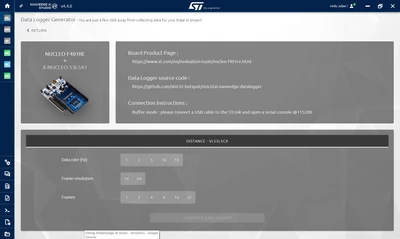
You can select parameters and generate a .bin file to flash directly on the board and then log outputted data through serial in NanoEdge or tools like putty, tera term etc...
The frames parameters are the number of consecutive matrixes that you want to use.
At the end of the month NanoEdge AI Studio will receive an update with a feature made to improve the way datasets are displayed when working with Time of Flight in the "signal" step of the studio.
Make sure to ask me if you have any other question during the process
Best Regards,
Julian
