VNava.1
Associate III
April 11, 2022
Solved

Is the VL53L5CX ToF a good choice, considering all the Time-of-Flight sensors family realized by ST for detecting obstacles below the floor level such as holes or stairs?

  • April 11, 2022
  • 3 replies
  • 2145 views

Hi community, 

I would like to understand if the VL53L5CX is a good choice to develop an application to detect holes and stairs. I decided to study them since I was impressed by these things:

  • The FoV of 45 ° horizontally or vertically;
  • The granularity of the zoning:
  1. 16 zones (in the case of 4x4 mapping)
  2. 64 zones (in the case of 8x8 mappatira);
  • The refresh rate is also interesting. Up to 15 Hz in the case of 64 zones and up to 60 Hz in the case of 16.

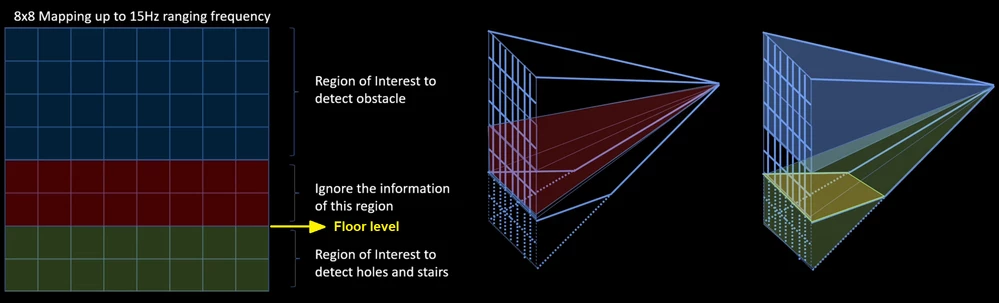
Among the other features that impressed me is the sharpner. Thanks to this feature I could sharpen the division of the zones. Having said that, my idea was to divide the matrix of interest into 2 zones:

- Region to detect holes or stairs below the floor level

- Region to detect other obstacles above the floor level

I had actually also thought of a third zone to be interposed between the two zones just mentioned

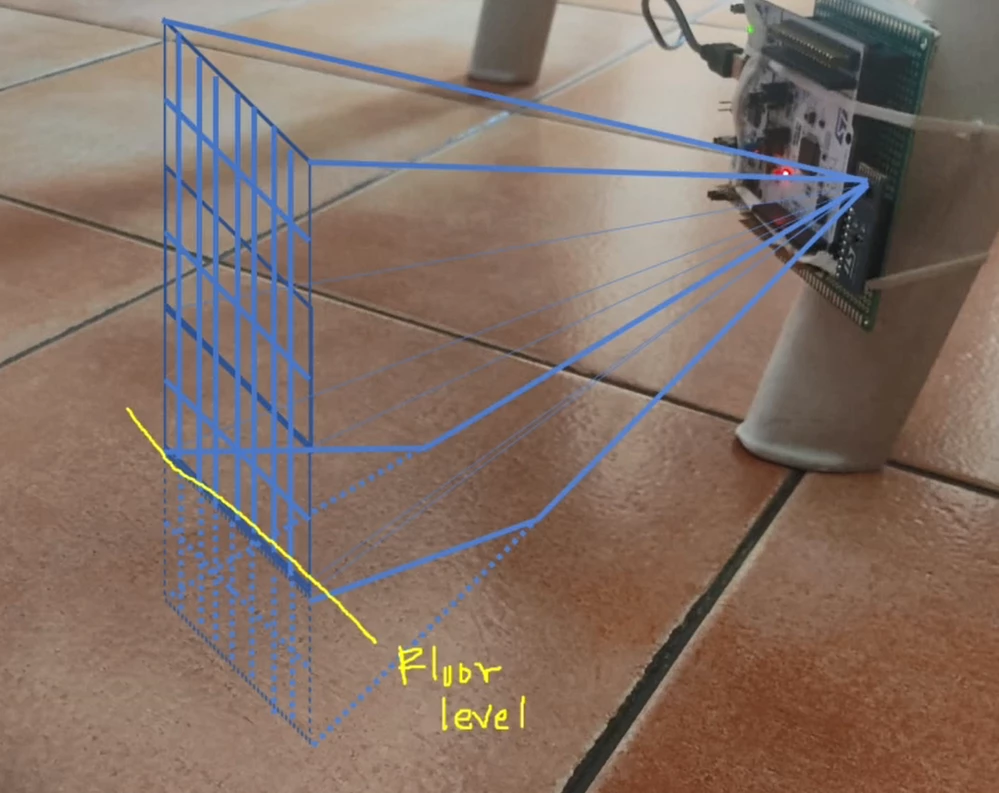
The scenario I had in mind was something like this:
0693W00000LxZHEQA3.png 

0693W00000LxZI7QAN.png 

Of course, to choose the sensor I must also understand the requirements to be assigned to my module, for example:

- How far must he be able to detect a hole or a downward flight of stairs?

- Are false negatives tolerated or must the reliability be maximum?

Let's say that with this question I would like to understand if:

- this sensor is suitable for the purpose of detecting holes or stairs

- it is suitable, your opinion would be useful in understanding whether the approach I have thought is useful or not

- there are other ToF sensors that can do the case presented above

Thank you in advance

This topic has been closed for replies.
Best answer by John E KVAM

The sensor would be fine, just as you described it. This is exactly how we suggest our customers use the device.

There is only one flaw that I can think of... If the floor is a mirror-like surface (specular) the photons might hit the floor and bounce away without ever returning. If the sensor does not see a return signal, it cannot get a range.

I'm going to guess there are not that many highly polished mirror-finish floors, but that is the only scenario where I see a flaw.

I tried a marble floor tile, and that has enough micro variations that you get a return signal, but that does not guarantee such a tile does not exist.

Good luck,

  • john

3 replies

John E KVAM
John E KVAMBest answer
ST Employee
April 11, 2022

The sensor would be fine, just as you described it. This is exactly how we suggest our customers use the device.

There is only one flaw that I can think of... If the floor is a mirror-like surface (specular) the photons might hit the floor and bounce away without ever returning. If the sensor does not see a return signal, it cannot get a range.

I'm going to guess there are not that many highly polished mirror-finish floors, but that is the only scenario where I see a flaw.

I tried a marble floor tile, and that has enough micro variations that you get a return signal, but that does not guarantee such a tile does not exist.

Good luck,

  • john
VNava.1
VNava.1Author
Associate III
April 12, 2022

Thank you, John!

You are always very helpful

Visitor II
December 11, 2023

Hi VNava.1,


I am interested in how you were able to accomplish the detecting object on the floor. Currently I am trying to do something like what you did but am looking at the bottom 3 rows. My target is small objects and potholes (like your stairs). I am wondering how you were able to accomplish this as it might help me with mine. 

Thank you in advance.

John E KVAM
ST Employee
December 11, 2023

It's math. If one knows you are at a particular angle to the floor at at a known height, you should be able to work out the distances one would expect assuming a flat floor. (or you can just run the sensor and see what you get.) Add a tollerance to those numbers and run your robot. 

If you get anyting unexpected, it's a object. Probably something to aviod. 

Keep in mind that the distance and the signal strength are both useful. An object will probably reflect a lot more photons than a floor at those angles. 

I'd get a good sample of floors and give it a try. Wood, tile and carpet are the most likely, but there are zillions of different floors. And unfortunately, that is the challange.

Visitor II
December 11, 2023

Thanks John 

I am still trying to figure out the maths for optimum distances. Which is not the problem, but the ground is going to be. My bot is looking to work on multiple different outdoor terrain, so figuring out the tolerance especially when I need to check for small to medium size objects as well is going to be trick I need to solve.

But thanks for your input. I forgot about the importance of signal strength. Currently I am using the pimoroni library (micropython) and so I was wondering if the reflectance shows the signal strength enough or do I still need to access the signal per SPAD? 

Thanks Again