

MFabb.1
Associate III
September 20, 2021
Solved

VL53L5CX with LPn pulled down during the power up sequence. What is the expected behavior?

  • September 20, 2021
  • 5 replies
  • 1448 views

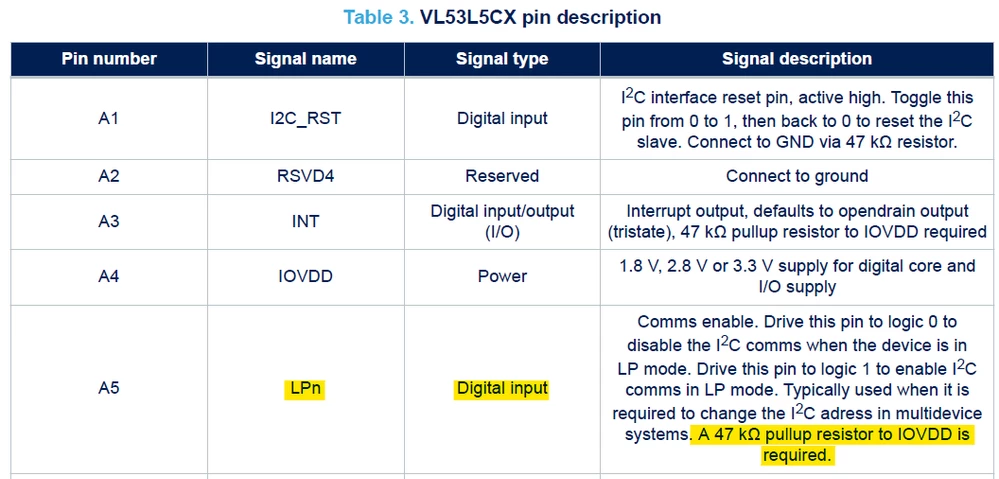
As reported in the datasheet, "a 47 KOhm pullup resistor is required" on the LPn signal.
0693W00000DniaDQAR.png 

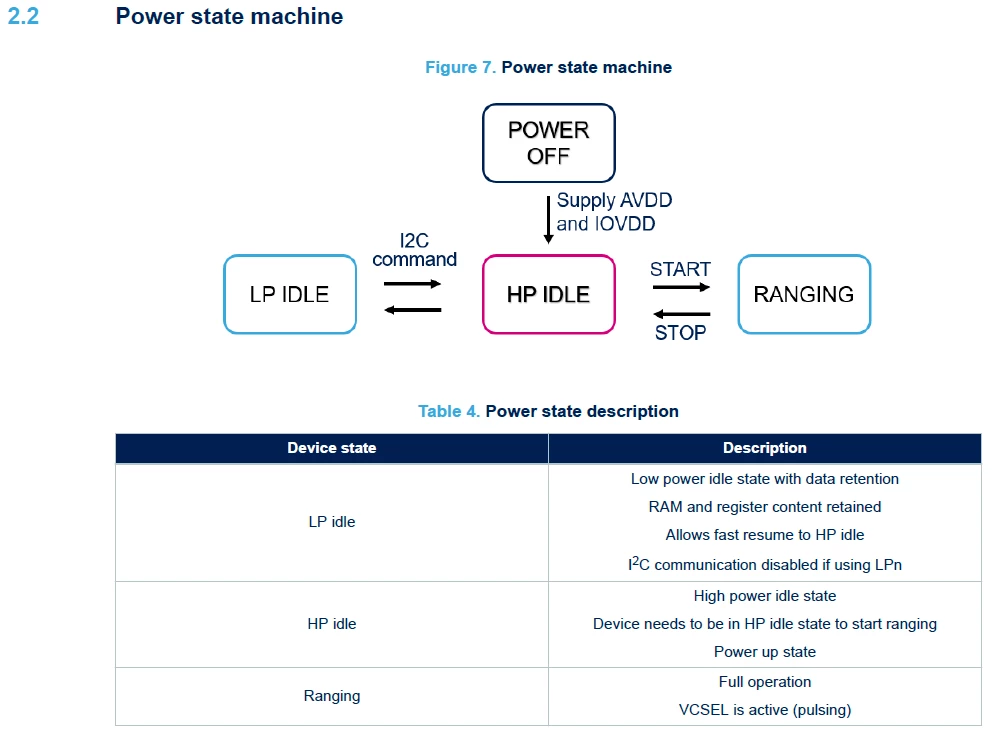
In that case the power state machine goes from POWER OFF to HP IDLE during the power up sequence.
0693W00000DniaXQAR.png 

What would the device state be if the LPn signal was low during the power up sequence?

Is it conceivable to assume that the subsequent device state would be the LP IDLE?

I am asking that because I would need to share a control signal that is normally pulled down at startup.

Thank you

BR

This topic has been closed for replies.
Best answer by John E KVAM

When the chip boots, it's only running a bootloader waiting for you to download the binary via the I2C.

If you leave the LPn low, it will simply sit there happily not doing anything.

So Yes, the sensor will be fine simply waiting on the LPn to come high and the I2C download to start.

5 replies

John E KVAM
ST Employee
October 11, 2021

The trick is the LPn has noting to to with low power. Perhaps that might have been the design idea when the pin was named, but it doesn't do that at all.

Functionally the LPn is the I2C alive pin. When low, the I2C will not respond.

This is used to allow for the changing of the I2C address on a different VL53 sensor. When low this sensor will not get the command.

So at boot, you are in LP Idle, until a I2C command is received. If the LPn line is low, the one thing you can be assured of is the VL53 will not be paying attention to any command on the I2C bus.

MFabb.1
MFabb.1Author
Associate III
October 18, 2021

Hence the Power State Machine block diagram (Figure 7) should be corrected as follow:

0693W00000FCp64QAD.png

Could you confirm that the device will start-up correctly if LPn line will be tied LOW during the power-up sequence?

Thank you

John E KVAM
ST Employee
October 18, 2021

Well, it might be better said that the LPn's main use is to disable the I2C. (Very handy when trying to change the I2C address and you have more than one sensor.)

To issue an I2C command the LPn must be high.

The LPn is the worst named pin in the world - it has nothing to do with low power. It's only I2C enable.

(One might suppose that it's original intent was power related, but when the chip was introduced that meaning had changed, but sadly no one went back and fixed the name.)

MFabb.1
MFabb.1Author
Associate III
October 19, 2021

I understood the function of the LPn signal: I2C alive/enable pin, nothing to do with the low power.

However, I would like to know if the device will be able to correctly initialize if the LPn pin will be tied to GND during the power-up sequence.

Could you confirm that?

Thank you

John E KVAM
John E KVAMBest answer
ST Employee
October 19, 2021

When the chip boots, it's only running a bootloader waiting for you to download the binary via the I2C.

If you leave the LPn low, it will simply sit there happily not doing anything.

So Yes, the sensor will be fine simply waiting on the LPn to come high and the I2C download to start.