Kurt-123
Associate II
July 31, 2023
Question

VL6180X -- Unexplained "Waves" in Time of Flight Data

  • July 31, 2023
  • 4 replies
  • 2875 views

Hi there, 

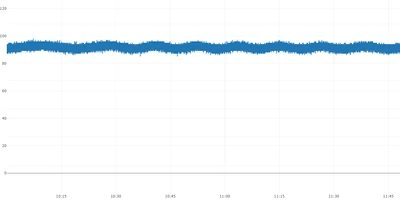
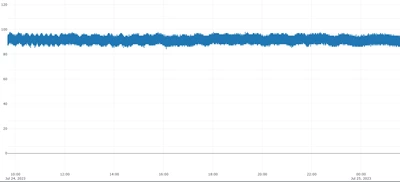
My team and I have noticed an irregularity in our VL6180X sensor data that we do not understand. Despite having a stationary target (~75mm away), the calculated range values from the VL6 appear to "wave" over time, and do not settle into a steady state (see screenshots). When running as expected, the sensor typically reads a consistent range value with a variance of +/-3.5mm between readings. Please note that we have eliminated all sources of cross talk as well and are conducting our experiments in a closed, dark tube that is not exposed to direct light. What could be the issue here? Is this normal behaviour for the sensor? 
Kurt123_0-1690835562838.png

Kurt123_1-1690835613360.png

Thank you in advance!

This topic has been closed for replies.

4 replies

RhSilicon
Lead
July 31, 2023

Have capacitors on AVDD and AVDD_VCSEL been placed? How is the PCB layout?

The datasheet recommends: "Capacitors on AVDD and AVDD_VCSEL should be placed as close as possible to the supply pads" which could be an indication that it doesn't have good noise immunity for the power supply.

vl6180x.png

Kurt-123
Kurt-123Author
Associate II
August 1, 2023

Hi RhSilicon, thank you for your reply!

Yes, we do have capacitors, but it looks like the Farad ratings are slightly lower than the recommended spec. Do you think that the difference is large enough to have an impact on noise stability? Our capacitors are less than 2mm away from the supply pads, too.

Kurt123_0-1690909410047.png

RhSilicon
Lead
August 1, 2023

In these cases it is recommended to use low ESR capacitors. How is the layout?

- (From the schematic it is possible to notice that the importance of the decoupling informed in the datasheet may not have been observed, the capacitors are close together and far from the pins)

And about the power supply circuit, are you using a switched or linear regulator?

About layout, here are some tips:

Low frequency noise decoupling generally requires electrolytic capacitors (typically 1 μF to 100 μF) that act as charge reservoirs to low frequency transient currents. High frequency power supply noise is best reduced with low inductance, surface-mount ceramic capacitors connected directly to the power supply pins of the IC (typically 0.01 μF to 0.1 μF). All decoupling capacitors must connect directly to a low impedance ground plane in order to be effective. Short traces or vias are required for this connection to minimize additional series inductance.

5104-fig3

See full text here: https://www.analog.com/en/analog-dialogue/studentzone/studentzone-april-2017.html

TDK
Super User
August 2, 2023

Is the X scale accurate? We're looking at an entire day's worth of samples in that first screenshot?

Really doesn't seem like a decoupling capacitor issue given the slow time scale.

My guess is the reading is affected by temperature swings and the HVAC cycling on/off causes the oscillations. Raise/lower the thermostat a few degrees and see if it has an effect.

"If you feel a post has answered your question, please click ""Accept as Solution""."
RhSilicon
Lead
August 2, 2023

Is the X scale accurate?

Good note about the timescale :magnifying_glass_tilted_right:

John E KVAM
ST Employee
September 6, 2023

Very interesting data. I don't think it's a layout issue. The sensor is not very sensitive to voltage changes. It's more digital than that.

If it were temp related, I would expect a slow ramp up as the device heated, then a sharp decline as the VHV Calibration adjusted. (It adjusts one 'count' every 2 degrees C.) So you would end up in more of a saw tooth. 

Could you add some details of the how much that wave is varying over time? It's kind of hard to tell from the plot. 

I'd like to send that to the chip designers and see if they had any thoughts.

- john