
Associate
May 29, 2025
Solved

STISO620 - pullup needed?

  • May 29, 2025
  • 1 reply
  • 374 views

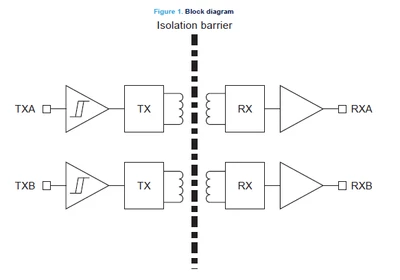
Hi to everybody and thank you in advance. I'm planning tu use the STISO620 as a function replacement for old-school optocouplers. STISO620 matches in every metric. My plan is use the part to interface an STM32 MCU.

My application will detect falling edge pulses by interrupt, so I need a pullup on the MCU side to hold the high level on RX of the STISO620 while there is no excitation on the TX side.
Tico_0-1748518314736.png

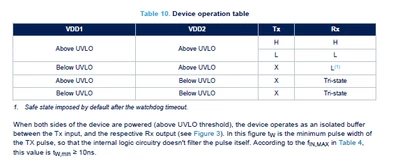
My question is: Will the adequate pullup hold the RX line high when TX states are X and power supplies well stablished?
Tico_1-1748518472569.png

Best wishes,


Best answer by Peter BENSCH

I'm not quite sure what your conditions are under which TX should not be stimulated?

It is important to know whether TX is floating or has a defined level. It is also important to know whether VDD1 and VDD2 have their setpoint, as table 10 of the data sheet also deals with the case of failed VDD1 and/or VDD2 in rows 2...4.

If you only want to consider the case of stable VDD1 and VDD2, it would probably be better to achieve a defined level on the TX instead of a pull-up on the RX, e.g. with a pull-up or pull-down. A pull-up is not very helpful because RX totem poles are outputs that a pull-up can only influence (at normal resistance values for the pull-up) if the respective RX is tri-state.

Regards
/Peter

1 reply

Peter BENSCH
Peter BENSCHBest answer
Technical Moderator
May 29, 2025

I'm not quite sure what your conditions are under which TX should not be stimulated?

It is important to know whether TX is floating or has a defined level. It is also important to know whether VDD1 and VDD2 have their setpoint, as table 10 of the data sheet also deals with the case of failed VDD1 and/or VDD2 in rows 2...4.

If you only want to consider the case of stable VDD1 and VDD2, it would probably be better to achieve a defined level on the TX instead of a pull-up on the RX, e.g. with a pull-up or pull-down. A pull-up is not very helpful because RX totem poles are outputs that a pull-up can only influence (at normal resistance values for the pull-up) if the respective RX is tri-state.

Regards
/Peter

TicoAuthor
Associate
May 30, 2025

Hi Peter, the application interfaces a normally open dry contact meteorological device, so by default that's a floating input, but your recommendation makes a LOT of sense. Pulling up at TX side clears any uncertainty and avoid any conflict with STISO602 output stage.

Great support!

Many thanks and have a nice weekend!