
Associate III
February 7, 2024
Solved

LIS2DH12 data rate

  • February 7, 2024
  • 4 replies
  • 2773 views

Hello,

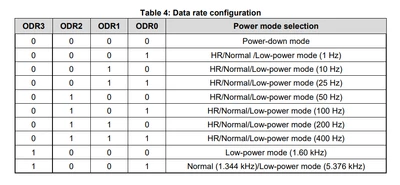
LIS2DH12 accelerometer. Datasheet AN5005 shows Table 4.
MykolaLevun_0-1707283363569.png

Is this the speed of data transfer via the SPI or I2C interface? Or the speed of converting data into accelerations and writing this accelerations to the OUTX_H and OUTX_L registers?

This topic has been closed for replies.
Best answer by Federica Bossi

Hi @MykolaLevun ,


It is the output data rate, the rate at which a sensor obtains new samples.

4 replies

Federica Bossi
Federica BossiBest answer
Technical Moderator
February 7, 2024

Hi @MykolaLevun ,


It is the output data rate, the rate at which a sensor obtains new samples.

In order to give better visibility on the answered topics, please click on 'Accept as Solution' on the reply which solved your issue or answered your question.
Andrew Neil
Super User
February 7, 2024

The Datasheet never once gives the meaning of the "ODR" abbreviation.

The Application Note uses it four times before finally mentioning the meaning on page 9 - and that's just in passing:

AndrewNeil_1-1707301203803.png

Even that's not very clear: it could be bits per second, bytes per second, etc, ...


A complex system that works is invariably found to have evolved from a simple system that worked.A complex system designed from scratch never works and cannot be patched up to make it work.
Andrew Neil
Super User
February 7, 2024

@MykolaLevun wrote:

Hello,

LIS2DH12 accelerometer. Datasheet AN5005 shows Table 4.


That's an Application Note - not the Datasheet.

The Datasheet is https://www.st.com/resource/en/datasheet/lis2dh12.pdf


A complex system that works is invariably found to have evolved from a simple system that worked.A complex system designed from scratch never works and cannot be patched up to make it work.
Federica Bossi
Technical Moderator
February 7, 2024

Hi @Andrew Neil ,


As in the screenshot posted by @MykolaLevun the unit of the ODR is Hz.

In order to give better visibility on the answered topics, please click on 'Accept as Solution' on the reply which solved your issue or answered your question.
Andrew Neil
Super User
February 7, 2024

But "Hz" really doesn't help - it could still mean bits per second, bytes per second, etc, ...

A complex system that works is invariably found to have evolved from a simple system that worked.A complex system designed from scratch never works and cannot be patched up to make it work.
Federica Bossi
Technical Moderator
February 7, 2024

Hi @Andrew Neil ,

As written before, ODR is output data rate and thus the unit is samples/s where samples means the output value of the sensor stored in the output register.

In order to give better visibility on the answered topics, please click on 'Accept as Solution' on the reply which solved your issue or answered your question.
Andrew Neil
Super User
February 7, 2024

Yes, you know that and I know that - but the documentation does not make that clear at all.

And that's why @MykolaLevun is here asking the question.

When I first started with this kind of thing, I remember being uncertain whether it was the rate of (x,y,z) triplets, or just the total rate of data (bytes/s).


Addendum

There's also Application Note AN4508, "Parameters and calibration of a low-g 3-axis accelerometer"

It has a 'Terminology' section, but still doesn't make it clear:

AndrewNeil_0-1707308922582.png


A complex system that works is invariably found to have evolved from a simple system that worked.A complex system designed from scratch never works and cannot be patched up to make it work.
Federica Bossi
Technical Moderator
February 7, 2024

Hi @Andrew Neil ,

Thank you for the suggestion, I will pass it on to the team for improvement in the future. In the meantime, I hope I have answered @MykolaLevun 's question.

In order to give better visibility on the answered topics, please click on 'Accept as Solution' on the reply which solved your issue or answered your question.