
Associate II
November 5, 2025
Question

More information about ASM330LHH embedded compensation of temperature

  • November 5, 2025
  • 1 reply
  • 154 views

Hi,

ASM330LHH datasheet states that "compensation for high stability over temperature" are embedded in the device. Could you provide more information about the correction algorithms applied ?

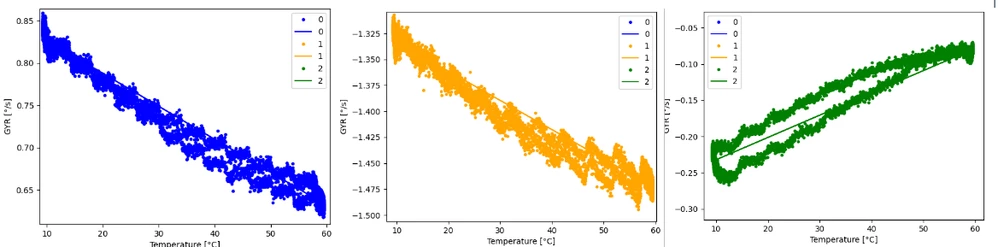
In particular, when we measure the bias at 0°/s of the ASM330LHH in a temperature chamber, we get strange non-linear behaviors that we suppose to be a consequence of these algorithms. For instance, in the following figure (filtered bias at 0°/s depending on temperature) some "steps" can be observed. Could you provide a description of the corrections applied / the reason of this behavior ? It would make the device more predictable for us.

Furthermore, is there a way to disable these corrections ?

Thank you a in advance.
 

fgs_0-1762377512878.png


1 reply

Federica Bossi
Technical Moderator
November 6, 2025

Hi @fgs ,

The internal compensation vs. T within the device is designed to compensate for the linear behavior of the curves. The zero rate level is expected to be not perfectly linear and thus some non linear residuals are still present. You can compensate measuring each piece.

In order to give better visibility on the answered topics, please click on 'Accept as Solution' on the reply which solved your issue or answered your question.
fgsAuthor
Associate II
November 7, 2025

Hi,

thank you for your answer.

> designed to compensate for the linear behavior of the curves

Do you mean that the implemented correction is kind of :

correction =  a.T + b

where a and b are two pre-calibrated constants ?

Given the above curves (the steps) I suspected corrections like :

correction =  a[T].T + b[T]

where a and b are tables, in which correction parameters are chosen depending on the temperature (one pair of parameter for each interval of 4°C typically...).