Solved
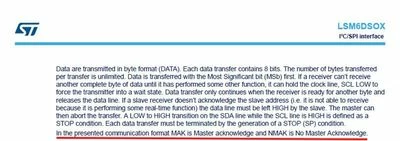
Receiving a NMAK when reading out WhoAmI register - lsm6dsox
Hi everyone,
I am currently trying to get a lsm6dsox to interface with a Nordic nRF52833 board using i2c communication. I am looking to read accelerometer/gyro values.
I am able to write to the sensor but I am unable to read from the sensor without receiving a NMAK.
I am using the STEVAL-MKI217V1 adapter board to connect to my nRF52833.
I have connected the VDD/VDDIO pins to VCC, my SCL/SDA pins to the pins I configured for i2c communication, I have connected CS to VDD, GND pins to GND, and SDO to ground.
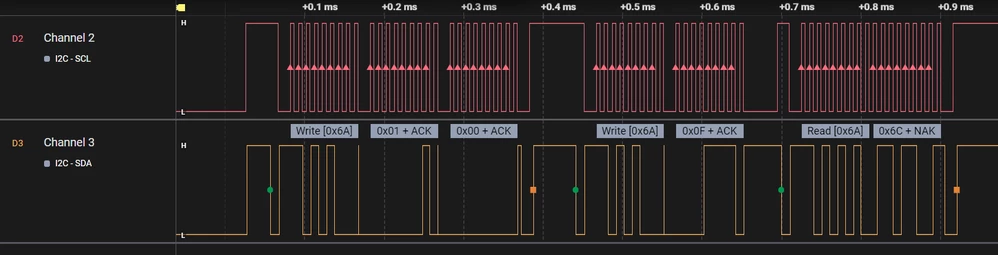
This is my result from the Logic analyzer
This is my source code:
Main.c:
/*
* Copyright (c) 2020 Yestin Sun
*
* SPDX-License-Identifier: Apache-2.0
*/
#include <stdio.h>
#include <zephyr/kernel.h>
#include <zephyr/device.h>
#include <zephyr/drivers/sensor.h>
static inline float out_ev(struct sensor_value *val)
{
return (val->val1 + (float)val->val2 / 1000000);
}
static void fetch_and_display(const struct device *dev)
{
struct sensor_value x, y, z;
static int trig_cnt;
trig_cnt++;
/* lsm6dso accel */
sensor_sample_fetch_chan(dev, SENSOR_CHAN_ACCEL_XYZ);
sensor_channel_get(dev, SENSOR_CHAN_ACCEL_X, &x);
sensor_channel_get(dev, SENSOR_CHAN_ACCEL_Y, &y);
sensor_channel_get(dev, SENSOR_CHAN_ACCEL_Z, &z);
printf("accel x:%f ms/2 y:%f ms/2 z:%f ms/2\n",
(double)out_ev(&x), (double)out_ev(&y), (double)out_ev(&z));
/* lsm6dso gyro */
sensor_sample_fetch_chan(dev, SENSOR_CHAN_GYRO_XYZ);
sensor_channel_get(dev, SENSOR_CHAN_GYRO_X, &x);
sensor_channel_get(dev, SENSOR_CHAN_GYRO_Y, &y);
sensor_channel_get(dev, SENSOR_CHAN_GYRO_Z, &z);
printf("gyro x:%f rad/s y:%f rad/s z:%f rad/s\n",
(double)out_ev(&x), (double)out_ev(&y), (double)out_ev(&z));
printf("trig_cnt:%d\n\n", trig_cnt);
}
static int set_sampling_freq(const struct device *dev)
{
int ret = 0;
struct sensor_value odr_attr;
/* set accel/gyro sampling frequency to 12.5 Hz */
odr_attr.val1 = 12.5;
odr_attr.val2 = 0;
ret = sensor_attr_set(dev, SENSOR_CHAN_ACCEL_XYZ,
SENSOR_ATTR_SAMPLING_FREQUENCY, &odr_attr);
if (ret != 0) {
printf("Cannot set sampling frequency for accelerometer.\n");
return ret;
}
ret = sensor_attr_set(dev, SENSOR_CHAN_GYRO_XYZ,
SENSOR_ATTR_SAMPLING_FREQUENCY, &odr_attr);
if (ret != 0) {
printf("Cannot set sampling frequency for gyro.\n");
return ret;
}
return 0;
}
#ifdef CONFIG_LSM6DSO_TRIGGER
static void trigger_handler(const struct device *dev,
const struct sensor_trigger *trig)
{
fetch_and_display(dev);
}
static void test_trigger_mode(const struct device *dev)
{
struct sensor_trigger trig;
if (set_sampling_freq(dev) != 0)
return;
trig.type = SENSOR_TRIG_DATA_READY;
trig.chan = SENSOR_CHAN_ACCEL_XYZ;
if (sensor_trigger_set(dev, &trig, trigger_handler) != 0) {
printf("Could not set sensor type and channel\n");
return;
}
}
#else
static void test_polling_mode(const struct device *dev)
{
if (set_sampling_freq(dev) != 0) {
return;
}
while (1) {
fetch_and_display(dev);
k_sleep(K_MSEC(1000));
}
}
#endif
int main(void)
{
const struct device *const dev = DEVICE_DT_GET_ONE(st_lsm6dso);
if (!device_is_ready(dev)) {
printk("%s: device not ready.\n", dev->name);
return 0;
}
#ifdef CONFIG_LSM6DSO_TRIGGER
printf("Testing LSM6DSO sensor in trigger mode.\n\n");
test_trigger_mode(dev);
#else
printf("Testing LSM6DSO sensor in polling mode.\n\n");
test_polling_mode(dev);
#endif
return 0;
}
Overlay file:
#include <zephyr/dt-bindings/sensor/lsm6dso.h>
&i2c0 {
status = "okay";
compatible = "nordic,nrf-twim";
pinctrl-0 = <&i2c0_default>;
pinctrl-1 = <&i2c0_sleep>;
pinctrl-names = "default", "sleep";
lsm6dsox:lsm6dsox@6A {
compatible = "st,lsm6dso";
status = "ok";
label = "LSM6DSO";
reg = <0x6A>;
accel-odr = <LSM6DSO_DT_ODR_1Hz6>;
};
};
&pinctrl {
i2c0_default: i2c0_default {
group1 {
psels = <NRF_PSEL(TWIM_SCL, 0, 27)>, <NRF_PSEL(TWIM_SDA, 0, 26)>;
bias-pull-up;
};
};
i2c0_sleep: i2c0_sleep {
group1 {
psels = <NRF_PSEL(TWIM_SCL, 0, 27)>,
<NRF_PSEL(TWIM_SDA, 0, 26)>;
low-power-enable;
};
};
};
Is there something I am missing to ensure that I can read via i2c?
I appreciate anyone's help as I am very stuck on this.
Thanks,
Regina