
Associate II
November 10, 2023
Solved

Reverse engineering an membrane keypad

  • November 10, 2023
  • 3 replies
  • 2648 views

I have a machine which have 2 BLDC motors and I need to control it. I'm planning to control the motors by tapping the membrane keypad which already exists in the machine using microcontroller signal. I found the 2 pins that connected to certain button and when I keep pressing the button and checking the continuity, multimeter didn't give a beep sound. When I checked the voltage difference in each pin when I pressed the membrane button one was giving 14V while other pin having 4V. But these voltages didn't fluctuate when I pressed the button, but the button function keeps working which means the button membrane should be working fine. Is there a way to mimic the button press using a microcontroller or I need to know an alternative way to control 2 BLDC motors which are 12V and 15A rated current.
This topic has been closed for replies.
Best answer by Karl Yamashita

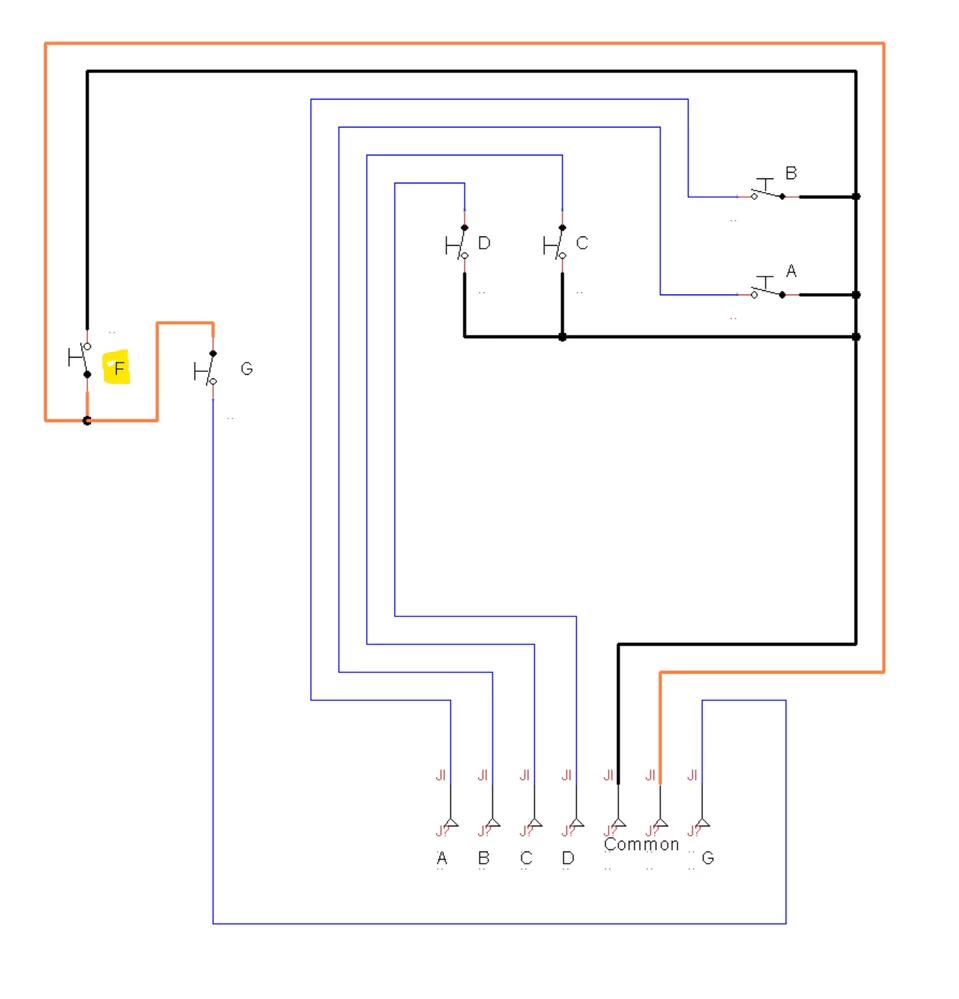
It looks like 2 traces are common. I'm not 100% sure, but it looks like button F doesn't do anything as both sides of the switch go to the common wires. Your fingers are covering part of the traces and it's slightly blurry by those buttons, so maybe i interpreted it wrong?

You'll have to determine if the common wires are going to either ground or Vcc, and the button traces are either pulled up or pulled down. Then you can use some appropriated circuitry if needed, to monitor buttons A-D and G, without causing an issue for the other microcontroller.


buttonMembrane.png

3 replies

Karl Yamashita
Principal
November 10, 2023

@jsw2000 wrote:

I'm planning to control the motors by tapping the membrane keypad which already exists in the machine using microcontroller signal.


It's not clear when you say tapping? Are you trying to tap into the signals in between the membrane that has an existing microcontroller? And you're trying to add another microcontroller to control the motors by using the signals from the membrane?

If a reply has proven helpful, click on Accept as Solution so that it'll show at top of the post.CAN Jammer an open source CAN bus hacking toolCANableV3 Open Source
jsw2000Author
Associate II
November 11, 2023

Yes, I'm trying to tap into the signals in between the membrane that has an existing microcontroller.

Karl Yamashita
Principal
November 11, 2023

Having a little more information on the membrane would help. Is it a custom one or is it like standard number keypad? How many conductors does it have? Picture and/or part number of membrane?

If a reply has proven helpful, click on Accept as Solution so that it'll show at top of the post.CAN Jammer an open source CAN bus hacking toolCANableV3 Open Source
jsw2000Author
Associate II
November 11, 2023

I tried short-circuiting the pins and found a way to mimic the button press. Thank you all for your help. It means a lot! 

Karl Yamashita
Karl YamashitaBest answer
Principal
November 11, 2023

It looks like 2 traces are common. I'm not 100% sure, but it looks like button F doesn't do anything as both sides of the switch go to the common wires. Your fingers are covering part of the traces and it's slightly blurry by those buttons, so maybe i interpreted it wrong?

You'll have to determine if the common wires are going to either ground or Vcc, and the button traces are either pulled up or pulled down. Then you can use some appropriated circuitry if needed, to monitor buttons A-D and G, without causing an issue for the other microcontroller.


buttonMembrane.png

If a reply has proven helpful, click on Accept as Solution so that it'll show at top of the post.CAN Jammer an open source CAN bus hacking toolCANableV3 Open Source
jsw2000Author
Associate II
November 11, 2023

You have drawn the correct schematic,  if I need to mimic the button press on B could I use a transistor between common and B wire and give a signal to short circuit the circuit. If not what are the other options, if yes, is there any recommendations in transistors? 

Visitor II
November 12, 2023

Instaed of Transistor, you can optocoupler or relay, try to isolate the MCU GND and Membrain Key GND / Common,

you can use PC817 opto for testing or SPDT / SPST relay.