naftilos76
Associate II
May 18, 2025
Solved

TSZ121 as a differential inpup stage

  • May 18, 2025
  • 2 replies
  • 566 views

Hi everyone, i am using the TSZ121 as a high to low impedance match stage in order to drive a differential MCU (MSP430i20x). The input stage seen below comprises several mosfet optocouplers (see C1-C5) that shape the input attenuation. C1-C5 is simply their cut-off state inherent capacitance. R6 is also the output of a mosfet optocoupler acting as shorted/non-shorted input for ADC offset calibration.

The image seen below depicts DC simulation and everything seems as expected.

However, on my pcb, i am measuring around 20mV between OUTB & GND and 70mV between OUTA & GND, provided that P1 trimmer is almost exactly centered (adjusted so that center tap is in the middle of adjustment range).

The PCB was re-flowed very carefully with a stencil and everything seems near-perfect.

R5 & R7 are 0Ω.

The pcb was cleaned with an ultrasonic cleaner which as proven after quite a few iterations at work is a very good solution for wiping out leakage between high impedance nodes. Looking at the PCB with a 100 euro Aliexpress microscope does not reveal any residue at all.

I have struggled with this issue for a few days but could not find the culprit.

I have measured between either INA/INB and GND and the resistance is nearly 12.5MΩ as expected. This proves that there is no leakage between either the TSZ121 non-inverting inputs and GND and that the potentiometer P1 is almost perfectly centered.

R1 and R2 either consist of 5x2MΩ 0.1% thin film resistors.

Can anyone guess what i am missing here?
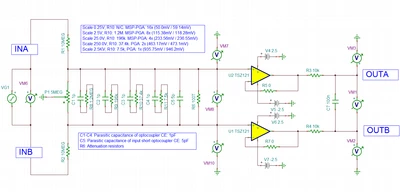
tsz121 input stages.png

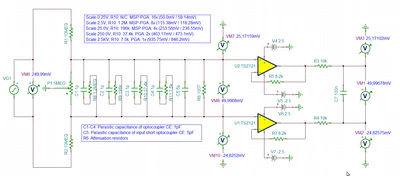
tsz121 input stages - Tina.png

DC simulation in Tina

Thanks for your time.

Manos

Best answer by naftilos76

Hi,

I am dumping the TSZ121 and driving the MSP430i2xxx input directly.

The only compromise here is lower input impedance for certain conditions.

Regards

Manos

2 replies

Peter BENSCH
Technical Moderator
May 21, 2025

Thoughts on your schematics:

  • where are the required capacitors across VCC+ and VCC- of each opamp?
  • the TSZ121 is a chopper opamp whose chopper spikes at the inputs have a massive influence on the offset with such a high-impedance input circuit, which in your case could be improved by a capacitor between each positive input and GND (for calculation instructions, see AN4587, section 2)

Regards
/Peter

naftilos76
Associate II
May 22, 2025

Dear Peter,

Thank you very much for your comments.

After having a look at the app. note it was obvious that i did not know that there are spikes at the inputs although i did know very well that this opamp was a chopper amplifier.

However i do not see how this is related to the issue i am facing.

The difference i am measuring between the two stages' outputs is precisely what i would expect which is exactly 50mV with a 250mV input.

What i find extremely weird is that both inputs are offset by a positive value of 45mV.

If i subtract 45mV from the 70mV i get 25mV which should be the case at the output of U2.

If i subtract 45mV from the 20mV i get -25mV which should be the case at the output of U1.

I heard you talking about offset and i am wondering if this offset is related to the fact that i do not have any caps between the non-inverting inputs and GND.

*There are decoupling caps between both pos. & neg. rails and GND. I just did not use them in the simulation.

I will keep digging.

Thank you so much for your time.

Regards

Manos

naftilos76
naftilos76AuthorBest answer
Associate II
June 8, 2025

Hi,

I am dumping the TSZ121 and driving the MSP430i2xxx input directly.

The only compromise here is lower input impedance for certain conditions.

Regards

Manos