
Associate II
January 30, 2025
Question

BTA26-80BWRG

  • January 30, 2025
  • 8 replies
  • 1743 views

Hello,

I have questions about a project we developed a long time ago. I will put the schematic below. We are using the BTA26-800BWRG (U8 and U9) in the schematic to parallel two inductors. The voltage applied to these two inductors is an ultrasonic signal of 600V at a frequency of 20-120 kHz. However, I don't fully understand how the TRIACs can switch, given that there is no voltage source in the loop between the two gates. Yet, the project works almost perfectly, except that sometimes, when the generator is off and the attempt is made to turn off the TRIACs, they remain switched on.
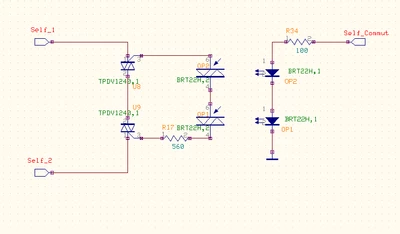
Joe26_0-1738256270041.png

U8 & U9 (BTA26-800BWRG) & OP1 & OP2 (IL410)


Thank's in advance for your help.

Best regards,

Joe

8 replies

Peter BENSCH
Technical Moderator
January 31, 2025

Welcome @Joe26, to the community!

Your circuit is a special application of triacs and only works because the triacs are connected antiserially (MT2 to MT2).

To understand how it works in more detail, you should take another look at the internal layer structure of triacs, e.g. in the Wikipedia article.

Put simply, when the potential at your net Self_1 is positive, you control the pn junction between MT1 and the gate of your U8, which switches it on (quadrant 3). The current via MT1, G of U8 will then take the path via gate and MT1 of your U9, which also switches it on (quadrant 1). Due to the symmetrical structure of the antiserially connected Triacs, everything is simply reversed when the polarity at Self_1 is reversed.

Does that answer your question?

Regards
/Peter

Joe26Author
Associate II
January 31, 2025

Thanks for your help!

Now it's more clear about the functionality!

I just have no idea how to correct the little bug with the switch off.

Joe26_0-1738316078845.png

Here is the schema with inductor. J200/201 is the connector for the ultrasonic transducers, which can be assimilated to capacitance.

I surch to make turn off more reliable.


Best regards,

Peter BENSCH
Technical Moderator
January 31, 2025
  • What else is connected to US+ and US-?
  • How (what) do you switch off?
  • What signal is coming from L200 and L201 when switched off?


Joe26Author
Associate II
January 31, 2025

We have to parallel or not the two inductance. Depend on the frequency of the US genrator.

We use the principle of resonance, it's the reason why we use variable inductances. And the voltage can rise up to 800VAC 20-120kHz.

And sometimes we can't change 1 or 2 paralelle inductances. The Triacs still passing even if the self_commut signal is at 0. Most of case when we turn off the generator, try to switch off the TRIAC, and then turn back on.

Peter BENSCH
Technical Moderator
January 31, 2025

I would be interested to know what precise value the voltage reaches: by 800VAC do you mean the RMS or peak value?

Joe26Author
Associate II
January 31, 2025

800 VAC should be the peak value, but it's really complicated to determinate because voltage is always changing due to inconstant frequency (specificity with ultrasonics transducer). I measured with oscilloscope and save the peak.

Peter BENSCH
Technical Moderator
January 31, 2025

Well, I asked because I'm afraid that the triacs will be triggered by overvoltage or capacitive effects. You must not forget that triacs are actually intended for mains voltage applications, i.e. 50/60Hz, but you feed them with 20...120kHz, which leads to very high dV/dt.

Joe26Author
Associate II
February 3, 2025
 

But what's strange is that the commutation works perfectly when the generator is turned on. The problem occurs only when the generator is turned off... I wonder if the inductance does not add a DC voltage to the system at the moment the generator is turned off.

Peter BENSCH
Technical Moderator
February 3, 2025

You should not assume knowledge of your ultrasound system. I have not yet fully understood how your system is constructed either:

  • what do you mean by generator and how does it work in relation to the triacs
  • what exactly is connected to 200 and 201
Joe26Author
Associate II
February 3, 2025

An ultrasonic generator is connected to the J200 & J201. The triacs are there just for changing the value of the inductance (in parallel). In fact we generate a square wave from 400VDC. Then we use the principe of resonance with Inductance / Ultrasonic transducer (Which is electrically like a capacitor). The square wave as a frequency between 20-120 kHz wich depend of the transducer mounted. The triacs is used when we have bifrequency transducer to permute. We change the frequency and we have also to change the value of the inductance to have a resonant system... Hope it's now more clear

Peter BENSCH
Technical Moderator
February 3, 2025

The community is a worldwide forum for mutual help between users of devices from STMicroelectronics. As I have already mentioned, you cannot assume that all users are familiar with the basic functioning of your system. I also see an ultrasonic generator as a device to which a transducer will be connected. However, if your system already has a transducer, you should explain where exactly your two points J200 and J201 are connected: parallel to the transducer?

In addition, I still don't understand what the problem is when the generator is switched off. When it is switched off, there should be no voltage at the terminals?

Joe26Author
Associate II
February 3, 2025

Yes the transducer is connected parallel with the inductance. An ultrasonic generator is just an electrical generator. 
As I have mention the generator provide a square wave from 400VDC and the frequency is between 20 and 120 kHZ.

When the generator is switched off there is no more power applied on the J200/J201.

I'm really sorry if my explanation aren't enough clear...

Peter BENSCH
Technical Moderator
February 3, 2025

Your explanations still don't give a clear picture. Such ping-pong questions to finally understand what the problem actually is will not help you or future readers of this forum. You have mentioned several times that the triacs are not switched off:

Post 1: "sometimes, when the generator is off and the attempt is made to turn off the TRIACs, they remain switched on."

Post 2: "I just have no idea how to correct the little bug with the switch off."

Post 3: The Triacs still passing even if the self_commut signal is at 0. Most of case when we turn off the generator, try to switch off the TRIAC, and then turn back on.

Post 4: The problem occurs only when the generator is turned off... I wonder if the inductance does not add a DC voltage to the system at the moment the generator is turned off.

Post 6: When the generator is switched off there is no more power applied on the J200/J201.

If a generator is switched off, it supplies no longer energy to its terminals. How do you know that the triacs are still switched on when there is no longer any voltage across their terminals and therefore no current anymore?


Joe26Author
Associate II
February 3, 2025

Don't know what is still not clear for you...?

Generator (Square wave 400V --> 20-120 kHz) connected to:

1. Inductance 1

2. Inductance 2

3. Ultrasonic transducer


Triacs are used to connect or not the inductance 2 (to the generator)

Then I try to switch off the triacs, turn back on the generator, then I see that the triacs are still switched... (Inductrance In parallel --> I have the good inductance --> the resonance is good --> more power consumed)

When I do same operation with generator turned on I have no problem. 

Peter BENSCH
Technical Moderator
February 3, 2025

However, excited resonant circuits usually have a very high voltage due to the resonance, so that triacs can be triggered even without external control via their gates. This is probably why you can separate your coils more cleanly with a suitable relay than with antiserial triacs.

Good luck!
/Peter