

Lack of documentation and inconsistency in STUSB4500Q code example
Hello,
I'm implementing the sink side of a usb-c PD system based on STUSB4500Q.
I had a look to documentation and to the example code.
It looks that the code was written by a first year intern. The ~25 global variables,
inconsistency in variable / constants casing, globals that are in fact locals, static locals that are in fact locals and an odd general architecture make It not very easy to understand.
As an example, I can read this:
if (Alert_Status.b.CC_DETECTION_STATUS_AL != 0) {
 connection_flag[Usb_Port] = 1;
 Status = I2C_Read_USB_PD(STUSB45DeviceConf[Usb_Port].I2cBus, STUSB45DeviceConf[Usb_Port].I2cDeviceID_7bit, PORT_STATUS_TRANS, &DataRW[0], 2);
 PD_status[Usb_Port].Port_Status.d8 = DataRW[1];
 if (PD_status[Usb_Port].Port_Status.b.CC_ATTACH_STATE != 0) {
 Status = I2C_Read_USB_PD(STUSB45DeviceConf[Usb_Port].I2cBus, STUSB45DeviceConf[Usb_Port].I2cDeviceID_7bit, CC_STATUS, &PD_status[Usb_Port].CC_status.d8, 1);
 } else /* Detached detected */
 {
 connection_flag[Usb_Port] = 1;
 PDO_FROM_SRC_Valid[Usb_Port] = 0;
 }
 }
Line 2 and 9 set the same variable to the same value. What should I understand? Best case: line 9 is useless, worse case: line 2 is a bug.
Line 3 reads 2 bytes but the first one DataRW[0] is never used. Should it be used somehow or should only the second byte be read?
In order to understand, I read the software programming manual but it is not more verbose and generally states "for further details see function xxxx in code".
If I have a look to chapter 3.6:
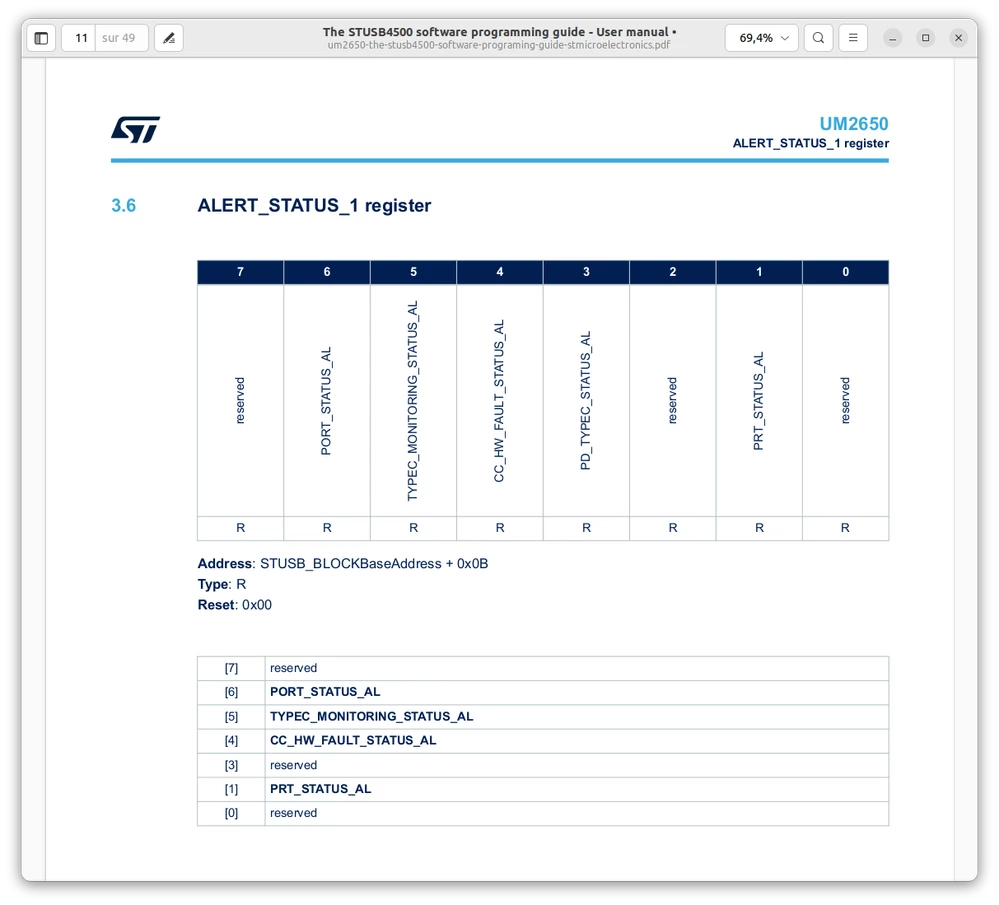 The fields are not documented. For example what are PORT_STATUS_AL and PRT_STATUS_AL?
You can also see that bit 2 is missing in the array and bit 3 is not consistent with the register drawing.
If I have a look to the code the corresponding structure is defined like this:
#define ALERT_STATUS_1 0x0B // Interrupt register
/*************************************************************************************************************
 * @brief 	STUSB_GEN1S ALERT_STATUS register Structure definition
 * @Address: 	0Bh
 * @Access: 	RC
 * @Note: 	This register indicates an Alert has occurred.
 * (When a bit value change occurs on one of the mentioned transition register, it automatically
 * sets the corresponding alert bit in ALERT_STATUS register. )
 ************************************************************************************************************/
typedef union
{
 uint8_t d8;
 struct
 {
 uint8_t PHY_STATUS_AL 		: 1;
 uint8_t PRT_STATUS_AL 		: 1;
 uint8_t _Reserved_2 		: 1;
 uint8_t PD_TYPEC_STATUS_AL 		: 1;
 uint8_t HW_FAULT_STATUS_AL 		: 1;
 uint8_t MONITORING_STATUS_AL 	: 1;
 uint8_t CC_DETECTION_STATUS_AL 	: 1;
 uint8_t HARD_RESET_AL 		: 1;
 } b;
} STUSB_GEN1S_ALERT_STATUS_RegTypeDef;
To summarize both (I assumed that the bits description is wrong and used the register drawing):
- bit 0: reserved vs PHY_STATUS_AL
- bit 1: PRT_STATUS_AL vs PRT_STATUS_AL
- bit 2: Reserved vs Reserved
- bit 3: PD_TYPEC_STATUS_AL vs PD_TYPEC_STATUS_AL
- bit 4: CC_HW_FAULT_STATUS_AL vs HW_FAULT_STATUS_AL
- bit 5: TYPEC_MONITORING_STATUS_AL vs MONITORING_STATUS_AL
- bit 6 : PORT_STATUS_AL vs CC_DETECTION_STATUS_AL
- bit 7: Reserved vs HARD_RESET_AL
In bold are "understandable" differences, in bold italic are inconsistancies....
At least CC_HW_FAULT_STATUS_1 and CC_HW_FAULT_STATUS_0 share the same kind of issue.
So for now, my question is simple: Is there a real reference guide like we can have for a microcontroler for example?
Thanks
Julien