

CBeif.1
Associate II
May 29, 2020
Question

What is max speed of POWERSTEP01 in steps/sec?

  • May 29, 2020
  • 3 replies
  • 1542 views

In the STPSIN software, it seems that I am limited to 15609.741 Steps / sec?

(See picture below)

With a 0.9 degree motor (400 steps / revolution)

this limits me to

15609 steps/sec * 1 rev/400 steps * 60 sec/1 minute = 2341 RPM

Is this the maximum speed of the device, because I need to move at 3000 RPM?

Is this for trajectory mode only? Can I move faster if I provide the external step pin?

Is there a fundamental speed limit for step mode?
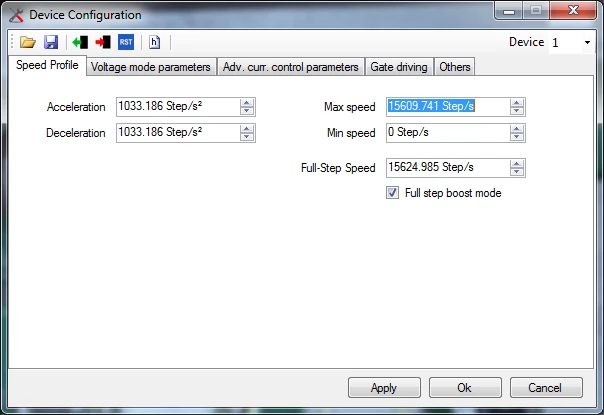
0693W000001pkQVQAY.png

This topic has been closed for replies.

3 replies

Enrico Poli
ST Employee
June 6, 2020

That is the maximum speed allowed by the integrated motion engine, i.e. the logic processing the SPI commands like GoTo, Move, ...

Using the StepClock mode (see stepclock command in the datasheet) you can overcome this limit.

Maximum step-clock frequency is about 1.5 MHz.

CBeif.1
CBeif.1Author
Associate II
June 8, 2020

Thank Enrico,

I gave up on Voltage mode with external stepping, since the chip will not do BEMF compensation in this mode.

But, in Current Mode, I can reach a speed of about 2190 RPM,

Are there any settings (Gate Driving, or Advanced Current mode settings) that would allow the top speed to increase?

I can't find a document that tells me how I should configure these registers for maximum performance.

Also do you have any suggestions on how to reduce resonance at slow speeds?

Enrico Poli
ST Employee
June 11, 2020

The maximum speed of the motor is also limited by the supply voltage (Back EMF effect). So them first suggestion is: if you can, increase the supply.

Please consider that its not true that a "12V" motor cannot be driven at higher voltages. The actual limit is the phase current rating and this limit is not a problem with modern ICs embedding current control circuitry and overcurrent protections.

The best solution to increase the maximum speed of the stepper is using the full-step driving. Unfortunately this conflicts with the second objective: reducing resonances at low speed. In fact the best way to reduce resonances is the microstepping mode.

Using the embedded motion engine you can take advantage of the automatic full-step mode, but in step clock mode this feature is not available.

Please, try the following configuration for the current control algorithm:

TON_MIN = 2.5 us (you must set the gate driving for the fastest possible commutation speed as in Table 11 of the DS)

TOFF_MIN = 20 us

TOFF_FAST = 14 us

TFAST_STEP = 4 us

Over a certain speed, when the motor current starts to be limited by the speed, you can also set the target current (TVAL_HOLD) at maximum.

This way at the high speeds the algorithm will pump as much as current as possible.

Associate
May 3, 2024

Hello,

I have a similar problem. The motor current drops at higher speeds.

  • Current mode
  • step clock mode
  • 1/16 microstep
  • 48 Volt

I have set a low acceleration for testing. Everything is fine up to approx. 16 kHz (microstep). Then the current drops further and further. The maximum speed (in the center of the diagram) is approx. 44.8 kHz. That's only 840 rpm.

1,8 [°/step] / 16 [microstep] = 0,1125 [°/microstep]
0,1125 [°/microstep] * 44800 [microsteps/s] = 5040 [°/s]
5040 [°/s] / 360 [°] = 14 [1/s]
14 [1/s] * 60 [s/min] = 840 [rpm]

Barley_0-1714722899935.png

This is the current configuration:

OCD_TH = 31
FS_SPD = 100
STEP_MODE = 12
GATECFG1 = 226
GATECFG2 = 96
CONFIG = 45952
TVAL_HOLD = 55
T_FAST = 17
TON_MIN = 4
TOFF_MIN = 4

What do I have to set so that the current always remains the same and does not drop?

Many thanks in advance!