
TouchGFX Performance Issues with Nested Containers and Graphs
I'm developing a UI on STM32H750 using TouchGFX with a 1024x768 display. I'm experiencing significant performance issues with touch responsiveness when displaying graphs.
My UI Structure:
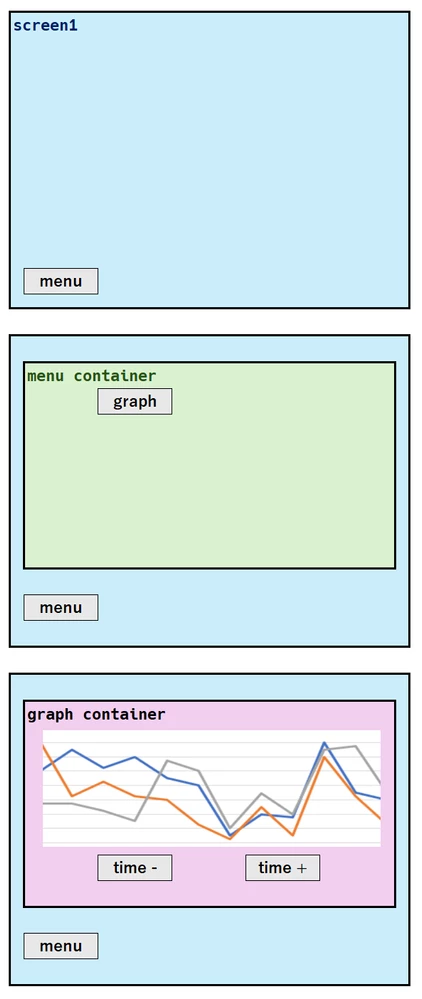
- Base screen (screen1) with a menu button
- When menu button is pressed, a menu container is displayed on top
- The menu container has a graph button which opens a graph container that overlays on top
- The graph display uses a CacheableContainer with multiple static graphs
The Problem:
When the graph is displayed, touch response becomes extremely slow. I've used CacheableContainer which helped slightly, but issues persist.
In the simulator, I discovered that during every tick, the entire screen (full rect 0,0,1024,768) is being redrawn unnecessarily. The CPU usage spikes when the graph is displayed.
Here's the call stack when debugging:
#0 0x005d3da7 in touchgfx::CacheableContainer::setupDrawChain(touchgfx::Rect const&, touchgfx::Drawable**) ()
#1 0x005d3aa0 in touchgfx::Container::setupDrawChain(touchgfx::Rect const&, touchgfx::Drawable**) ()
#2 0x005d3aa0 in touchgfx::Container::setupDrawChain(touchgfx::Rect const&, touchgfx::Drawable**) ()
#3 0x005d3aa0 in touchgfx::Container::setupDrawChain(touchgfx::Rect const&, touchgfx::Drawable**) ()
#4 0x005ec7fc in touchgfx::Screen::startSMOC(touchgfx::Rect const&) ()
#5 0x005ec6b1 in touchgfx::Screen::draw(touchgfx::Rect&) ()
#6 0x005e8b7a in touchgfx::Application::draw(touchgfx::Rect&) ()
#7 0x005eacad in touchgfx::Application::drawCachedAreas() ()
#8 0x005d4c0a in touchgfx::HAL::tick() ()
#9 0x00716f06 in touchgfx::HAL::backPorchExited (
this=0x810120 <touchgfx::getHAL<touchgfx::HALSDL2>(touchgfx::DMA_Interface&, touchgfx::LCD&, touchgfx::TouchController&, short, short)::hal>)
at ../Middlewares/ST/touchgfx/framework/include/touchgfx/hal/HAL.hpp:641
#10 0x005cf030 in touchgfx::HALSDL2::taskEntry (
this=0x810120 <touchgfx::getHAL<touchgfx::HALSDL2>(touchgfx::DMA_Interface&, touchgfx::LCD&, touchgfx::TouchController&, short, short)::hal>)
at ../Middlewares/ST/touchgfx/framework/source/platform/hal/simulator/sdl2/HALSDL2.cpp:755
#11 0x005d1213 in WinMain@16 (hInstance=0x400000, hPrevInstance=0x0, lpCmdLine=0xa9329de "", nCmdShow=10) at
Further Details:
- The drawing process is redrawing screen1, menu container, and graph container in sequence during each tick
- The graph only needs to update every 10+ seconds, not on every frame
- All this unnecessary redrawing is causing significant performance overhead
Question:
Is there a more efficient way to handle drawing in this scenario? How can I prevent the entire screen redraw on every tick when only small portions need updating?
Would you like me to modify anything specific in this translation?