
EEPROM Emulated Timing (x-cube-eeprom)
I am running a bluetooth application using freeRTOS on a Nucleo-WB55 (STM32WB55RG). I am in the process of implementing Emulated EEPROM (X-Cube-EEPROM) to store som data.
After implementing eeprom emulated in a ble_heartrate_freertos example I have had problems understanding the execution of the Emulated EEPROM operation after a pagetransfer + cleanup (obs. for simplicity I use EE_CleanUp here)
Without BLE activated (in SingleCore mode) EEPROM Emulated write and pagetransfer+cleanup looks just fine:
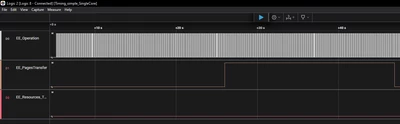
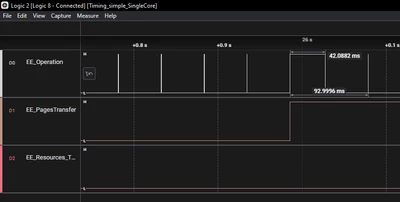
Pagetransfer + cleanup takes ~40-50ms
With BLE activated (in DualCore Mode) the following EEPROM operation occupies much more time than expected: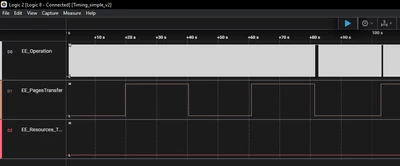
Pagetransfer + cleanup still takes ~40-50ms, but a long delay is introduced in the next EEPROM operation:
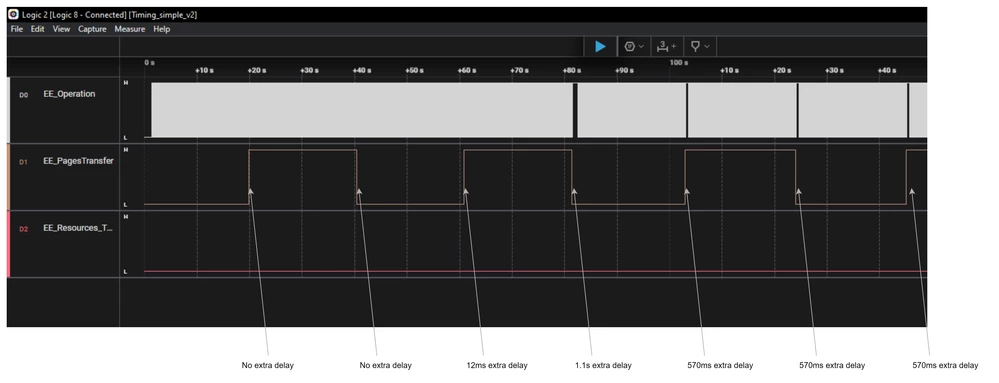
Here is an example of the additional delay introduced in the following EEPROM (after a pagetransfer + cleanup) operation: 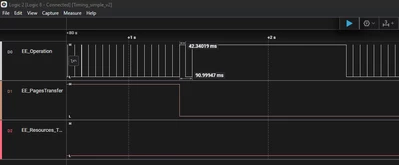
Here is the code:
int main(void)
{
 ...

 osKernelInitialize();
 defaultTaskHandle = osThreadNew(StartDefaultTask, NULL, &defaultTask_attributes);
 APPE_Init();

 EEPROM_Emul_Init();
 EEPROMTimer_Id = osTimerNew(EEPROM_Emul_Simple, osTimerPeriodic, (void *)0, NULL);
 osTimerStart(EEPROMTimer_Id, 50);

 /* Start scheduler */
 osKernelStart();

 /* We should never get here as control is now taken by the scheduler */
 while (1) { }
}
static void EEPROM_Emul_Simple()
{
 HAL_GPIO_TogglePin(DEBUG1_Gpio_Port, DEBUG1_Pin);
 static uint32_t VarValue = 1;
 static uint32_t Index = 1;
 static EE_Status ee_status = EE_OK;

 taskENTER_CRITICAL(); // Exit of critical section in FreeRTOS (disables interrupts)

 /* Wait for the flash semaphore to be free */
 if (HAL_HSEM_IsSemTaken(CFG_HW_FLASH_SEMID)) {
 taskEXIT_CRITICAL(); // exit of critical section in FreeRTOS

 HAL_GPIO_TogglePin(DEBUG3_Gpio_Port, DEBUG3_Pin);
 return;
 }
 if (HAL_HSEM_Take(CFG_HW_FLASH_SEMID, HSEM_PROCESS_1) != HAL_OK) {
 taskEXIT_CRITICAL(); // exit of critical section in FreeRTOS

 HAL_GPIO_TogglePin(DEBUG3_Gpio_Port, DEBUG3_Pin);
 return;
 }

 HAL_FLASH_Unlock(); /* Unlock the Flash Program Erase controller */

 /* ----------- WRITE ----------- */
 /* Toggle LED to show the EEPROM operations are effectively running */
 BSP_LED_Toggle(LED_BLUE);

 ee_status = EE_WriteVariable32bits(Index, Index*VarValue);
 /* If flash is used by CPU2 */
 if (ee_status == EE_FLASH_USED) {
 /* Lock the Flash Program Erase controller and release the semaphore */
 HAL_FLASH_Lock();
 HAL_HSEM_Release(CFG_HW_FLASH_SEMID, HSEM_PROCESS_1);
 taskEXIT_CRITICAL(); // exit of critical section in FreeRTOS

 HAL_GPIO_TogglePin(DEBUG3_Gpio_Port, DEBUG3_Pin);
 return;
 }

 /* Start cleanup mode, if cleanup is needed */
 if ((ee_status & EE_STATUSMASK_CLEANUP) == EE_STATUSMASK_CLEANUP) {ErasingOnGoing = 0; ee_status |= EE_CleanUp();}
 if ((ee_status & EE_STATUSMASK_ERROR) == EE_STATUSMASK_ERROR) {Error_Handler();}

 /* Prepare the static parameters for the next time next the function is called by the FreeRTOS */
 Index++;
 if (Index >= (NB_OF_VARIABLES + 1)) {
 VarValue++;
 Index = 1;
 }

 /* Lock the Flash Program Erase controller and release flash semaphore if needed */
 HAL_FLASH_Lock();
 HAL_HSEM_Release(CFG_HW_FLASH_SEMID, HSEM_PROCESS_1);
 taskEXIT_CRITICAL(); // exit of critical section in FreeRTOS

 HAL_GPIO_TogglePin(DEBUG1_Gpio_Port, DEBUG1_Pin);
 return;
}