
Associate III
September 26, 2025
Solved

How to Wire NTC10k Temperature Sensors to NUCLEO-H7S3L8 ADC?

  • September 26, 2025
  • 4 replies
  • 821 views

Hello,


I’m trying to read temperature from some NTC10k sensors using a NUCLEO-H7S3L8 board. The datasheet says it has 14 ADC channels available, but I’m not sure how to wire the sensors correctly. I am using all channels in single ended mode

Each sensor is a simple 2-wire heat-dependent resistor (variable resistance in ohms). They don’t have their own power supply and only change resistance with temperature.


My questions are:

How do I need to wire the NTC10k to an ADC channel so that the MCU can actually measure something?

Do I need a voltage divider or extra resistor in the circuit?

If I want to connect several of these sensors (up to 14), do I need one resistor per sensor, or is there a simpler way?

Thanks in advance.
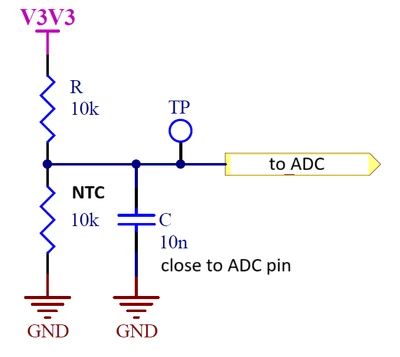
Best answer by LCE

LCE_0-1759130228947.png

This is what TDK means - although the capacitor seems to be debatable.
I actually use a H7 ADC for voltage monitoring with many muxed inputs, each input has a divider like that, always with 10k || 10 nF to GND. But with low ADC clock and big sampling times.

4 replies

TDK
Super User
September 26, 2025

Connect them in series with a 10 kOhm resistor and hook up the middle node to the ADC pin. You need 1 resistor per NTC. After calculating the voltage, back-calculate what the resistance of the NTC is and from there, the temperature.

"If you feel a post has answered your question, please click ""Accept as Solution""."
htxyAuthor
Associate III
September 26, 2025

But if all sensors are positioned indipendently from each other, a seriell connection would mean that a resistance of a previous sensor would effect the next one in the line. Wouldnt a paralell setup be more suitable?

TDK
Super User
September 26, 2025

Connect each of them in series with a 10 kOhm resistor. So you have 14 resistors.

14 of these circuits:

[3.3V] -> [10 kOhm] -> [NTC] -> [GND]

Connect the middle node to the ADC pin.


I do not recommend a capacitor here.

"If you feel a post has answered your question, please click ""Accept as Solution""."
LCE
Principal II
September 26, 2025

And do some calculations concerning resistor change per °C and if the resulting voltage change will give you high enough resolution.

Also check the STM32 ADC input impedance, it's usually not that high and might affect your 10k / 10k divider.

Use lots of oversampling, and give each ADC input an extra capacitor with (at least) a few nF.

htxyAuthor
Associate III
September 26, 2025

My sampling time per ADC-channel is currently set to round about 614 cycles. Why though should i put a capacitor before the ADC INP pin?


Regarding the "manual" calibration, i completely agree

LCE
LCEBest answer
Principal II
September 29, 2025

LCE_0-1759130228947.png

This is what TDK means - although the capacitor seems to be debatable.
I actually use a H7 ADC for voltage monitoring with many muxed inputs, each input has a divider like that, always with 10k || 10 nF to GND. But with low ADC clock and big sampling times.

htxyAuthor
Associate III
September 29, 2025

Looks really good, i have it set up similarly now with a sampling time of 640 cycles, thanks a lot for the effort.