

TCP/IP - STM32F767ZI-Nucleo - Cannot manage to make it work - ETH
Hello,
Today and for the past days I am struggling trying to setup a TCP/IP server on the STM32F767Zi-Nucleo board..
The IP address is set to :
192.168.0.10
The mast address is set to :
255.255.255.0
The gateway address is set to :
192.168.0.1
My local machine show an IP address : 192.168.1.95
From my PC I am able to ping the board (w/ delay ~.025ms)
The main function is defined as :
int main(void)
{
 HAL_Init();

 SystemClock_Config();

 MX_GPIO_Init();
 osKernelInitialize();

 defaultTaskHandle = osThreadNew(StartDefaultTask, NULL, &defaultTask_attributes);
 osKernelStart();

 while (1)
 {
 }
}
The task is defined as :
void StartDefaultTask(void *argument)
{
 MX_LWIP_Init();
 printf("Entered task\n");
 tcp_echoserver_init();

 for(;;)
 {

 }
}
And the server initialization :
void tcp_echoserver_init(void) {
	local = netconn_new(NETCONN_TCP);
	if (local == NULL) {
		printf("Setup local connection failed\n");
		return;
	}
	printf("Local connection initialized\n");
	err_t err;

	err = netconn_bind(local, IP_ADDR_ANY, 7); // open port 7 || WILL BE CHANGED

	struct netbuf *buf = netbuf_new();
	void *data;
	uint16_t len;

	if (err == ERR_OK) {
		printf("Connection binded to port 7\n");
		err = netconn_listen(local); // set listening mode
		if (err != ERR_OK) printf("listen issue\n");
		printf("Port 7 is in listening mode\n");
		printf("Socket : %d\n", local->socket); // -1 is a problem
		while (1) {
			printf("Accepting..\n");
			err = netconn_accept(local, &remote);
			if (err == ERR_OK) {
				printf("Accepted!\n");
				while ((err = netconn_recv(remote, &buf)) == ERR_OK) {
					do {
						netbuf_data(buf, &data, &len);
						netconn_write(remote, data, len, NETCONN_COPY);
					} while (netbuf_next(buf) >= 0);
					netbuf_delete(buf);
				}
				netconn_close(remote);
				netconn_delete(remote);
			}
		}
	} else {
		printf("Bind issue\n");
		netconn_delete(remote);
	}
}
In my ioc file the clock is configured : 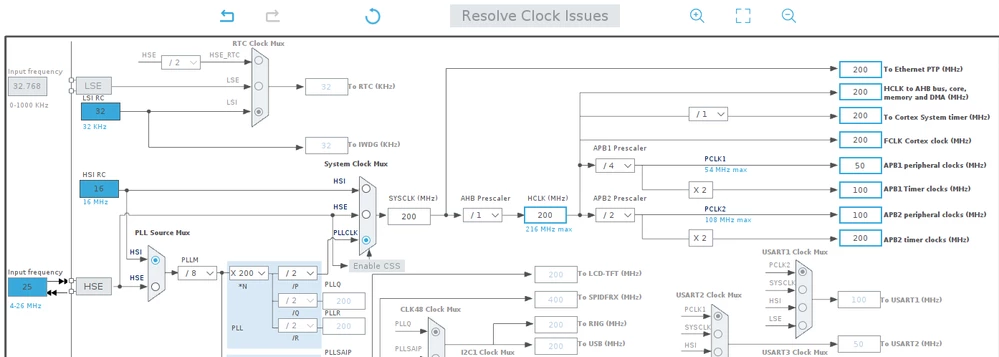
I didn’t showed the rest since only this part is manually configurable.
LWIP Config :
Version 2.12 and DHCP disabled
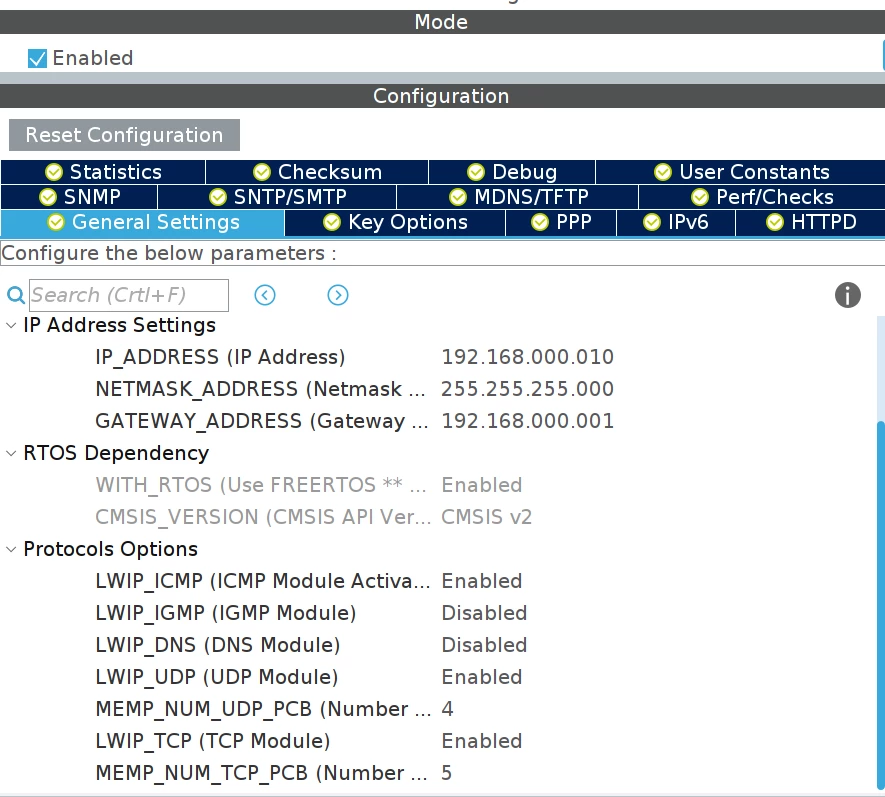
The rest is at default configuration
I also turned on RTOS :
API : CMSIS v2
FreeRTOS version 10.2.1
CMSIS-RTOS 2.0
The ETH port is enabled in RMII with global interrupt (w/o wake-up interrupt EXTI line 19)
RCC is Crystal/Ceramic Resonator HSE, rest of configuration unchanged
And SYS :
Debug to Serial Wire with timebase source TIM1 (as RTOS wont use Systick)
When launching debug session I got the following output in ITM console I got the following output :
Entered task
Local connection initialized
Connection binded to port 7
Port 7 is in listening mode
Socket : -1
Accepting..
For output to work. change write function from
__attribute__((weak))
int _write(int file, char *ptr, int len)
{
	int DataIdx;

	for (DataIdx = 0; DataIdx < len; DataIdx++)
	{
		__io_putchar(*ptr++);
	}
	return len;
}
to
//__attribute__((weak))
int _write(int file, char *ptr, int len)
{
	/* Implement your write code here, this is used by puts and printf for example */
	for(int i = 0 ; i < len ; i++) ITM_SendChar((*ptr++));
	return len;
//	int DataIdx;
//
//	for (DataIdx = 0; DataIdx < len; DataIdx++)
//	{
//		__io_putchar(*ptr++);
//	}
//	return len;
}
From there I simply though : “Hey let’s use netcat or whatever and just connect.�?
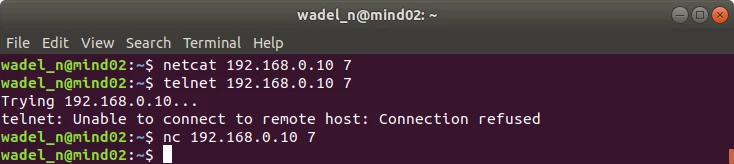
Or setting a C project that going to communicate with the board (as it is my final goal)
client.c
#include <netdb.h>
#include <stdio.h>
#include <stdlib.h>
#include <string.h>
#include <sys/socket.h>
#include <unistd.h>
#include <arpa/inet.h>

#define MAX 80
#define PORT 8080
#define SA struct sockaddr
void func(int sockfd)
{
 char buff[MAX];
 int n;
 for (;;) {
 bzero(buff, sizeof(buff));
 printf("Enter the string : ");
 n = 0;
 while ((buff[n++] = getchar()) != '\n')
 ;
 write(sockfd, buff, sizeof(buff));
 bzero(buff, sizeof(buff));
 read(sockfd, buff, sizeof(buff));
 printf("From Server : %s", buff);
 if ((strncmp(buff, "exit", 4)) == 0) {
 printf("Client Exit...\n");
 break;
 }
 }
}

int main()
{
 int sockfd, connfd;
 struct sockaddr_in servaddr, cli;

 // socket create and varification
 sockfd = socket(AF_INET, SOCK_STREAM, 0);
 if (sockfd == -1) {
 printf("socket creation failed...\n");
 exit(0);
 }
 else
 printf("Socket successfully created..\n");
 bzero(&servaddr, sizeof(servaddr));

 // assign IP, PORT
 servaddr.sin_family = AF_INET;
 servaddr.sin_addr.s_addr = inet_addr("127.0.0.1");
 servaddr.sin_port = htons(PORT);

 // connect the client socket to server socket
 if (connect(sockfd, (SA*)&servaddr, sizeof(servaddr)) != 0) {
 printf("connection with the server failed...\n");
 exit(0);
 }
 else
 printf("connected to the server..\n");

 // function for chat
 func(sockfd);

 // close the socket
 close(sockfd);
}
server.c
#include <stdio.h>
#include <netdb.h>
#include <netinet/in.h>
#include <stdlib.h>
#include <string.h>
#include <sys/socket.h>
#include <sys/types.h>
#include <unistd.h>

#define MAX 80
#define PORT 8080
#define SA struct sockaddr

// Function designed for chat between client and server.
void func(int sockfd)
{
 char buff[MAX];
 int n;
 // infinite loop for chat
 for (;;) {
 bzero(buff, MAX);

 // read the message from client and copy it in buffer
 read(sockfd, buff, sizeof(buff));
 // print buffer which contains the client contents
 printf("From client: %s\t To client : ", buff);
 bzero(buff, MAX);
 n = 0;
 // copy server message in the buffer
 while ((buff[n++] = getchar()) != '\n')
 ;

 // and send that buffer to client
 write(sockfd, buff, sizeof(buff));

 // if msg contains "Exit" then server exit and chat ended.
 if (strncmp("exit", buff, 4) == 0) {
 printf("Server Exit...\n");
 break;
 }
 }
}

// Driver function
int main()
{
 int sockfd, connfd, len;
 struct sockaddr_in servaddr, cli;

 // socket create and verification
 sockfd = socket(AF_INET, SOCK_STREAM, 0);
 if (sockfd == -1) {
 printf("socket creation failed...\n");
 exit(0);
 }
 else
 printf("Socket successfully created..\n");
 bzero(&servaddr, sizeof(servaddr));

 // assign IP, PORT
 servaddr.sin_family = AF_INET;
 servaddr.sin_addr.s_addr = htonl(INADDR_ANY);
 servaddr.sin_port = htons(PORT);

 // Binding newly created socket to given IP and verification
 if ((bind(sockfd, (SA*)&servaddr, sizeof(servaddr))) != 0) {
 printf("socket bind failed...\n");
 exit(0);
 }
 else
 printf("Socket successfully binded..\n");

 // Now server is ready to listen and verification
 if ((listen(sockfd, 5)) != 0) {
 printf("Listen failed...\n");
 exit(0);
 }
 else
 printf("Server listening..\n");
 len = sizeof(cli);

 // Accept the data packet from client and verification
 connfd = accept(sockfd, (SA*)&cli, &len);
 if (connfd < 0) {
 printf("server acccept failed...\n");
 exit(0);
 }
 else
 printf("server acccept the client...\n");

 // Function for chatting between client and server
 func(connfd);

 // After chatting close the socket
 close(sockfd);
}
gcc server.c -o server && gcc client.c -o client

When changing client server address fomr 127.0.01 to 192.168.0.10 and port from 8080 to 7

So… PC-wise it seems to work. But the connection is never accepted on the board.
I also tried to use the project from the git :
LwIP_HTTP_Server_Netconn_RTOS under STM32CubeF7-master/Projects/STM32F767ZI-Nucleo/Applications/LwIP/LwIP_HTTP_Server_Netconn_RTOS
removed the line #define USE_LCD and #define USE_DHCP
changing the IP by the one I set on my board. Still have no result. Trying to access the webpage at 192.168.0.10:80 shows “Unable to connect�? from e.g. Firefox
I also tried to use MBED /w their IDE, still get no results.
I've only been working with STM board since like... 3-4 month on only 2projects, the one only involved USART & i2C communication (way easier). That's for my background w/ MCUs :)
Thanks a lot !
Nicolas