Associate
November 20, 2025
Solved

With multiple SPI slaves, why do we need multiple SS ?

  • November 20, 2025
  • 3 replies
  • 202 views

why more than one STM32 SPI Slave connect to master means More SS need ?

Best answer by mƎALLEm

Hello,

Nothing to do with STM32 itself. 

The SPI lines data and clock are common to all slaves. How the master could address the communication to a specific slave if there is nothing to indicate which slave to communicate with?  SS: Slave Select. that corresponds to SPI_NSS signal in STM32 which means Negative Slave Select).

https://en.wikipedia.org/wiki/Serial_Peripheral_Interface
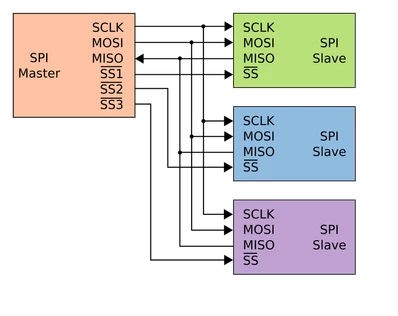
SPI_three_slaves.svg.png

3 replies

mƎALLEm
mƎALLEmBest answer
Technical Moderator
November 20, 2025

Hello,

Nothing to do with STM32 itself. 

The SPI lines data and clock are common to all slaves. How the master could address the communication to a specific slave if there is nothing to indicate which slave to communicate with?  SS: Slave Select. that corresponds to SPI_NSS signal in STM32 which means Negative Slave Select).

https://en.wikipedia.org/wiki/Serial_Peripheral_Interface

SPI_three_slaves.svg.png

"To give better visibility on the answered topics, please click on ""Accept as Solution"" on the reply which solved your issue or answered your question."
Andrew Neil
Super User
November 20, 2025
A complex system that works is invariably found to have evolved from a simple system that worked.A complex system designed from scratch never works and cannot be patched up to make it work.
Ozone
Principal
November 20, 2025

As suggested, read a good tutorial about the basics of the SPI bus.
In it's duplex incarnation, SPI clocks out data via the MOSI line, and at the same time clocks in data from slaves via the MISO line.
You cannot have more than one slave connected at a time that disagree on the bus state.
In the best case, the result is chaos and incorrect data.

Only if you have an unidirectional connection (writing to slaves, MOSI only), you could drive several devices with one NSS signal.