
Associate
July 30, 2024
Solved

STLink V3MINIE no target voltage

  • July 30, 2024
  • 3 replies
  • 4825 views

I have the STLink V3MINIE. When connected to the PC the red power LED is on. But I can't program any device because there is not target voltage. 

ST Prog (v2.17) shows Target voltage 0.00 V

How can I fix this? Is there a jumper or solder connection missing on the stlink? Or is the board damaged?
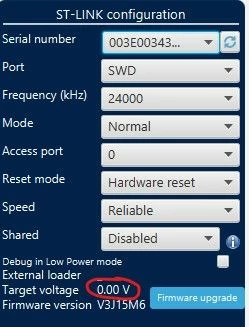
Screenshot 2024-07-30 093547.jpg

Thanks for help! 

Best answer by TDK

> What is the suggested way to program a STM32 that has no external power only with a  STLINK?

You need to get it power somehow. It's up to the board designer to determine how best to get it power. How will it get power when the programmer is not connected?

> Would it be save to connect these 2 pads if current consumption of my PCB is low? 

Likely, yes. If it's directly off of the LDO on the board, almost definitely yes.

> Is there a schematic availible for the MINIE board?

Unfortunately not.


3 replies

TDK
Super User
July 30, 2024

The programmer does not supply power to the board.

Is the board powered? What board is this?

"If you feel a post has answered your question, please click ""Accept as Solution""."
Andrew Neil
Super User
July 30, 2024

@TDK wrote:

Is the board powered? 


@Seba52 - and is the the Target voltage sense input correctly connected to the ST-Link?

A complex system that works is invariably found to have evolved from a simple system that worked.A complex system designed from scratch never works and cannot be patched up to make it work.
Seba52Author
Associate
July 30, 2024

I have connected the stlink to a custom board, was not aware, that the MINIE does not give out a voltage. 

If I power my PCB externaly it works and the voltage is displayed :) 


What is the suggested way to program a STM32 that has no external power only with a  STLINK?

I found a pin that has the needed 3.3V on the MINIE board. Would it be save to connect these 2 pads if current consumption of my PCB is low? 

Is there a schematic availible for the MINIE board?

MINIE.jpg

Thanks!

TDK
TDKBest answer
Super User
July 30, 2024

> What is the suggested way to program a STM32 that has no external power only with a  STLINK?

You need to get it power somehow. It's up to the board designer to determine how best to get it power. How will it get power when the programmer is not connected?

> Would it be save to connect these 2 pads if current consumption of my PCB is low? 

Likely, yes. If it's directly off of the LDO on the board, almost definitely yes.

> Is there a schematic availible for the MINIE board?

Unfortunately not.


"If you feel a post has answered your question, please click ""Accept as Solution""."
Seba52Author
Associate
July 30, 2024

@TDK wrote:

> What is the suggested way to program a STM32 that has no external power only with a  STLINK?

You need to get it power somehow. It's up to the board designer to determine how best to get it power. How will it get power when the programmer is not connected? 

There is a way to power the board when in normal use. But how do people usually power the STM32 for programming in production? Or do I need to build a custom board using the STLINK-V3MODS? 

It really would be nice to have a (solder) jumper on the STLINK boards to send power to the T_VCC pin. 

My initial question is answered now, thanks! 

TDJ
Senior III
August 27, 2025

I’ve just realized that debugging will not start without detecting the target voltage (pin 3 connected). This voltage is likely required by the level shifters. My custom probe doesn’t provide the target voltage, since I can use only four pins, and in addition to GND, SWDIO and SWCLK, I need TX. Below is working workaround I just tested.
Needless to say, this solution can be used with 3.3 V system only. I purposely used older STLINK-V3MODS because it is easier to modify.


IMG_5090.jpg


Andrew Neil
Super User
August 27, 2025

@TDJ wrote:

This voltage is likely required by the level shifters. 


Indeed.

A complex system that works is invariably found to have evolved from a simple system that worked.A complex system designed from scratch never works and cannot be patched up to make it work.