

Oleksii
Senior
January 25, 2025
Solved

FDCAN1 error in STM32G431 with interrupt vectors.

  • January 25, 2025
  • 1 reply
  • 1276 views


The conclusion is that setting filters and interrupts on FIFO0 leads to exception handling
FDCAN1_IT1_IRQHandler.
The reason for this behavior is an error in the file. startup_stm32g431cbtx.s

ERROR

..
.word ADC1_2_IRQHandler
.word USB_HP_IRQHandler
.word USB_LP_IRQHandler
.wordh FDCAN1_IT0_IRQHandler
.word FDCAN1_IT1_IRQHandler
.word EXTI9_5_IRQHandler
.word TIM1_BRK_TIM15_IRQHandler


..


This is how it should be

...

.word ADC1_2_IRQHandler
.word USB_HP_IRQHandler
.word USB_LP_IRQHandler
.word FDCAN1_IT1_IRQHandler
.word FDCAN1_IT0_IRQHandler
.word EXTI9_5_IRQHandler
.word TIM1_BRK_TIM15_IRQHandler

...


As an example, the code that I use is for testing so that there are no questions).

void CAN_Config(void) {

 FDCAN_GlobalTypeDef *CAN = FDCAN1;
 uint32_t *filterRAM = (uint32_t *)RAMBaseFDCAN1;

 // Включение тактирования для CAN
 RCC->APB1ENR1 |= RCC_APB1ENR1_FDCANEN;

 RCC->CCIPR &= ~RCC_CCIPR_FDCANSEL;
 // PLL "Q" for FDCAN
 RCC->CCIPR |= (0x1 << RCC_CCIPR_FDCANSEL_Pos); 


 // Init FDCAN module
 CAN->CCCR |= FDCAN_CCCR_INIT;
 while (!(CAN->CCCR & FDCAN_CCCR_INIT));
 CAN->CCCR |= FDCAN_CCCR_CCE; 

/*
 Baudrate	NSJW	NBRP	NTSEG1	NTSEG2	FDCAN_NBTP (uint32)
 125000		1		640		543		95		0x21F5F
 250000		1		320		271		47		0x10F2F
 500000		2		160		67		12		0x08617
 800000		1		100		84		14		0x0540E
 1000000		1		80		67		11		0x0430B
*/

 // Set the nominal bit timing register
 CAN->NBTP = (1 << FDCAN_NBTP_NSJW_Pos) |
 		(1 << FDCAN_NBTP_NBRP_Pos) |
		(66 << FDCAN_NBTP_NTSEG1_Pos)|
		(11 << FDCAN_NBTP_NTSEG2_Pos);

 // Clear message RAM
 for(uint8_t i=0;i< 212;i++){filterRAM[i] = 0;};

 /* FDCAN global filter configuration register (FDCAN_RXGFC)
 	 Address offset: 0x0080
 	 Reset value: 0x0000 0000
 */
 //CAN->RXGFC = STDfilter_n(2)|EXTfilter_n(0)|ANFS_Reject_rx|ANFE_Reject_rx;
 CAN->RXGFC = (2<<16)|(2<<4)|(2 << 2);//

 // ID filters 100 and 80
 // filterRAM[0] = STDfilterID_DUAL | STDfilterRxFIFO0 | STDfilterID1(0x100) | STDfilterID2(0x80); 
 filterRAM[0] = (1 << 30) | (1 << 27) | (0x100 << 16) | 80; 

 // Включить прерывания в FDCAN FIFO

 CAN->IE |= 3; // FDCAN_IE_RF0NE_| RF0FE
 CAN->ILS |= 1; // RXFIFO0: RX FIFO bit grouping the following interruption
 CAN->ILE |= 3; // Enable IT0

 // Normal MODE
 CAN->CCCR &= ~FDCAN_CCCR_INIT; // Выход из режима инициализации
 while (CAN->CCCR & FDCAN_CCCR_INIT);

 NVIC_EnableIRQ(FDCAN1_IT0_IRQn);;
 NVIC_EnableIRQ(FDCAN1_IT1_IRQn);
 
 }


It took me several hours to understand that someone had screwed up.(


RM0440 
Sometimes it blows my mind too))
Знімок екрана з 2025-01-25 18-53-54.png


Best answer by Oleksii

Hello Elmü

You were right, it’s just a *** typo in the RM for G0, G4, and H5 — a classic copy-paste error. I actually found an old project where I misconfigured FDCAN1->ILS and forgot about it, but it stuck in my head as if it were some "special feature" of that chip )).
I wrote some nonsense here, but the most important thing is to admit the mistake rather than just arguing forever )).
I rewrote the test code from scratch and verified everything: it works exactly the same way as on the H7 )))

#include "stm32g4xx.h"
#include "main.h"

#define RAMBaseFDCAN1 		 0x4000A400
#define STDfilterRxFIFO0 (1 << 27)
#define STDfilterRxFIFO1 (2 << 27)
#define STDfilterID1(a) (a << 16)
#define STDfilterID2(a) (a << 0)
#define STDfilterID_DUAL (1 << 30)
#define ESIbit			 0x80000000
#define XTDbit 		 0x40000000
#define RTRbit 		 0x20000000
#define Ram11bitfilter 0x0000
#define Ram29bitfilter 0x0070
#define RamFIFO0RX	 0x00B0
#define RamFIFO1RX	 0x0188
#define RamTxeventFIFO 0x0260
#define RamBaseTX 0x0278
#define LED1 (1 << 6)
#define LED2 (1 << 5)
#define STDfilter_n(a) (a << FDCAN_RXGFC_LSS_Pos) //max 28
#define EXTfilter_n(a) (a << FDCAN_RXGFC_LSE_Pos) //max 8
#define ANFE_FIFO0_rx 0
#define ANFE_FIFO1_rx (1 << 2)
#define ANFE_Reject_rx (2 << 2) //0b1100

//Accept Non-matching frames standard
#define ANFS_FIFO0_rx 0
#define ANFS_FIFO1_rx (1 << 4)
#define ANFS_Reject_rx (2 << 4) //0b1100


void SystemClock_Config(void) {

 RCC->APB1ENR1 |= RCC_APB1ENR1_PWREN;
 PWR->CR5 &= ~PWR_CR5_R1MODE;
 while (PWR->SR2 & PWR_SR2_VOSF);

 // HSE 8Mhz on
 RCC->CR |= RCC_CR_HSEON;
 while (!(RCC->CR & RCC_CR_HSERDY));

 //Flash
 FLASH->ACR = FLASH_ACR_LATENCY_4WS | FLASH_ACR_PRFTEN | FLASH_ACR_ICEN | FLASH_ACR_DCEN;


 RCC->PLLCFGR = 0; // reset PLL
 RCC->PLLCFGR |= (RCC_PLLCFGR_PLLSRC_HSE | // HSE ON
 (1 << RCC_PLLCFGR_PLLM_Pos) | // PLLM = 2 (8 / 2 = 4 )
 (80 << RCC_PLLCFGR_PLLN_Pos)| // PLLN = 80 * 4 * 320 )
 (0 << RCC_PLLCFGR_PLLR_Pos) | // PLLR = 2 (320 МГц / 2 = 160 )
					 (1 << RCC_PLLCFGR_PLLQ_Pos) | // PLLQ = 4 (320 МГц / 4 = 80 ) for FDCAN
 RCC_PLLCFGR_PLLREN | RCC_PLLCFGR_PLLQEN);

 RCC->CR |= RCC_CR_PLLON;
 while (!(RCC->CR & RCC_CR_PLLRDY)); 


 RCC->CFGR |= RCC_CFGR_HPRE_DIV1; // AHB = SYSCLK
 RCC->CFGR |= RCC_CFGR_PPRE1_DIV1; // APB1 = HCLK
 RCC->CFGR |= RCC_CFGR_PPRE2_DIV1; // APB2 = HCLK

 
 RCC->CFGR |= RCC_CFGR_SW_PLL;
 while ((RCC->CFGR & RCC_CFGR_SWS) != RCC_CFGR_SWS_PLL);


 RCC->APB1ENR1 |= RCC_APB1ENR1_CRSEN;
 RCC->APB2ENR |= RCC_APB2ENR_SYSCFGEN;

 SystemCoreClockUpdate();

 SysTick->LOAD = 160000000/1000 - 1; // (48 mHz / 1000) -1 // 1ms
 SysTick->VAL = 0; // reset
 SysTick->CTRL = SysTick_CTRL_CLKSOURCE_Msk | SysTick_CTRL_TICKINT_Msk | SysTick_CTRL_ENABLE_Msk;

 NVIC_EnableIRQ(SysTick_IRQn);

}

void GPIO_INIT(void){

/* LED_1 PA5, FDCAN1 PB8 RX
 LED_2 PA6, FDCAN1 PB9 TX */

	RCC->AHB2ENR |= RCC_AHB2ENR_GPIOAEN | RCC_AHB2ENR_GPIOBEN;
	// ------------ 151413121110 9 8 7 6 5 4 3 2 1 0
	GPIOA->MODER &= 0b11111111111111111100001111111111;
	GPIOA->MODER |= 0b00000000000000000001010000000000;
	GPIOB->MODER &= 0b11111111111100001111111111111111;
	GPIOB->MODER |= 0b00000000000010100000000000000000;
	//------------- 151413121110 9 8 7 6 5 4 3 2 1 0
	GPIOA->OSPEEDR|= 0b00000000000000000010100000000000;
	GPIOB->OSPEEDR|= 0b00000000000011110000000000000000;
	 //-------	 15 14 13 12 11 10 9 8
	GPIOB->AFR[1] |= 0b00000000000000000000000010011001;

}

uint16_t systick_pause = 0;

void SysTick_Handler(void) {

	if (systick_pause) systick_pause--;

}


void FDCANs_Config(void){


	uint32_t *RAM_CANFD1 = (uint32_t*)RAMBaseFDCAN1;

	RCC->APB1ENR1 |= RCC_APB1ENR1_FDCANEN;
	RCC->CCIPR &= ~RCC_CCIPR_FDCANSEL;
	RCC->CCIPR |= (0x1 << RCC_CCIPR_FDCANSEL_Pos); // Установить PLL "Q"

	FDCAN1->CCCR |= FDCAN_CCCR_INIT;
	while (!(FDCAN1->CCCR & FDCAN_CCCR_INIT));
	FDCAN1->CCCR |= FDCAN_CCCR_CCE;

	// Set the nominal bit timing register -1 (500kb)

	FDCAN1->NBTP = (1 << FDCAN_NBTP_NSJW_Pos) | (1 << FDCAN_NBTP_NBRP_Pos)
			| (66 << FDCAN_NBTP_NTSEG1_Pos) | (11 << FDCAN_NBTP_NTSEG2_Pos);

	for (uint8_t i = 0; i < 212; i++) {RAM_CANFD1[i] = 0;};

	FDCAN1->RXGFC = STDfilter_n(2)|EXTfilter_n(0)|ANFS_Reject_rx|ANFE_Reject_rx;
	*RAM_CANFD1++ = STDfilterID_DUAL | STDfilterRxFIFO0| STDfilterID1(0x20) | STDfilterID2(0x25);
	*RAM_CANFD1 = STDfilterID_DUAL | STDfilterRxFIFO1| STDfilterID1(0x30) | STDfilterID2(0x35);


	FDCAN1->IE |= 0x09; // FDCAN_IE_RF0N_| RF1N fifoO/fifo1
	FDCAN1->ILS |= 0; // IT0
	FDCAN1->ILE |= 1; // Enable bit1 it0?


	FDCAN1->CCCR &= ~FDCAN_CCCR_INIT; 
	while (FDCAN1->CCCR & FDCAN_CCCR_INIT);

 NVIC_EnableIRQ(FDCAN1_IT0_IRQn);

 //NVIC_EnableIRQ(FDCAN1_IT1_IRQn);

}

void FDCAN1_IT0_IRQHandler(void) {

	uint32_t index_rxfifo = 0, rxHeader0,id;// rxHeader1,dlc;
	uint32_t *RxBuffer;

	// msg FIFO 0
	if (FDCAN1->IR & 1) {

		index_rxfifo = (FDCAN1->RXF0S & FDCAN_RXF0S_F0GI) >> FDCAN_RXF0S_F0GI_Pos;
		RxBuffer = (uint32_t*) (RAMBaseFDCAN1 + RamFIFO0RX + (index_rxfifo * 18 * 4));
		rxHeader0 = *RxBuffer++;
		//rxHeader1 = *RxBuffer++;
		id = (rxHeader0 & XTDbit) ? rxHeader0 & 0x1FFFFFFF : (rxHeader0 & 0x1FFFFFFF) >> 18;
		//dlc = (rxHeader1 >> 16) & 0xF;

		if(id == 0x20){ GPIOA->BSRR = (GPIOA->ODR & LED1)? LED1 <<16: LED1;};

		FDCAN1->RXF0A = index_rxfifo;

		FDCAN1->IR |= 1; // clearFifo
	}

	// msg FIFO 1

	if (FDCAN1->IR & 8) {

			index_rxfifo = (FDCAN1->RXF1S & FDCAN_RXF1S_F1GI) >> FDCAN_RXF1S_F1GI_Pos;
			RxBuffer = (uint32_t*) (RAMBaseFDCAN1 + RamFIFO1RX + (index_rxfifo * 18 * 4));
			rxHeader0 = *RxBuffer++;
			//rxHeader1 = *RxBuffer++;
			id = (rxHeader0 & XTDbit) ? rxHeader0 & 0x1FFFFFFF : (rxHeader0 & 0x1FFFFFFF) >> 18;
			//dlc = (rxHeader1 >> 16) & 0xF;

			if(id==0x30){ GPIOA->BSRR = (GPIOA->ODR & LED1)? LED1 <<16: LED1;};


			FDCAN1->RXF1A = index_rxfifo;

			FDCAN1->IR |= 8; // clearFifo
		}

}


void SendCANframe() {

	uint32_t PutIndex;
	uint32_t *TxBuffer;

	// Проверяем, что Tx FIFO не заполнен
	if ((FDCAN1->TXFQS & FDCAN_TXFQS_TFQF) == 0) {

		PutIndex = (FDCAN1->TXFQS & FDCAN_TXFQS_TFQPI) >> FDCAN_TXFQS_TFQPI_Pos;
		TxBuffer = (uint32_t*) (RAMBaseFDCAN1 + RamBaseTX + (PutIndex * 18 * 4));
		*TxBuffer++ = (0x300 << 18);
		*TxBuffer++ = (8 << 16); //header1
		*TxBuffer++ = 0x11223344; //data 1-4
		*TxBuffer++ = 0x55667788; //data 5-8

		FDCAN1->TXBAR = (1 << PutIndex);

	};
}


int main(void)
{

	SystemClock_Config();
	GPIO_INIT();
	FDCANs_Config();

	GPIOA->BSRR = LED1|LED2;

 while(1){

	 if(!systick_pause){

		 GPIOA->BSRR = (GPIOA->ODR & LED2)? LED2 <<16: LED2;
	 systick_pause = 1000;
	 SendCANframe();

	 }

	 // FDCAN1_IT0_IRQHandler();

 };


};


/**
 * @brief This function is executed in case of error occurrence.
 * @retval None
 */
void Error_Handler(void)
{
 /* USER CODE BEGIN Error_Handler_Debug */
 /* User can add his own implementation to report the HAL error return state */
 __disable_irq();
 while (1)
 {
 }


1 reply

mƎALLEm
Technical Moderator
January 28, 2025

Hello,

I didn't understand how you arrived to the conclusion that the IRQ vector table needs to be in this order:

FDCAN1_IT1_IRQHandler
FDCAN1_IT0_IRQHandler

Instead of :

FDCAN1_IT0_IRQHandler
FDCAN1_IT1_IRQHandler

According to the reference manual RM0440 / Table 97. STM32G4 series vector table ,the implemented order is correct:

SofLit_0-1738077936326.png

I invite you to use the HAL to confirm your observation instead of playing with the direct access to the registers.

"To give better visibility on the answered topics, please click on ""Accept as Solution"" on the reply which solved your issue or answered your question."
Oleksii
OleksiiAuthor
Senior
January 28, 2025

I will answer your question)


Following the logic RM0440


FDCAN interrupt enable register (FDCAN_IE)

Bit 5 RF1LE: Rx FIFO 1 message lost interrupt enable
0: Interrupt disabled
1: Interrupt enabled
Bit 4 RF1FE: Rx FIFO 1 full interrupt enable
0: Interrupt disabled
1: Interrupt enabled
Bit 3 RF1NE: Rx FIFO 1 new message interrupt enable
0: Interrupt disabled
1: Interrupt enabled
Bit 2 RF0LE: Rx FIFO 0 message lost interrupt enable
0: Interrupt disabled
1: Interrupt enabled
Bit 1 RF0FE: Rx FIFO 0 full interrupt enable
0: Interrupt disabled
1: Interrupt enabled
Bit 0 RF0NE: Rx FIFO 0 new message interrupt enable
0: Interrupt disabled
1: Interrupt enabled

FDCAN interrupt line select register (FDCAN_ILS)
Bit 1 RXFIFO1: RX FIFO bit grouping the following interruption
RF1LL: Rx FIFO 1 message lost interrupt line
RF1FL: Rx FIFO 1 full interrupt line
RF1NL: Rx FIFO 1 new message interrupt line

Bit 0 RXFIFO0: RX FIFO bit grouping the following interruption
RF0LL: Rx FIFO 0 message lost interrupt line
RF0FL: Rx FIFO 0 full interrupt line
RF0NL: Rx FIFO 0 new message interrupt line


What do you expect to see in the register FDCAN_ILE ?

bit0 is the enable interrupt for FIFO0
bit1 - is the enable interrupt for FIFO1.


But what do we see)
An inconvenient crutch with an attempt to justify it.

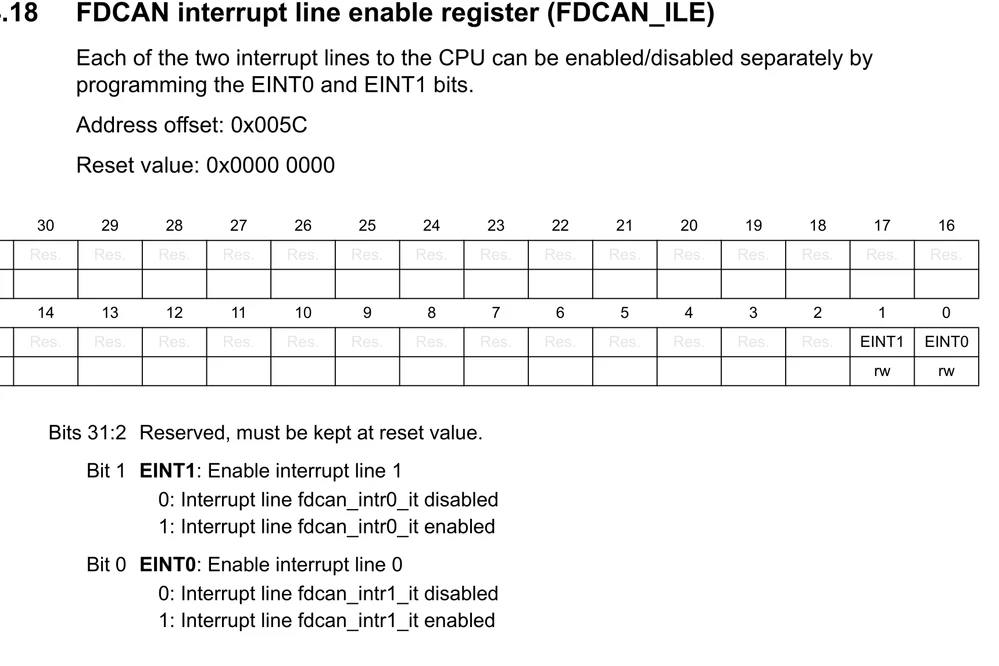
FDCAN interrupt line enable register (FDCAN_ILE)

Bit 1 EINT1: Enable interrupt line 1
0: Interrupt line fdcan_intr0_it disabled
1: Interrupt line fdcan_intr0_it enabled

Bit 0 EINT0: Enable interrupt line 0
0: Interrupt line fdcan_intr1_it disabled
1: Interrupt line fdcan_intr1_it enabled


The solution is to simply make changes to the vector table.

As for HAL - due to its multi-level abstraction, of course this error can be corrected..

But don't suggest this to me, it's a lot of extra text and extra code.)


Registers are much simpler and better.
As a result, the firmware is much smaller.

There is no need to create an entire structure to write one value to a register))

Associate
February 6, 2026

What you mean is this on page 2001 of the RM0440:

Interruptsd1.png

But to me this seem to be a typo in the manual.
Did you test this in the real world, or do you blindly trust the manual ?