
Solved
NUCLEO-H7S3L8: Unstable readings with Dual ADC + DMA in Continuous Mode
Hi everyone,
I am working on a project with the NUCLEO-H7S3L8 and trying to read 2 ADCs simultaneously in Continuous Conversion mode using HPDMA.
The Goal:
ADC1 & ADC2: Reading 7 channels each (14 channels total).
Mode: Continuous Conversion, Circular Mode.
Transfer: HPDMA to SRAM (AHB SRAM).
The Problem: I am receiving data, but the values are extremely unstable/fluctuating.
When running a smaller example from a ST-Employee, values were stable (around 400).
With the full 7-channel scan, the data fluctuates significantly, at a level where data should be wrong.
Can someone take a look at it? They both use the same bootloader. I honestly cant see any issues with my custom config.
Thanks in advance.
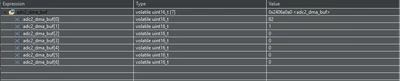

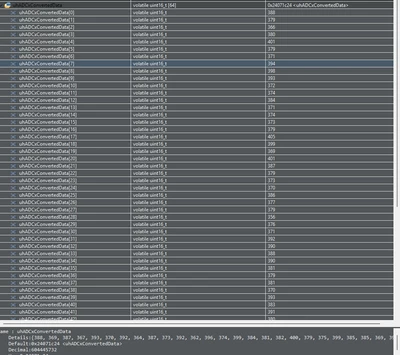
This is also my linker if relevant:
/*
******************************************************************************
**
** @file : LinkerScript.ld
**
** @author : STM32CubeIDE
**
** Abstract : Linker script for STM32H7Sxx Device
** 128KBytes FLASH
** 456KBytes RAM
**
** Set heap size, stack size and stack location according
** to application requirements.
**
** Set memory bank area and size if external memory is used
**
** Target : STMicroelectronics STM32
**
** Distribution: The file is distributed as is, without any warranty
** of any kind.
**
******************************************************************************
** @attention
**
** Copyright (c) 2024 STMicroelectronics.
** All rights reserved.
**
** This software is licensed under terms that can be found in the LICENSE file
** in the root directory of this software component.
** If no LICENSE file comes with this software, it is provided AS-IS.
**
******************************************************************************
*/

/* Entry Point */
ENTRY(Reset_Handler)

/* Highest address of the user mode stack */
_estack = ORIGIN(DTCM) + LENGTH(DTCM); /* end of "DTCM" Ram type memory */

_Min_Heap_Size = 0x200; /* required amount of heap */
_Min_Stack_Size = 0x400; /* required amount of stack */

__FLASH_BEGIN = 0x70000000;
__FLASH_SIZE = 0x08000000;


__RAM_BEGIN = 0x24000000;
__RAM_SIZE = 0x6A000;

/* Non-Cacheable Buffer: Increased to 32 KB */
__RAM_NONCACHEABLEBUFFER_SIZE = 0x8000;

/* Memories definition */
MEMORY
{
 RAM (xrw) : ORIGIN = __RAM_BEGIN, LENGTH = __RAM_SIZE
 RAM_NONCACHEABLEBUFFER (xrw) : ORIGIN = __RAM_BEGIN + __RAM_SIZE, LENGTH = __RAM_NONCACHEABLEBUFFER_SIZE

 ITCM (xrw) : ORIGIN = 0x00000000, LENGTH = 0x00010000
 DTCM (rw) : ORIGIN = 0x20000000, LENGTH = 0x00010000
 SRAMAHB (rw) : ORIGIN = 0x30000000, LENGTH = 0x00008000
 BKPSRAM (rw) : ORIGIN = 0x38800000, LENGTH = 0x00001000

 FLASH (xrw) : ORIGIN = __FLASH_BEGIN, LENGTH = __FLASH_SIZE
}

/* Sections */
SECTIONS
{
 /* The startup code into "FLASH" FLASH type memory */
 .isr_vector :
 {
 . = ALIGN(4);
 KEEP(*(.isr_vector)) /* Startup code */
 . = ALIGN(4);
 } >FLASH

 /* The program code and other data into "FLASH" FLASH type memory */
 .text :
 {
 . = ALIGN(4);
 *(.text) /* .text sections (code) */
 *(.text*) /* .text* sections (code) */
 *(.glue_7) /* glue arm to thumb code */
 *(.glue_7t) /* glue thumb to arm code */
 *(.eh_frame)

 KEEP (*(.init))
 KEEP (*(.fini))

 . = ALIGN(4);
 _etext = .; /* define a global symbols at end of code */
 } >FLASH

 /* Constant data into "FLASH" FLASH type memory */
 .rodata :
 {
 . = ALIGN(4);
 *(.rodata) /* .rodata sections (constants, strings, etc.) */
 *(.rodata*) /* .rodata* sections (constants, strings, etc.) */
 . = ALIGN(4);
 } >FLASH

 .ARM.extab (READONLY) : /* The READONLY keyword is only supported in GCC11 and later, remove it if using GCC10 or earlier. */
 {
 . = ALIGN(4);
 *(.ARM.extab* .gnu.linkonce.armextab.*)
 . = ALIGN(4);
 } >FLASH
 .ARM (READONLY) : /* The READONLY keyword is only supported in GCC11 and later, remove it if using GCC10 or earlier. */
 {
 . = ALIGN(4);
 __exidx_start = .;
 *(.ARM.exidx*)
 __exidx_end = .;
 . = ALIGN(4);
 } >FLASH

 .preinit_array (READONLY) : /* The READONLY keyword is only supported in GCC11 and later, remove it if using GCC10 or earlier. */
 {
 . = ALIGN(4);
 PROVIDE_HIDDEN (__preinit_array_start = .);
 KEEP (*(.preinit_array*))
 PROVIDE_HIDDEN (__preinit_array_end = .);
 . = ALIGN(4);
 } >FLASH

 .init_array (READONLY) : /* The READONLY keyword is only supported in GCC11 and later, remove it if using GCC10 or earlier. */
 {
 . = ALIGN(4);
 PROVIDE_HIDDEN (__init_array_start = .);
 KEEP (*(SORT(.init_array.*)))
 KEEP (*(.init_array*))
 PROVIDE_HIDDEN (__init_array_end = .);
 . = ALIGN(4);
 } >FLASH

 .fini_array (READONLY) : /* The READONLY keyword is only supported in GCC11 and later, remove it if using GCC10 or earlier. */
 {
 . = ALIGN(4);
 PROVIDE_HIDDEN (__fini_array_start = .);
 KEEP (*(SORT(.fini_array.*)))
 KEEP (*(.fini_array*))
 PROVIDE_HIDDEN (__fini_array_end = .);
 . = ALIGN(4);
 } >FLASH

 /* Used by the startup to initialize data */
 _sidata = LOADADDR(.data);

 /* Initialized data sections into "RAM" Ram type memory */
 .data :
 {
 . = ALIGN(4);
 _sdata = .; /* create a global symbol at data start */
 *(.data) /* .data sections */
 *(.data*) /* .data* sections */
 *(.RamFunc) /* .RamFunc sections */
 *(.RamFunc*) /* .RamFunc* sections */

 . = ALIGN(4);
 _edata = .; /* define a global symbol at data end */

 } >RAM AT> FLASH

 /* Uninitialized data section into "RAM" Ram type memory */
 . = ALIGN(4);
 .bss :
 {
 /* This is used by the startup in order to initialize the .bss section */
 _sbss = .; /* define a global symbol at bss start */
 __bss_start__ = _sbss;
 *(.bss)
 *(.bss*)
 *(COMMON)

 . = ALIGN(4);
 _ebss = .; /* define a global symbol at bss end */
 __bss_end__ = _ebss;
 } >RAM

 RW_NONCACHEABLE :
 {
 __NONCACHEABLEBUFFER_BEGIN = .;/* create symbol for start of section */
 KEEP(*(noncacheable_buffer))
 __NONCACHEABLEBUFFER_END = .; /* create symbol for start of section */
 } > RAM_NONCACHEABLEBUFFER

 /* User_heap_stack section, used to check that there is enough "RAM" Ram type memory left */
 ._user_heap_stack :
 {
 . = ALIGN(8);
 PROVIDE ( end = . );
 PROVIDE ( _end = . );
 . = . + _Min_Heap_Size;
 . = . + _Min_Stack_Size;
 . = ALIGN(8);
 } >DTCM

 /* Remove information from the compiler libraries */
 /DISCARD/ :
 {
 libc.a ( * )
 libm.a ( * )
 libgcc.a ( * )
 }

 .ARM.attributes 0 : { *(.ARM.attributes) }
}