
Associate
February 19, 2026
Solved

NUCLEO-U575ZI-Q - HAL_GetTick returns 0

  • February 19, 2026
  • 4 replies
  • 620 views

Bonjour,

J'utilise la suite CUBEMX et CUBEIDE  pour créer mon projet à partir d'une carte de développement NUCLEO-U575ZI-Q.
J'ai réalisé mon projet sur CUBEMX en gardant et validant le BSP de la NUCLEO pour utiliser les leds et surtout le debug via ST-LINK embarqué.

J'ai ajouté des IO pour effectuer une maquette avec SPI1 et OCTO-SPI1 plus quelques IO notamment une PWM.

Pour commencer j'ai d'abord réalisé un bout de code pour faire clignoter une led (LED_GREEN); à une certaine fréquence réglée par HAL_Delay.

Le souci est que cette fonction bloque car le Tick ne semble pas être validé, (HAL_GetTick  me retourne toujours 0)...

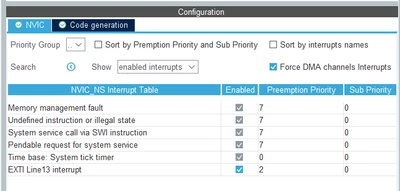
Je crois pourtant avoir validé les interruptions :

Hello,

I am using the CUBEMX and CUBEIDE suite to create my project based on a NUCLEO-U575ZI-Q development board.
I created my project on CUBEMX, keeping the NUCLEO BSP to use the LEDs and, above all, debugging via the embedded ST-LINK.

I added I/Os to create a model with SPI1 and OCTO-SPI1, and a few I/Os, including a PWM.

To start with, I wrote a piece of code to make a LED (LED_GREEN) flash at a certain frequency set by HAL_Delay.

The problem is that this function blocks because the tick does not seem to be validated (HAL_GetTick always returns 0)...

However, I believe I have validated the interrupts:

Translated with DeepL.com (free version)
CLC_EricF_0-1771519169847.png

Can you help me, je débute dans l'environnement STM32CUBE...
Thanks in advance,

Eric
 

Best answer by mƎALLEm

@CLC_EricF wrote:

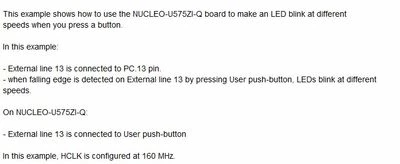
Here is the descriptif:
ExampleDescriptif.jpg


Humm well. That seems to be this example from Github:

https://github.com/STMicroelectronics/STM32CubeU5/tree/main/Projects/NUCLEO-U575ZI-Q/Examples/GPIO/GPIO_Demo

Indeed you can start by that one. Then move on with this one (GPIO_IOToggle_TrustZone):

https://github.com/STMicroelectronics/STM32CubeU5/tree/main/Projects/NUCLEO-U575ZI-Q/Examples/GPIO/GPIO_IOToggle_TrustZone

at least to inspire from the TrustZone configuration/implementation.

For SPI example refer to these examples (I think without TrustZone enabled): https://github.com/STMicroelectronics/STM32CubeU5/tree/main/Projects/NUCLEO-U575ZI-Q/Examples/SPI

If you feel one of the posts helped you/answered your question please don't hesitate to accept it as solution.

And you are welcome.

4 replies

mƎALLEm
Technical Moderator
February 19, 2026

Hello @CLC_EricF and welcome to the ST community, 

Check if the option to generate the system tick interrupt handler code is checked in the code generation tab:

mALLEm_0-1771531262370.png

"To give better visibility on the answered topics, please click on ""Accept as Solution"" on the reply which solved your issue or answered your question."
StevenG
Associate III
February 19, 2026

Eric,

  Somewhere within your project (usually main.c) you should have a function similar to the following:

/**
 * @brief Period elapsed callback in non blocking mode
 * @note This function is called when TIM6 interrupt took place, inside
 * HAL_TIM_IRQHandler(). It makes a direct call to HAL_IncTick() to increment
 * a global variable "uwTick" used as application time base.
 * @PAram htim : TIM handle
 * @retval None
 */
void HAL_TIM_PeriodElapsedCallback(TIM_HandleTypeDef *htim)
{
 /* USER CODE BEGIN Callback 0 */

 /* USER CODE END Callback 0 */
 if (htim->Instance == TIM6)
 {
 HAL_IncTick();
 }
 /* USER CODE BEGIN Callback 1 */

 /* USER CODE END Callback 1 */
}

In my case I am using TIM6 to create the time base used by HAL_GetTick().  Make sure you have similar code in your application and maybe place a breakpoint on the line with HAL_IncTick() to make sure your code is getting to this point.  NOTE:  in general I always use a timer to create the system clock so I am not sure what happens if you use the SysTick. 


You mention that you created your project based on the NUCLEO board.  Are you running code on a NUCLEO board or on hardware you designed and built?  The NUCLEO board appears to have on-board HSE and LSE crystals/oscillators.  If you have designed a board without HSE or LSE clock sources, your code will need to use only the internal RC oscillators. 


The HAL code often doesn't implement fail-safe operation and will enter code loops waiting for a bit to be set/cleared without any kind of timeout.  Of course, if you are using an actual NUCLEO board, you shouldn't have a problem with this type of issue.

CLC_EricFAuthor
Associate
February 20, 2026

Thanks  @mƎALLEm and @StevenG  for your responses.

 @mƎALLEm : Yes the option to generate the system tick interrupt handler code is checked in the code generation tab:

Capture d’écran 2026-02-20 144402.jpg

 @StevenG :No, I didn't have the function implemented in main.c, I added it by synchronizing it with TIM1 declared as OutputCompare. It doesn't go into any interrupt.
And HAL_GetTick always returns 0...
Best Regards,

Eric

mƎALLEm
Technical Moderator
February 20, 2026

Hello,

Thank you for the confirmation,

Could you please attach your project so I could reproduce the case in the next week as I don't have that board for now?

"To give better visibility on the answered topics, please click on ""Accept as Solution"" on the reply which solved your issue or answered your question."
CLC_EricFAuthor
Associate
February 20, 2026

Thank you for your proposal. !

CLC_EricFAuthor
Associate
February 25, 2026

Hello,

So I ran an example (GPIO_Demo.ioc) without touching the .ioc file (just generating the code with CubeMX and compiling and debugging it in CubeIDE).
Naturally, everything works: Get_Tick, HAL_Delay, and EXi interrupts.
Now I'm going to try to compare the two projects (mine in Secure-NoSecure mode) and the demo to try to understand what I'm missing.
I already notice that in the demo's ioc file, neither the NUCLEO board's BSP nor DEBUG are validated in the file, so everything is done by code?

I admit this confuses me a little...

Regards,

Eric

mƎALLEm
Technical Moderator
February 25, 2026

Hello,

Sorry I'm not sure to follow you.

Did you test a simple project without TrustZone or not? if yes what was your finding?

"To give better visibility on the answered topics, please click on ""Accept as Solution"" on the reply which solved your issue or answered your question."
CLC_EricFAuthor
Associate
February 25, 2026

Hello @mƎALLEm ,

Yes, I tested a simple project taken from the examples provided by ST for the NUCLEO-U575 board, without TrustZone. It is the GPIO_Demo code, which I had already used as inspiration, but I created my own configuration by adding TrustZone and the I/O for the SPI and octo-spi outputs so that I could control the screen and the QSPI flash on my future prototype.
The demo works well without TrustZone.

When I look at the GPIO_Demo.ioc project on CubeMX, I see, for example, that neither the debug interface nor the Nucleo board's BSP are validated, even though I validated them in my CubeMX project.
The clock configuration is the same.

Extract from GPIO_Demo.ioc :    Extract from my project :

gpio_demo.ioc.jpg     MyProject.ioc.jpg

The pinouts view of the two projects:

gpio_dem_pinout.jpg          my project : myproject_pinout.jpg


I used to work on Renesas Synergy with the BSP suite in e2studio, where everything could be configured graphically. I think it's the same here with cubeMX, but the example project doesn't really demonstrate this.
I think I have a lot to learn; the transition seems more complicated than I thought.
Eric