
Monitoring individual cells of battery pack (on NUCLEO-L432KC)
Greetings,
Being rather new to designing/connecting electronics components, I got some questions regarding battery monitoring.
Setup:
NUCLEO-L432KC, driven by regular AA NiMH batteries in 3S configuration. Voltage is regulated by a small board based on a TI TPS63802 buck-boost-converter, which ensures a stable 3.3V output for the Nucleo board. The MCU is running stable with this power supply, everythings works out so far.
Task:
Now there's monitoring of the individual battery cells on the table. With three cells, three ADC inputs are required (if you don't do some switching outside of the MCU). The NiMH cells in question are rated at 1.2V nominal, with close to 1.4V when at full charge. Thus, if you measure the voltage after each cell, it would result to 1.2V, 2.4V and 3.6V nominal (or 1.4V, 2.8V and 4.2V max).
Gathered intel:
I understand that the ADC can only measure voltages between 0 and VREF, which equals to the 3.3V input voltage.
Regarding the measurement of <3.3V battery pack nodes, there's contradictory information on the web on how to connect this. Some say that you'd just connect the 1.2V/2.4V nominal from the battery pack directly to the ADC pin on the MCU. Others say, that you'd need at least some resistor to reduce the current flow (without specifying further).
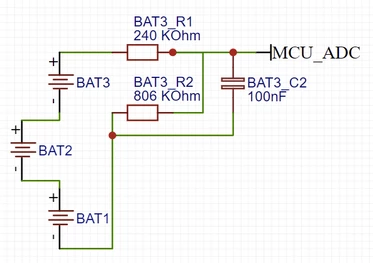
Regarding the total package voltage, a divider is required (because 3.6V/4.2V is greater than 3.3V). From what I could gather, I would go with a high resistance divider with a filter cap. I understood, that high ADC sample times would be required, maybe even taking multiple measurements and taking an average. The setup for measuring the total pack voltage would look like this:
Questions:
- How to connect the first two batteries of the pack to the ADC? Simply wire it up? Put some resistors in series? Maybe even some more components, to make it safe for the MCU?
- Does the divider for measuring the total pack voltage look sound? Using a capacitor or not seemed to be a major discussion point.
Thanks in advance for your feedback! I'm happy to provide more information if required.