STM32L4 STOP2 System abnormal restart
Environment: STM32L4 + 32.768K LSE
Function: Wake up and work once every hour, then enter stop2 mode. During the one-hour sleep, wake up every ten minutes to feed the external watchdog.
Problem: The device resets directly when waking up every ten minutes.
Current known information: The device was tested in the company for over twenty days without any issues (including restarts, freezes, etc.). After the prototypes were given to customers, problems started to occur in about 10 to 20 days. Currently, there are two failed devices. After power cycling, the devices did not return to normal. External reset also did not restore them to normal. Re-flashing the devices allows them to operate normally, and they are currently under continuous pressure testing to see if the issue will recur.
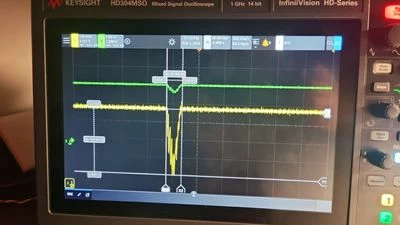
Current debugging progress: When the device restarts, the nRST pin has a low-level time of less than 1ms. The 3.3V power supply pin of the MCU is stable as observed by the oscilloscope. The TP5010_DONE_Pin has a 40ms high-level time during each ten-minute wake-up period (HAL_Delay(1) --> SystemCoreClock configured at 80M, after low-power wake-up, it switches to the default 4M of MSI, reducing by 20 times, plus the HAL_GPIO_WritePin time, which is exactly 40ms), but during the first low-power entry, it has a high-level time of over 20ms (caused by unstable PLL switching to MSI?).
------------------------------------------------------------------------------------
2026/02/03 23:18 UPDATE:
Environment:
50 mAh battery + STM32L4 MCU + 32.768 kHz LSE crystal + 4G module + GPS module + solar charging panel
Functionality:
- The device wakes up once per hour to collect sensor data.
- Every 8 hours, it uploads the accumulated data to a server via the 4G module.
- Immediately after completing its tasks, the MCU enters STOP2 low-power mode.
- Data collection and logging are stored in the internal Flash memory.
- During the long sleep period, the MCU wakes up every 10 minutes solely to feed an external watchdog timer.
Problem:
The device occasionally resets during these 10-minute wake-up intervals.
Known Information:
- Our LDO can only supply a peak current of 300 mA.
- There is approximately 10 µF of capacitance on the 3.3V power rail.
- The 4G module’s datasheet specifies a peak current requirement of 1 A. During RF transmission, significant voltage droop occurs—oscilloscope measurements show the 3.3V rail dropping as low as 2.4V.
- The GPS module draws about 100 mA during operation, causing ~100 mV voltage pulses visible on the oscilloscope.
- The Brown-Out Reset (BOR) threshold is configured at 1.7V.
Current Observations & Issues:
- Around twenty devices failed within a few days after deployment, exhibiting frequent reboots followed by permanent disconnection.
- Two faulty units were recovered:
- One resumed normal operation after reflashing the firmware.
- The other was not reflashed; attempting to read its Flash memory using STM32CubeProgrammer resulted in errors (see: https://community.st.com/t5/stm32-mcus-products/stm32l4-stop2-system-abnormal-restart/m-p/875450/highlight/true#M291981).
- Logs captured just before reboot are shown here: https://community.st.com/t5/stm32-mcus-products/stm32l4-stop2-system-abnormal-restart/m-p/875962/highlight/true#M292077 (voltage, timestamps, and reboot status are annotated; the column marked "#####" indicates 4G signal strength, which varies without clear pattern).
Current Analysis:
- Power supply IC limitation: Although we haven’t captured the exact 3.3V waveform at the moment of reset, we have observed dips down to 2.4V. It’s reasonable to assume that under real-world outdoor conditions—especially with poor cellular signal requiring higher 4G transmit power—the voltage could drop even further. (See image showing a 2.8V dip: https://community.st.com/t5/stm32-mcus-products/stm32l4-stop2-system-abnormal-restart/m-p/875903/highlight/true#M292050.)
- Power cable issue: The current wiring uses approximately AWG16 gauge, which may be too thin, contributing to additional voltage drop.
- Flash corruption during write operations: Data logging, Flash writes, and 4G transmission occur simultaneously. Therefore, it’s highly likely that a voltage droop-induced reset happens during a Flash write, potentially corrupting the memory contents.
Current Questions:
- Regarding point #3 above: If a reset caused by voltage droop occurs during Flash read/write, will it permanently damage the Flash memory or only partially corrupt its contents?
Next Steps:
- Redesign the power circuit: Replace the current LDO with one capable of handling higher peak currents, then conduct further testing.
- Use thicker power cables (lower gauge) to reduce resistive losses.
- Investigate and resolve the STM32CubeProgrammer read failure—either recover the root cause or implement mitigation strategies (e.g., robust Flash write protocols, power monitoring before writes).