
Associate II
May 21, 2025
Question

How to make QSPI transmission without delay between Command and Data?

  • May 21, 2025
  • 7 replies
  • 1374 views

I need to communicate with FPGA by QuadSPI. I use the NUCLEO-H743ZI2 and FreeRTOS with STM32Cub IDE.
So my code to write data to FPGA looks next:

uint32_t qspi_write(const uint8_t* RXbuf, uint8_t* TXbuf, uint16_t* tx_length) {
	sCommand.InstructionMode 	= QSPI_INSTRUCTION_NONE; /* Specifies the Instruction Mode: value of @ref QSPI_InstructionMode */
	sCommand.Instruction		= 0; /* Specifies the Instruction to be sent: value (8-bit) between 0x00 and 0xFF */
	sCommand.AddressMode		= QSPI_ADDRESS_4_LINES; /* Specifies the Address Mode: value of @ref QSPI_AddressMode */
	sCommand.AddressSize		= QSPI_ADDRESS_32_BITS; /* Specifies the Address Size: value of @ref QSPI_AddressSize */
	sCommand.Address			= *(uint32_t *) RXbuf; /* Specifies the Address to be sent (Size from 1 to 4 bytes according AddressSize): value (32-bits) between 0x0 and 0xFFFFFFFF */
	sCommand.AlternateByteMode	= QSPI_ALTERNATE_BYTES_NONE; /* Specifies the Alternate Bytes Mode: value of @ref QSPI_AlternateBytesMode */
	sCommand.AlternateBytesSize	= QSPI_ALTERNATE_BYTES_8_BITS; /* Specifies the Alternate Bytes Size: value of @ref QSPI_AlternateBytesSize */
	sCommand.AlternateBytes		= 0; /* Specifies the Alternate Bytes to be sent (Size from 1 to 4 bytes according AlternateBytesSize): value (32-bits) between 0x0 and 0xFFFFFFFF */
	sCommand.DummyCycles		= 1; /* Specifies the Number of Dummy Cycles: number between 0 and 31 */
	sCommand.DataMode			= QSPI_DATA_4_LINES; /* Specifies the Data Mode (used for dummy cycles and data phases): value of @ref QSPI_DataMode */
	sCommand.NbData				= (uint32_t) *tx_length; /* Specifies the number of bytes to transfer: value between 0 and 0xFFFFFFFF (0 means undefined length until end of memory)*/
	sCommand.DdrMode			= QSPI_DDR_MODE_DISABLE; /* Specifies the double data rate mode for address, alternate byte and data phase: value of @ref QSPI_DdrMode */
	sCommand.DdrHoldHalfCycle	= QSPI_DDR_HHC_ANALOG_DELAY; /* Specifies if the DDR hold is enabled: value of @ref QSPI_DdrHoldHalfCycle */
	sCommand.SIOOMode			= QSPI_SIOO_INST_EVERY_CMD; /* Specifies the send instruction only once mode: value of @ref QSPI_SIOOMode */

	configPRINTF( ("qspi: Command to Address = 0x%08x\n", sCommand.Address) );
	HAL_StatusTypeDef result = HAL_QSPI_Command(&hqspi, &sCommand, QSPI_TIMEOUT_VALUE);
	if ( result != HAL_OK ) {
		qspi_error_handler(result);
 	return result;
	}

	configPRINTF( ("qspi: Transmit NbData = %d\n", (uint16_t) *tx_length) );
//	result = HAL_QSPI_Transmit(&hqspi, TXbuf, QSPI_TIMEOUT_VALUE);
	result = HAL_QSPI_Transmit_IT(&hqspi, TXbuf);
 if ( result != HAL_OK ) {
 	qspi_error_handler(result);
 	return result;
 }
	return HAL_QSPI_ERROR_NONE;
}

As result, I see by Logic Analyser the next picture:
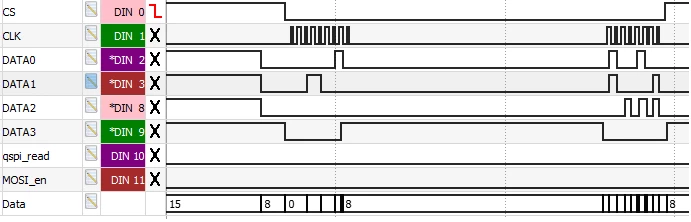
Untitled.png
The first burst of clocks corresponds to the transmission if Command, the 2nd - to the Data. The gap between two bursts  is about 0.76 mks in the case of using of HAL_QSPI_Transmit_IT and 1.5 mks in case of HAL_QSPI_Transmit which is somehow strange.
But the main question how I have to organize QSPI transmission without delay between Command and Data?


7 replies

CTapp.1
Senior III
May 21, 2025

Possibly a silly question, but how long does the call to configPRINTF() take?

All posts are made in a personal capacityMISRA C++ ChairMISRA C WG MemberDirector The MISRA Consortium Limited (TMCL)
IrekAuthor
Associate II
May 21, 2025

@CTapp.1 
If I comment the all configPRINTF() in the code the gap between burst do not change - this I tested before writing a post. 
I should mention that my previous project on the same board was used MBed OS - and there was not any gap inside QSPI transmissions. So STM32H7 hardware is able to transmit without any gap/delay. So how to program the same in the FreeRTOS?


urbito
Senior II
May 21, 2025

i am on the same page as CTapp.1, you should not have those "prints" on a transmission, normally those kind of prints add a delay around 50/100ms.

IrekAuthor
Associate II
May 21, 2025

@urbito :
Ok, I have to repeat test. Here is results: 

Code:

//	configPRINTF( ("qspi: Command to Address = 0x%08x\n", sCommand.Address) );
	HAL_StatusTypeDef result = HAL_QSPI_Command(&hqspi, &sCommand, QSPI_TIMEOUT_VALUE);
//	if ( result != HAL_OK ) {
//		qspi_error_handler(result);
// 	return result;
//	}

//	configPRINTF( ("qspi: Transmit NbData = %d\n", (uint16_t) *tx_length) );
//	result = HAL_QSPI_Transmit(&hqspi, TXbuf, QSPI_TIMEOUT_VALUE);
	result = HAL_QSPI_Transmit_IT(&hqspi, TXbuf);
// if ( result != HAL_OK ) {
// 	qspi_error_handler(result);
// 	return result;
// }

	return HAL_QSPI_ERROR_NONE;

Logic Analyser:
Untitled.png

Tesla DeLorean
Guru
May 21, 2025

Inspect HAL_QSPI_Command source and construct a multi-byte variant 

Tips, Buy me a coffee, or three.. PayPal VenmoUp vote any posts that you find helpful, it shows what's working..
IrekAuthor
Associate II
May 23, 2025

I tried to combine the HAL_QSPI_Command and HAL_QSPI_Transmit functions in a single function without additional conditional checks or __HAL_LOCK like functions use.
The result is the same - I see the gap between Command and Data sections during QSPI transmission. 

I looked the MBed's realization of the qspi.write - they use same HAL functions:

 if (HAL_QSPI_Command(&obj->handle, &st_command, HAL_QSPI_TIMEOUT_DEFAULT_VALUE) != HAL_OK) {
 status = QSPI_STATUS_ERROR;
 } else {
 if (HAL_QSPI_Transmit(&obj->handle, (uint8_t *)data, HAL_QSPI_TIMEOUT_DEFAULT_VALUE) != HAL_OK) {
 status = QSPI_STATUS_ERROR;
 }
 }

So obviously either I or FreeRTOS configure some QSPI registers in a wrong way. But I did not find in STM's manuals any explanation about delay between Command and Data transmission.

Any idea what should I check now?


Ozone
Principal
May 23, 2025

Could it be that FreeRTOS performs a task switch after the command is initiated and the task waits for completion ?

TDK
Super User
May 23, 2025

Don't know how much it helps but i see no gaps using qspi on the H723. Clock rate something like 50 MHz. Was wondering if it could be a cache thing.

Also couldnt see anything in RM to explain this.

"If you feel a post has answered your question, please click ""Accept as Solution""."
IrekAuthor
Associate II
May 23, 2025

@TDK

Thank you! I'll look at the cache section of the RM. And next week will do a new tests. 

IrekAuthor
Associate II
June 5, 2025

Hello,

I returned to this strange problem with delays in QSPI transmission. I succeeded to enable the I and D cache in my project - it was a problem with TCP+:  https://forums.freertos.org/t/freertos-tcp-stm32h743-dcache-doesnt-work/23167/10 
But this do not help with QSPI. Even more - I tried to send as a data 12 bytes. Result is next:

Untitled.png

I see that data is transmitted by 4-bytes chunks separated by similar delays as a Command. And this strange behaviour do not depend on hqspi.Init.FifoThreshold value - it can be 1 or 4 doesn't matter. All transmission takes 3.8 mks instead of 0.57 mks - this is awful! 

Any idea what I can do? 


TDK
Super User
June 5, 2025

The code probably just isn't keeping up. I didn't realize you were using blocking and IT methods. If you use DMA, or memory mapped mode, these should disappear.

"If you feel a post has answered your question, please click ""Accept as Solution""."
IrekAuthor
Associate II
June 6, 2025

@TDK 

I did not find in RM or AN4760 any sentence that using blocking and IT methods will lead to such strange data transfer. But Ok - I still need find a way to make QSPI working. Today I studied how to enable MDMA with QSPI. I did everything - and result again strange. The HAL_QSPI_Transmit_IT(&hqspi, TXbuf) line of code transfers data on the QSPI lines as I demonstrated above. However, when I replace it with HAL_QSPI_Transmit_DMA(&hqspi, TXbuf), I cannot see any data transferred by the logic analyzer.
Any idea why it can be?

TDK
Super User
June 6, 2025

Is DMA configured?

"If you feel a post has answered your question, please click ""Accept as Solution""."
IrekAuthor
Associate II
June 6, 2025

I think yes. Here is some code:

// In the main.c 
 hqspi.Instance = QUADSPI;
 hqspi.Init.ClockPrescaler = 4;
 hqspi.Init.FifoThreshold = 1;
 hqspi.Init.SampleShifting = QSPI_SAMPLE_SHIFTING_NONE;
 hqspi.Init.FlashSize = 31;
 hqspi.Init.ChipSelectHighTime = QSPI_CS_HIGH_TIME_1_CYCLE;
 hqspi.Init.ClockMode = QSPI_CLOCK_MODE_0;
 hqspi.Init.FlashID = QSPI_FLASH_ID_1;
 hqspi.Init.DualFlash = QSPI_DUALFLASH_DISABLE;
// In the stm32h7xx_hal_msp.c
 /* QUADSPI MDMA Init */
 /* QUADSPI_FIFO_TH Init */
 hmdma_quadspi_fifo_th.Instance = MDMA_Channel0;
 hmdma_quadspi_fifo_th.Init.Request = MDMA_REQUEST_QUADSPI_FIFO_TH;
 hmdma_quadspi_fifo_th.Init.TransferTriggerMode = MDMA_BUFFER_TRANSFER;
 hmdma_quadspi_fifo_th.Init.Priority = MDMA_PRIORITY_VERY_HIGH;
 hmdma_quadspi_fifo_th.Init.Endianness = MDMA_LITTLE_ENDIANNESS_PRESERVE;
 hmdma_quadspi_fifo_th.Init.SourceInc = MDMA_SRC_INC_BYTE;
 hmdma_quadspi_fifo_th.Init.DestinationInc = MDMA_DEST_INC_DISABLE;
 hmdma_quadspi_fifo_th.Init.SourceDataSize = MDMA_SRC_DATASIZE_BYTE;
 hmdma_quadspi_fifo_th.Init.DestDataSize = MDMA_DEST_DATASIZE_WORD;
 hmdma_quadspi_fifo_th.Init.DataAlignment = MDMA_DATAALIGN_PACKENABLE;
 hmdma_quadspi_fifo_th.Init.BufferTransferLength = 1;
 hmdma_quadspi_fifo_th.Init.SourceBurst = MDMA_SOURCE_BURST_SINGLE;
 hmdma_quadspi_fifo_th.Init.DestBurst = MDMA_DEST_BURST_SINGLE;
 hmdma_quadspi_fifo_th.Init.SourceBlockAddressOffset = 0;
 hmdma_quadspi_fifo_th.Init.DestBlockAddressOffset = 0;
 if (HAL_MDMA_Init(&hmdma_quadspi_fifo_th) != HAL_OK)
 {
 Error_Handler();
 }

 if (HAL_MDMA_ConfigPostRequestMask(&hmdma_quadspi_fifo_th, 0, 0) != HAL_OK)
 {
 Error_Handler();
 }

 __HAL_LINKDMA(hqspi,hmdma,hmdma_quadspi_fifo_th);

 /* QUADSPI interrupt Init */
 HAL_NVIC_SetPriority(QUADSPI_IRQn, 0, 0);
 HAL_NVIC_EnableIRQ(QUADSPI_IRQn);