

Andrew Neil
Super User
June 27, 2025
Solved

No code generated for inline function call

  • June 27, 2025
  • 3 replies
  • 859 views

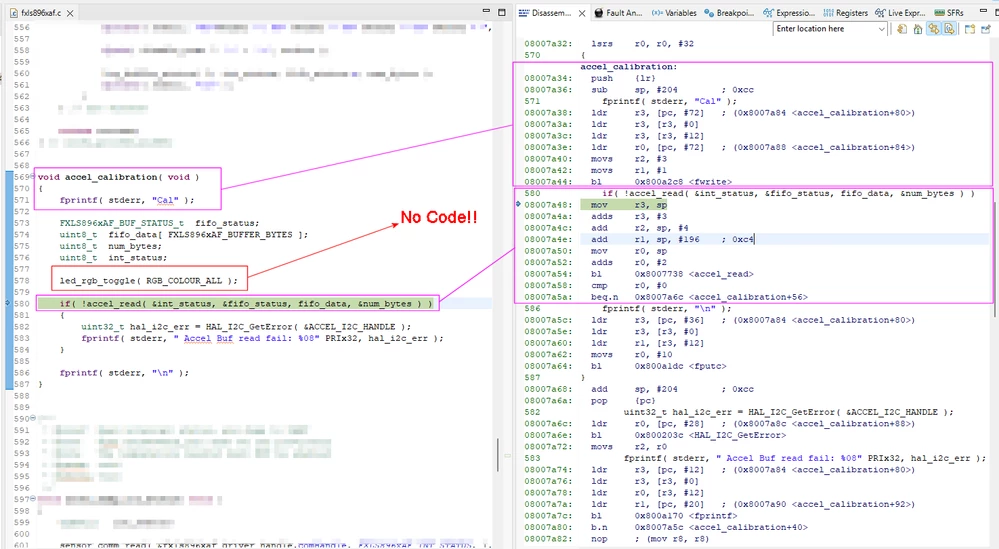
There is no code generated for the led_rgb_toggle() call here:
AndrewNeil_0-1751021380876.png

led_rgb_toggle() is an inline function:

static inline void led_rgb_toggle( GPIO_PinState r_state, GPIO_PinState g_state, GPIO_PinState b_state )
{
#if defined PROJECT_WITH_RGB_LEDS
 if( r_state ) HAL_GPIO_TogglePin( LED_R_GPIO_Port, LED_R_Pin );
 if( g_state ) HAL_GPIO_TogglePin( LED_G_GPIO_Port, LED_G_Pin );
 if( b_state ) HAL_GPIO_TogglePin( LED_B_GPIO_Port, LED_B_Pin );
#endif
}


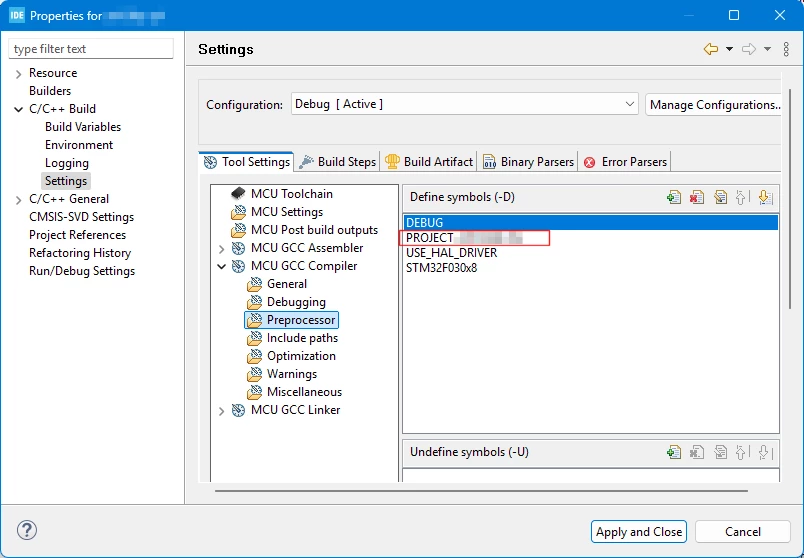
PROJECT_WITH_RGB_LEDS is defined in the Project defines (name has been changed for confidentiality):
AndrewNeil_2-1751022078656.png


It is working in other places.

Why would there be no code generated here?


This is CubeIDE v1.13.0 on Win 11

There are no build errors or warnings.

Best answer by Andrew Neil

It was the Optimiser:

Turns out my definition of RGB_COLOUR_ALL was wrong, and actually equated to "none".

So the optimiser spotted that the call did nothing - and left it out!

As it should.


@Andrew Neil wrote:

It is working in other places..


Actually, it wasn't:

I had tried setting a breakpoint in led_rgb_toggle(), and it seemed that breakpoint was being hit.

What I hadn't noticed was that the place the breakpoint actually hit wasn't in led_rgb_toggle() - it was in another nearby inline function, with a similar name.

In fact, led_rgb_toggle() was not being used anywhere else in the Project.

So another misdirection by the Optimiser.


Optimisation level was -Og.

3 replies

Andrew Neil
Andrew NeilAuthorBest answer
Super User
June 27, 2025

It was the Optimiser:

Turns out my definition of RGB_COLOUR_ALL was wrong, and actually equated to "none".

So the optimiser spotted that the call did nothing - and left it out!

As it should.


@Andrew Neil wrote:

It is working in other places..


Actually, it wasn't:

I had tried setting a breakpoint in led_rgb_toggle(), and it seemed that breakpoint was being hit.

What I hadn't noticed was that the place the breakpoint actually hit wasn't in led_rgb_toggle() - it was in another nearby inline function, with a similar name.

In fact, led_rgb_toggle() was not being used anywhere else in the Project.

So another misdirection by the Optimiser.


Optimisation level was -Og.

A complex system that works is invariably found to have evolved from a simple system that worked.A complex system designed from scratch never works and cannot be patched up to make it work.
waclawek.jan
Super User
June 28, 2025

Sometimes one would wish the compiler/optimizer gives a warning about superficial/omitted code (it sometimes does about omitted variables).

But then, too many warnings lead users to ignore them/switch them off, so it's hard to strike a good compromise.

JW

Andrew Neil
Super User
June 28, 2025

Indeed.


But I do think the optimiser could communicate/cooperate better with the debugger - so the debugger (better) understands what the optimiser has done.


eg, not allowing you to set a breakpoint on code that doesn't exist - or, at least, warning when you do.


Especially when the place it does actually put the breakpoint is in an entirely different function.


Though, to be fair, I should have noticed that the breakpoint was actually happening in an entirely different function!

A complex system that works is invariably found to have evolved from a simple system that worked.A complex system designed from scratch never works and cannot be patched up to make it work.
waclawek.jan
Super User
June 30, 2025

> could

Sure.

gcc/gdb are open source, you are free to contribute...  ;)

Some 50 years ago, Donald Knuth wrote an article, Structured Programming with go to Statements. It's obviously a (rather lengthy) essay inspired by the famous Dijkstra article with the even more famous Wirth title and as such not that much important; but it contains a very interesting and a slightly tangential chapter titled Program Manipulation Systems. In it, Knuth describes a hypothetical programming environment, which allows the programmer to see "online" the output of optimization and direct the optimizer interactively. He says there: As I say, this idea certainly isn't my own; it is so exciting I hope that  everyone soon becomes aware of its possibilities. We know what came of it.

The reason is, that writing a basic compiler or interpreter to a new language is relatively easy, whereas writing and *maintaining* an optimizer and its environment (i.e. a related debugger and a "language" to convey information between them, dwarf in case of gcc/gdb) is several orders of magnitude harder; so the enthusiastic youth still prefers to invent another new and shiny language (rust, cough cough) to the tiresome and usually publicly unacknowledged hard work.

JW