

SPC570 CAN outputs bad frame, independent of frame parameters
Hello,
I am currently trying to transmit CAN frames from my SPC570S-DISP board. The board is connected to a verified working CAN node that is expecting frames at 500 kbps. I am able to write to the CAN buffers and get the CAN core to transmit, but it transmits the same nonsensical frame regardless of the input parameters (data, ID, RTR, IDE, SRR, length).
To send these frames, I configure the CAN core to the timing settings I need, then I configure a TX and RX MB, then I write the data and ID to a TX MB, then I set the TX MB code to 0x0C to initiate a transmission. I then await for the TX MB code to return to 0x08, which never happens. I observe the following frame on my scope, repeated every 4 ms or so:
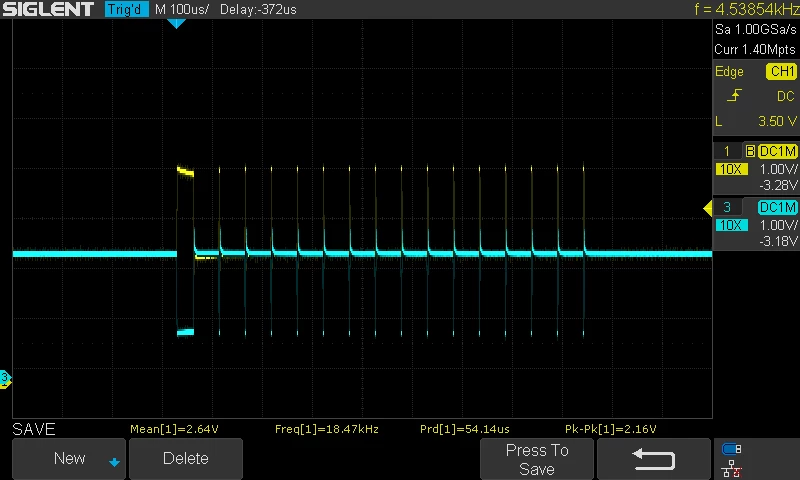
The bit widths are as expected: multiples of 2 us. The first dominant section is 17 bits long, followed by repeated patterns of 25 bits recessive and 1 bit dominant. No matter what settings I put into the TX MB, the result is the same. What additional settings need to be set for the transmission to go through correctly? My source code follows:
#include "main.h"

int main(void)
{

 // Clock init from SPC5Studio
 clock_init();

 // Pin D9: CAN 0 RX
 SIUL2.MSCR_MUX[512-512].R = 0x01; // Input mux to FlexCAN0-RX

 // Pin D10: CAN 0 TX
 SIUL2.MSCR_IO[PD10].R = IO_SSS(0x01); // Output mux from FlexCAN0-TX
 SIUL2.MSCR_IO[PD10].B.OERC = 0x03; // Set output strength to very strong
 SIUL2.MSCR_IO[PD10].B.ODC = 0x02; // Enable push-pull output

 // Init interrupt vector table (no interrupts are used in this program)
 INTC_IACKR = (uint32_t)_vectors;

 irq_disable();

 SPC5_FLEXCAN0_ENABLE_CLOCK();
 FLEXCAN_0.CTRL.B.CLK_SRC = 0x01; // Bus clock (40 MHz) straight from xtal
 for (int i = 0; i < 32; i++)
 {
 FLEXCAN_0.MB[i].MB_CS.R = 0; // Clear all message buffers
 }
 FLEXCAN_0.MCR.B.MDIS = 0x00; // Enable module
 FLEXCAN_0.MCR.B.SRX_DIS = 0x01; // Disable self-receive
 FLEXCAN_0.MCR.B.MAXMB = 0x1F; // 32 max message buffers

 FLEXCAN_0.CTRL.B.PRESDIV = 0x03; // Clock prescaler
 FLEXCAN_0.CTRL.B.PROPSEG = 0x05; // Propagation segment
 FLEXCAN_0.CTRL.B.PSEG1 = 0x07; // Phase segment 1
 FLEXCAN_0.CTRL.B.PSEG2 = 0x04; // Phase segment 1
 FLEXCAN_0.CTRL.B.RJW = 0x01; // Resync jump width

 FLEXCAN_0.RXGMASK.R = 0x00000000; // Global mask: accept all frames

 FLEXCAN_0.MB[15].MB_CS.B.CODE = 0X04; // Enable a RX message buffer
 FLEXCAN_0.MB[14].MB_CS.B.CODE = 0x08; // Enable a TX message buffer

 FLEXCAN_0.MCR.B.HALT = 0x00; // Take out of freeze mode

 irq_enable();


 while(true)
 {
 irq_disable();
 FLEXCAN_0.MB[14].MB_CS.B.CODE = 0x08; // Deactivate message buffer, just in case
 FLEXCAN_0.MB[14].MB_ID.R = 0x02020202; // Set ID
 FLEXCAN_0.MB[14].MB_DATAH.R = 0x12345678; // Set data
 FLEXCAN_0.MB[14].MB_DATAL.R = 0x9ABCDEF0; // Set data
 FLEXCAN_0.MB[14].MB_CS.R = 0x0C680000; // SRR=1, IDE=1, LENGTH=8, start tx (CODE=C)
 irq_enable();
 while (FLEXCAN_0.MB[14].MB_CS.B.CODE != 0x08); // Await tx end
 }
}
When I use the example code provided with spc5studio, I observe the same results.
Thank you for your insight!
Anton