
SYun.4
Associate
December 9, 2022
Question

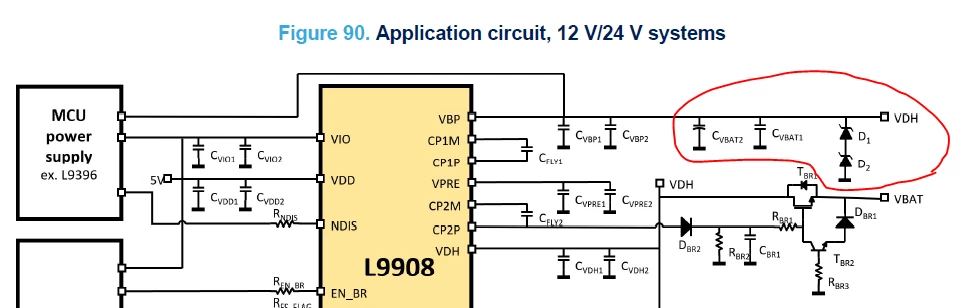
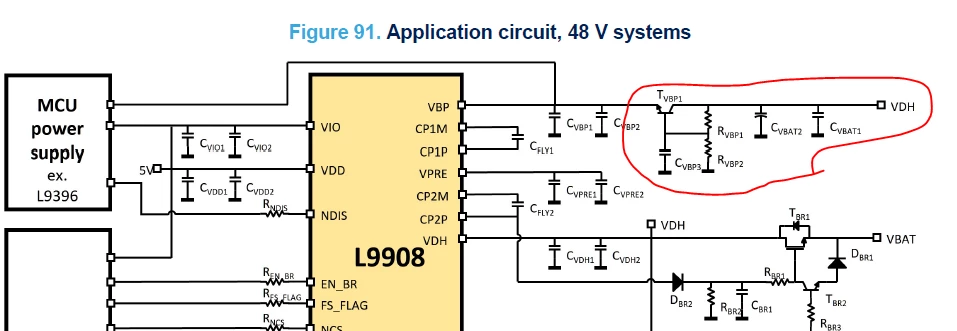
The circuit in the figure below is L9908 Application Circuit (Datasheet page.136, page 137). The VBP input circuits of the 12/24V system and the 48V system are different. Please explain why the circuit is different.
  • December 9, 2022
  • 2 replies
  • 2017 views

0693W00000WKcVUQA1.png0693W00000WKcVjQAL.png

This topic has been closed for replies.

2 replies

Peter BENSCH
Technical Moderator
December 9, 2022

Well, the voltage at VBP should not exceed 36V, so the 48V there must be reduced. This could be done with a voltage regulator, however the variant shown in fig 91 with npn BJT is able to generate VBP proportional to the 48V, so the undervoltage detection is more feasible.

Such a transistor is not necessary for 12/24V applications shown in fig 90, where TVS are still used for limiting voltage spikes to be on the safe side.

Does it answer your question?

Regards

/Peter

SYun.4
SYun.4Author
Associate
December 12, 2022

Thank you for your answer.

Maximum Voltage of my motor driver is 36V. ​

According to your answer, should I design the VBP circuit referring to Fig90.

Peter BENSCH
Technical Moderator
December 12, 2022

Well, the only difference between fig. 90 and 91 is the voltage divider Rvbp1, Rvbp2, Cvbp3 with amplifier Tvbp1 and the missing TVS D1 and D2. The rest of the circuit is exactly identical.

Now it depends on your conditions of the motor voltage whether you can be 100% sure that it does not exceed 36V.

There are also the two voltage limits VBP in the data sheet: extended voltage range 1 and 2, but they are only valid for certain time conditions, so you cannot use them for continuous operation. In this respect, I would recommend to use the circuit according to fig. 90 for continuous operation <=36V, but if this cannot be guaranteed and the voltage can also be higher, then the circuit according to fig. 91 with Tvb1 +R/C.

Regards

/Peter
