
Problems with Cube AI Project
Hello,
I am working on a Human Activity Recognition model with a STMU585CIU6 using Cube AI. In summary, my model takes accelerometer data from my lsm6dsox sensor, and use a frame of 2s of sampling (for ODR 104Hz, it takes 208 samples) as input for the network, which return a prediction among 4 different classes.
After struggling for some time to use the generated functions in my main.c, I managed to perform the inference, but not as I expected. I reached a point where I'm not being able to identify and solve the problem.
I left my board on the desk to run some inferences, and as you can see in the image, the prediction values are the same for all the classes.
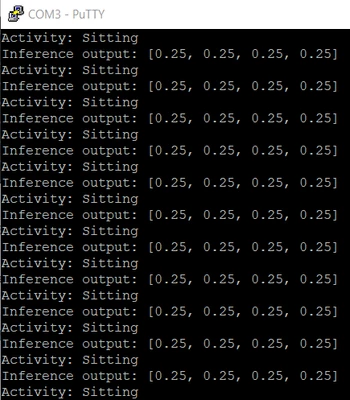
I would really appreciate if someone could help me to identify what could be possibly wrong. I am mostly suspicious about the network weights/parameters initialization, but I can't really figure it out. Here is an adapted snippet of my main.c:
ai_u8 activations[AI_NETWORK_DATA_ACTIVATIONS_SIZE];
ai_u8 weights[AI_NETWORK_DATA_WEIGHTS_SIZE];
ai_float in_data[AI_NETWORK_IN_1_SIZE];
ai_float out_data[AI_NETWORK_OUT_1_SIZE];
/* AI buffer IO handlers */
ai_buffer *ai_input;
ai_buffer *ai_output;
int main(void) {
HAL_Init();
MX_GPIO_Init();
MX_ICACHE_Init();
MX_CRC_Init();
MX_I2C1_Init();
MX_USART3_UART_Init();
stmdev_ctx_t dev_ctx;
uint8_t dummy;
/* Initialize mems driver interface */
dev_ctx.write_reg = platform_write;
dev_ctx.read_reg = platform_read;
dev_ctx.mdelay = platform_delay;
dev_ctx.handle = &hi2c1;
ai_handle network = AI_HANDLE_NULL;
ai_error err;
ai_network_report report;
/** @brief Initialize network */
const ai_handle acts[] = { activations };
const ai_handle wgts[] = { weights };
err = ai_network_create_and_init(&network, acts, wgts);
if (err.type != AI_ERROR_NONE) {
printf("ai init_and_create error\n");
return -1;
}
/** @brief {optional} for debug/log purpose */
if (ai_network_get_report(network, &report) != true) {
printf("ai get report error\n");
return -1;
}
printf("Model name : %s\r\n", report.model_name);
printf("Model signature : %s\r\n", report.model_signature);
ai_input = &report.inputs[0];
ai_output = &report.outputs[0];
printf("input[0] : (%d, %d, %d)\r\n", AI_BUFFER_SHAPE_ELEM(ai_input, AI_SHAPE_HEIGHT),
AI_BUFFER_SHAPE_ELEM(ai_input, AI_SHAPE_WIDTH),
AI_BUFFER_SHAPE_ELEM(ai_input, AI_SHAPE_CHANNEL));
printf("output[0] : (%d, %d, %d)\r\n", AI_BUFFER_SHAPE_ELEM(ai_output, AI_SHAPE_HEIGHT),
AI_BUFFER_SHAPE_ELEM(ai_output, AI_SHAPE_WIDTH),
AI_BUFFER_SHAPE_ELEM(ai_output, AI_SHAPE_CHANNEL));
int ret = 1;
ret = lsm6dsox_device_id_get(&dev_ctx, &dummy);
lsm6dsox_xl_data_rate_set(&dev_ctx, LSM6DSOX_XL_ODR_104Hz);
lsm6dsox_xl_full_scale_set(&dev_ctx, LSM6DSOX_4g);
while (1) {
/* Read accelerometer data */
lsm6dsox_axis3bit16_t data_raw_acceleration;
float acceleration_g[3];
const float sensitivity_a = 0.122f / 1000.0f; // 0.122 mg/LSB converted to g/LSB
/** @brief Fill input buffer with acceleration/gyroscope values*/
int bufIdx = 0;
while (bufIdx < AI_NETWORK_IN_1_SIZE) {
uint8_t regXL = 0;
lsm6dsox_xl_flag_data_ready_get(&dev_ctx, ®XL);
if (regXL) {
lsm6dsox_acceleration_raw_get(&dev_ctx, data_raw_acceleration.i16bit);
/* int16 -> float conversion */
acceleration_g[0] = data_raw_acceleration.i16bit[0] * sensitivity_a;
acceleration_g[1] = data_raw_acceleration.i16bit[1] * sensitivity_a;
acceleration_g[2] = data_raw_acceleration.i16bit[2] * sensitivity_a;
in_data[bufIdx] = acceleration_g[0];
in_data[bufIdx + 1] = acceleration_g[1];
in_data[bufIdx + 2] = acceleration_g[2];
bufIdx += 3;
}
}
/** @brief Perform inference */
ai_i32 n_batch;
/** @brief Set input/output buffer addresses */
ai_input[0].data = AI_HANDLE_PTR(in_data);
ai_output[0].data = AI_HANDLE_PTR(out_data);
ai_input[0].format = AI_BUFFER_FORMAT_FLOAT;
ai_output[0].format = AI_BUFFER_FORMAT_FLOAT;
/** @brief Perform the inference */
n_batch = ai_network_run(network, &ai_input[0], &ai_output[0]);
if (n_batch != 1) {
err = ai_network_get_error(network);
printf("ai run error %d, %d\n", err.type, err.code);
return -1;
}
/** @brief Post-process the output results/predictions */
printf("Inference output: [");
float maxValue = -1.0f; // update the highest probability
int maxIndex = -1;
/** @brief AI_NETWORK_OUT_1_SIZE = 4 */
for (int i = 0; i < AI_NETWORK_OUT_1_SIZE; i++) {
float value;
value = out_data[i];
printf("%.2f", value);
if (i < AI_NETWORK_OUT_1_SIZE - 1) printf(", ");
if (value > maxValue) {
maxValue = value;
maxIndex = i;
}
}
printf("]\r\n");
// Print activity with highest probability
const char* activities[AI_NETWORK_OUT_1_SIZE] = {"Sitting", "Stairs", "Standing", "Walking"};
if (maxIndex != -1) printf("Activity: %s\r\n", activities[maxIndex]);
}
}
I would really appreciate if someone could help me solve this problem. Thanks!