Associate III
November 8, 2024
Solved

VL53L0X enclosure/cover?

  • November 8, 2024
  • 1 reply
  • 2636 views

Hi,


I've been developing a simple water level sensor with the VL53L0X and i'm having trouble putting it into the enclosure that is protected from the moisture. I've been mainly experimenting now, but one of my problems is mounting the sensor behind glass or something like that. I'm happy to glue that on over a hole or something, but wanted to figure out what works.

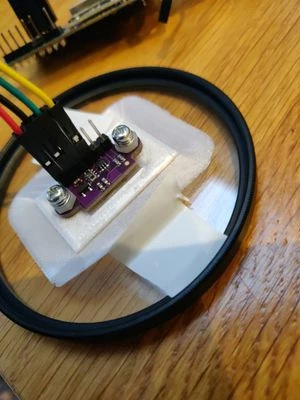
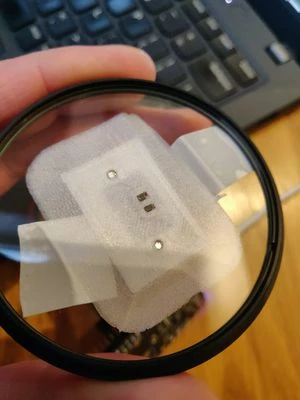
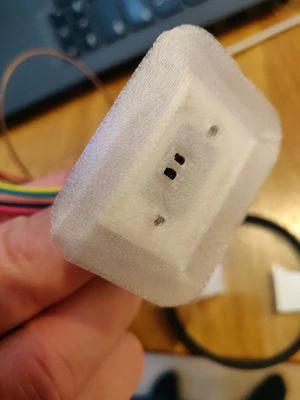
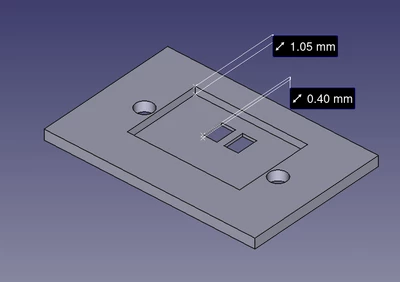
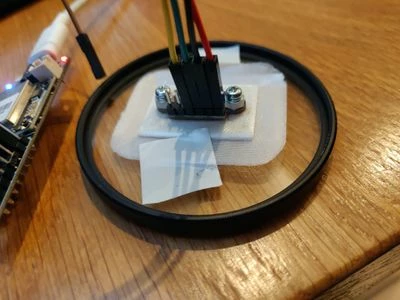
I've followed some of the video's around crosstalk and have made a 3d print that should help (please see photos).

The sensor works as expected in the 3d printed element, but doesn't work properly when i add the glass lens filter. I took the lens filter after trying a few other things, but not being great at materials, i wanted to be sure, so i tested with this filter from one of my camera lenses.
I think i'm doing everything correctly, albeit not professionally, but can't get it to work.

I would be greatful if somebody could point out some issues that i might have made.
WhatsApp Image 2024-11-08 at 07.55.19(3).jpeg

WhatsApp Image 2024-11-08 at 07.55.19(2).jpeg

WhatsApp Image 2024-11-08 at 07.55.19(1).jpeg

WhatsApp Image 2024-11-08 at 07.55.19.jpeg


cyclops_0-1731052732907.png


Best answer by John E KVAM

The VL53L4CX would be a fine choice if the CD distance is too short.

3D printer plastic is problematic - It's basically transparent to 940nm. One really has to paint it. 

But is there any way you can simply shove the sensor up against the glass? That's one way of cutting down the crosstalk. Or you could make that gasket out of compressible black 'rubber'. (Actually, it's carbon infused silicon) 

That VCSEL laser creates enough light it can bounce off a wall at 6meters and still return enough photons to get a range. As the light dissipates as a square of the distance you can imagine how much light is hitting around your structure.

That's why your semi-transparent frame didn't work. 

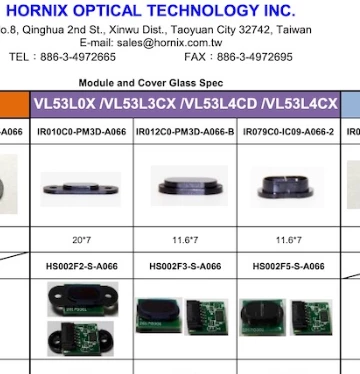
Consider buying the oval coverglass from Hornix

The one on the right has your barrier. you have to cut an oval in your plastic and glue the coverglass to it. 

It completely eliminates crosstalk.

JohnEKVAM_0-1731338834401.png

ST and Hornix are not associated, although we did jointly design that coverglass.  That bit has two separate bits of transparent 'glass' separated by an opaque barrier and surround. 

You could consider building something like that. 

- john 


1 reply

Visitor II
November 8, 2024

If the sensor performs well without any protective layer, it confirms that the issue is likely due to interference from the glass.

cyclopsAuthor
Associate III
November 8, 2024

Thanks.


I understand the conclusion that you make, and also agree with it. However, i find it hard to understand why a UV filter used for a photo camera lens wouldn't be sufficient. That's why i'm wondering what i'm doing wrong. Should i just try other glass/acrylic? I've tried a few things here at home, but i'm quite sceptical that other things will work.

John E KVAM
ST Employee
November 8, 2024

If you want to check water level, I want you to do some different things. 

1) Use the VL53L4CD. It's cheaper and newer, but most importantly it has an 18 degee Field of View. With water you want only those photons that hit perpendicularly to the water. So 18 degrees is better. 

Same footprint, so all your work is presevered.

2) Paint that plastic black.  Photons that hit white bounce. And most plastics are translucent at best. Use a flat black paint. Rust-o-lium makes one with primer in it - and it works on plastic

3) Make the bottom of your container as non-reflective as possible. I put a black shelf under my clear tanks. 

- john