
VL53L8CX: measurements on flat ground: large variation between cell
Hello,
I have a question about the distance values returned by the VL53L8CX across the 16 cells in 4*4 mode.
I performed repeated measurement with my sensor facing the ground, both with and without a glass cover.
I noticed significant discrepancies between the distance values of the different cells, even though the target is a flat ground plane.
By repeating the measurements and plotting the 16 cell distances as bar graphs, I observed a consistent pattern.
Graphs 1 and 2 were taken consecutively at 30 Hz.
Graph 3 was taken with the sensor farther from the ground, while still facing it.
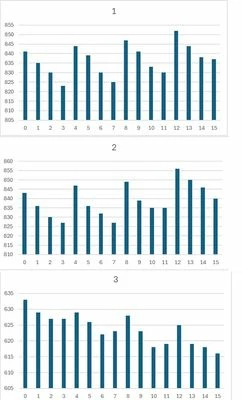
From this pattern, it seems clear that the sensor was not perfectly parallel to the ground plane during the measurements. However, I am surprised by the magnitude of the difference between the highest and lowest cells.
I have read in several posts that the VL53L8CX may return the perpendicular distance to the target plane rather than the radial distance along each cell’s line of sight. I would like to better understand how the reported distance is actually computed.
My questions are:
-
Does each cell return the radial distance along its own optical axis, or is some geometric compensation already applied internally?
-
If the sensor is slightly pitched or rolled relative to a flat plane, how should the returned values be interpreted?
-
If I want to compute the true perpendicular distance from the sensor to the plane, what is the correct way to do it from the VL53L8CX measurements?
Any clarification on the internal processing of the distance output would be very helpful.
Thank you for your help.
Thomas