
Associate
March 20, 2026
Question

LSM6DSV16X SFLP Performance

  • March 20, 2026
  • 2 replies
  • 389 views

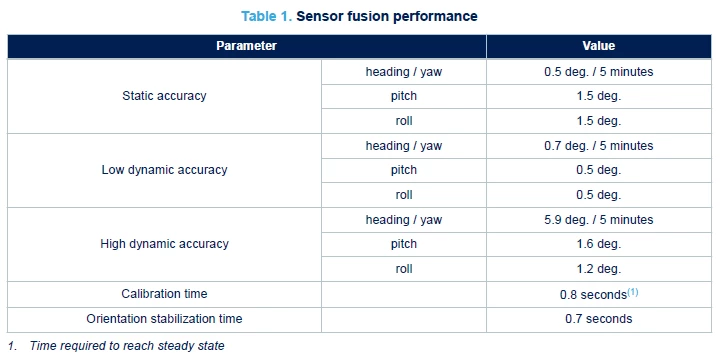
In LSM6DSV16X DS13510-Rev 4 Page 8, Table lists sensor fusion performance:
 

SFLP.png

Question 1: are these values guaranteed over temperature and all angles, or at a particular angle and at room temperature?

Question 2: without a magnetometer or GNSS heading input, what is meant by heading/yaw accuracy? Is it a drift value (over 5 minutes) from whatever value it is given at the beginning of 5 minutes?

Thank you.

2 replies

KWine
Senior
April 12, 2026

With accel and gyro only, yaw/heading is relative only and subject to drift. After any significant motion the heading will change and become essentially arbitrary. It really cannot be relied on for absolute orientation estimation. However, the roll and pitch are likely to be as accurate as quoted or better (~1 degree) with proper accel/gyro calibration and repeatable even after significant motion, which is still very useful.

Associate II
April 12, 2026

The Holy Grail is being able to tell where you are in 3 dimensional space, but that is near impossible below cm accuracy over a short or long time.  The problem is the absolute zero point and hopefully it is not moving.  

All the methods suffer from something.  

I am talking about real human sized objects. 

Plus humans make mistakes in understanding the results.  


KWine
Senior
April 12, 2026

Two related problems: accurate 1) absolute orientation estimation and 2) dead reckoning navigation. Both are hard with cheap sensors in small form factors at ultra-low power, but this has been our goal for ten years.

Both require accurate sensors. For us it is the MMC5983MA magnetometer and LSM6DSM accel/gyro, although the LSM6DSV is even better. The LPS22DF baro allows ~10 cm accurate relative height estimation, great for tracking stair climbing, etc. Such a 10 DoF sensor suite should be enough for accurate AHRS and navigation in a perfect world!

By far the most important ingredient is proper calibration for bias, orthonomality erros, cross-axis, cross-sensor alignment errors, scale errors, etc. We have developed proprietary methods for this purpose with some success.

We have achieved the first of our goals with the USFSMAX Module, with which we routinely measure << 0.5 degree absolute heading accuracy.

As for dead reckoning, we would be thrilled with 1 meter accuracy over an hour. Dead reckoning is useful for GNSS gaps in cars, but it is also useful for gaps in magnetic field with no GNSS due to magnetic interference or anomalies. In this case, dead reckoning accuracy is determined mostly by gyro drift. Unfortunately, LSM6DSV gyro drift is not small enough for this task.

One solution is an external 3 ppm TCXO input to the ICM42688 accel/gyro to minimize gyro drift. Reducing the internal clock error from ~50,000 ppm to ~3 ppm means the gyro drift is greatly reduced, and dead reckoning navigation without GNSS or a magnetometer at 1 meter accuracy becomes possible, we just don't know yet for how long.

Associate II
April 13, 2026

We use a tilt meter developed by a small company as part of an accelerometer.   We duplicate some features with ST accelerometers.  

The tilt meter will provide an accuracy

draw a circle of 50 m radius,  put down a 2d nail on the circle, enscribe 100 lines on the head of the nail and the tilt meter will tell you from the center which line it is pointing at, according to a simple calculation. 

But we do large bridges, where tilt is an issue.  See picture. 

So we deal with different problems.  The critical issue is construction damage and large vehicles.