
Associate
December 19, 2025
Question

ST Micro M41T11M6 RTC Drift Issue

  • December 19, 2025
  • 7 replies
  • 760 views

I’m currently having an issue w/ ST Micro P/N M4T11M6 RTC w/ clock drift. Specifically, I’ve performed verification testing on 4 units to this point and I’m seeing over 8 seconds/day (Extrapolating to a value of 4.25 minutes/month) of drift from NIST time. The RTC clock calibration register only allows for a maximum of -2.75 minutes/month which isn’t enough range to allow for the drift observed to be calibrated out. This makes me question my PCA schematic and perhaps layout design. The XTAL used meets the required 32.768 KHz XTAL w/ 12.5 pF load capacitance. I have cut-away the GND plane under the XTAL as well (However, it turns-out the +3.3V plane isn’t cut-away, but is in the middle of the 8 layer stack-up and the RTC and XTAL are on the top layer). 
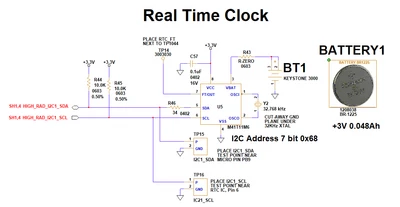
MattBerberich_2-1766163555169.png


What am I potentially doing wrong that would cause such a drift issue?

We are in the middle of verification on a high-priority project w/ a tight schedule, so your urgency on this matter is truly appreciated. Thanks in advance for your assistance w/ resolving this RTC issue.

7 replies

AScha.3
Super User
December 19, 2025

Do you use recommended crystal ?

AScha3_0-1766167728875.png

+

>I’m seeing over 8 seconds/day

What then ? crystal/clock is to fast or too slow ?

"If you feel a post has answered your question, please click ""Accept as Solution""."
Associate
January 30, 2026

AScha.3, 

I'm using ST Micro P/N M41T11M6F which is the SOIC8.  The datasheet specifically states that the load capacitances are integrated internal to the IC.  For the XTAL, I'm using Citizen P/N CM1610H32768DZFT which is a 12.5pF 32.768 KHz XTAL meeting the specification requirements in the M41T11M6F datasheet.  Do you know if the specified 35ppm tolerance in the M41T11M6F specification includes the XTAL or do I need to stack the PPM of the XTAL such that the total PPM will be 35PPM + XTAL PPM (20PPM for what I'm using) = 55 PPM???  Just trying to understand why I'm seeing > 8 seconds/day RTC drift.  I've tested 4 PCAs and unpowered, I'm seeing 8.7, 8.1, 8.2, and 8.4 seconds/day drift. I've attached both the XTAL I'm using and the M41T11M6F datasheet I'm referencing on page 20.

MattBerberich_0-1769781919926.png


AScha.3
Super User
January 30, 2026

Still no info:

>I’m seeing over 8 seconds/day

What then ? crystal/clock is too fast or too slow ?

+

Did you try other crystals (types) ?

+

Did you try setting the calibration/correction ?

"If you feel a post has answered your question, please click ""Accept as Solution""."
Associate
December 19, 2025

Yes, if you mean a 32.768 KHz XTAL w/ 12.5 pF load capacitance. I attached the XTAL datasheet for the XTAL I'm using in this design.

Peter BENSCH
Technical Moderator
January 30, 2026

@MattBerberich

You haven't answered the second question of @AScha.3, yet.

In addition, you mentioned the crystal, but what load capacitors do you have on pins 1 and 2?

Regards
/Peter

Visitor II
January 30, 2026

The too high frequency suggests crystal capacitance is too low. The data sheet Table 8 is ambiguous when it says in note 1 that capacitance is external for SOIC8, but note 3 says provided internally. And, @PeterBensch asks if you have external caps. Perhaps he can clarify.

Its a bit of delicate soldering, but  if no Bensch response I suggest adding increasingly larger external caps starting at about 3 pf until you get the needed accuracy.

Associate
January 30, 2026

I don't have external capacitors based on the datasheet information.  Again, I'm using the SOIC8 package.  The datasheet says that capacitors are externally supplied for the SO8 package.  Also, the datasheet includes no information for calculating and populating a C1 & C2 external load capacitors.  In my experience w/ NXP, ST MICRO MCUs, if load capacitors are required, there's a section on them w/ formulas provided for calculating the values and layout requirements, ect.  This doesn't exist in the datasheet for the M41T11M6F, which also reenforces the idea that they're not needed as they're integrated within the IC so long as you're using a 12.5pF XTAL.  I am using a 12.5pF XTAL.  See my layout below.  I have very little stray C as the XTAL is connected straight to the pins w/ close 4 mil traces.

If I solder in load caps as you suggest, to what GND would I attach on the right side?  There's nothing there so I would need to add a lead wire and add additional stray C on one side vs the other.

MattBerberich_0-1769796464361.png


TDK
Super User
January 30, 2026

That sure looks like the SO8 package to me.

> M4T11M6

This is an SO8 package part number.

Am I missing something? I bet the load caps are not integrated. Datasheet could be improved for clarity.

I don’t see a soic8 package in the datasheet.

TDK_0-1769799989803.jpeg


"If you feel a post has answered your question, please click ""Accept as Solution""."
AScha.3
Super User
January 30, 2026

AScha3_0-1769801094835.png


"If you feel a post has answered your question, please click ""Accept as Solution""."
Chris21
Associate II
January 30, 2026

Is your electronics temperature 25°C ±5°C?  Outside this range your crystal specification is not +/- 20 ppm. 

Associate
January 30, 2026

Yes.  The testing performed has been performed at room temperature (25C).

TDK
Super User
January 30, 2026

To answer the other question, the accuracy of the device before calibration is the same as the accuracy of the crystal. If the crystal is +/- 20 ppm, that’s what the device is.

The datasheet reads as if load caps are internal to me. I can’t explain why you do not get the accuracy expected. Most likely explanation is the crystal is not as accurate as expected. Soldering can affect frequency.

You also would not be the first person to receive a crystal that didn’t meet specs.

"If you feel a post has answered your question, please click ""Accept as Solution""."
Associate
January 30, 2026

I get what you're saying, but I've tested 4 PCAs to this point at room temperature and all show > 8 second/day drift in an unpowered state (Meaning powered only by 3V BR-1225 battery).  When powered by +3.3V, I get similar results w/ the best being around 5-6 seconds/day.  If it was a one-off XTAL, I would say okay, but this would have to be a lot to lot issue for the part or possibly the PCA house screwed-up and over-temped the ICs during SMT process.  Anyways, thanks for the reply and explaining the expected PPM for the RTC + XTAL scenario.