

DanielGouvea
Associate
March 17, 2026
Solved

TDA7293V Mute/ST-BY Control Range for High Voltage Design

  • March 17, 2026
  • 1 reply
  • 110 views

Dear Support Team,
I am planning to implement a circuit based on the TDA7293V. In this design, the IC will remain powered on, so I intend to use the circuit shown in Figure 6 (Single signal standby/mute control circuit) to prevent 'pop' noise. Given that my supply rails are ±44V (+Vs = +44V and -Vs = -44V), what is the recommended voltage range for the MUTE/ST-BY signal to ensure reliable operation?
Thanks in advance!! With warm regards, Daniel.
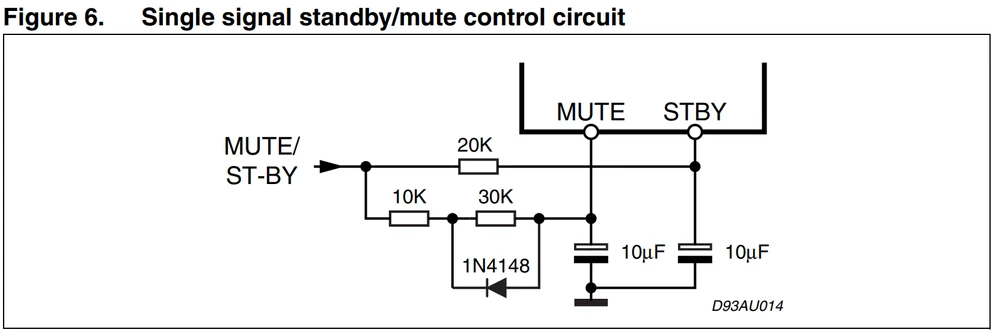
 

MUTE_STDBY.png


Best answer by Peter BENSCH

STBY and MUTE voltages of up to (+Vs)+|(-Vs)| can be applied, in your case 88V (referenced to Vs-) or 44V (referenced to GND).

However, since both inputs switch between a maximum of 1.5V (switch-on threshold) and a minimum of 3.5V (switch-off threshold), a control voltage referenced to Pin 1, typically GND, close to 0V is appropriate for the activated state and 4...5V for the deactivated state.

Does it answer your question?

Regards
/Peter

1 reply

Peter BENSCH
Peter BENSCHBest answer
Technical Moderator
March 19, 2026

STBY and MUTE voltages of up to (+Vs)+|(-Vs)| can be applied, in your case 88V (referenced to Vs-) or 44V (referenced to GND).

However, since both inputs switch between a maximum of 1.5V (switch-on threshold) and a minimum of 3.5V (switch-off threshold), a control voltage referenced to Pin 1, typically GND, close to 0V is appropriate for the activated state and 4...5V for the deactivated state.

Does it answer your question?

Regards
/Peter

DanielGouvea
Associate
March 19, 2026

Yes, that perfectly answers my question! Thank you very much for the clear explanation.

It is great to know that the pins can safely handle the high voltage if needed, but I will configure my voltage divider to provide around 4.7V to 5V for the deactivated state and 0V for the activated state, exactly as you recommended.

I really appreciate your help!