
STM32F303CB - Low DC resistance between VDD and VSS (electrical short circuit) due to unknown reason
Hi,
I have a setup on a PCB that resembles the following.
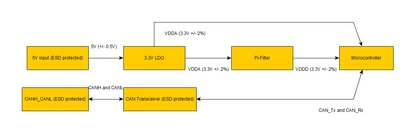
The 5V supply is pretty stable (0.5V tolerance) and the 3.3V LDO delivers a low-noise power to the microcontroller. The µC communicates with the outside world through CAN (transceiver present). There are already some precautionary measures present on this setup, as follows.
- All the lines (power and CAN) are ESD protected (IEC61000−4−2 standard level-4.
- Setup is completely coated (conformal coating on PCB). Hence, any physical contact from outside world will be difficult.
During routine operation, the communication with a sensor system (STM32F303CB on-board) was lost. On further investigation, the following was found.
- Optical examination revealed no bad component. All the active and passive components on the PCB seemed intact. No burning out (or) abrasion on coated areas were found.
- The resistance between 3.3V LDO output and Ground was <2ohms, which was narrowed down to the microcontroller itself.
- The resistance between VDD and VSS pins of the controller were between ~1.9 to ~6 ohms.
Table 1 - DC resistance measurement overview
Test Pin | Resistance against GND (ohms) |
Pin 24 | 1.9 |
Pin 36 | 4.5 |
Pin 48 | 5.9 |
Note - During resistance measurement, the VDD pins were not in contact with the PCB or neighbouring pin (short is indeed "within" the controller).
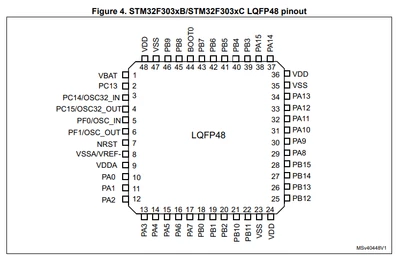
Figure 1 - STM32F303CB pinout
I looked into possible sources and found that through any ESD events directly on uC pin (not through the input connector which is already ESD protected) or any over-voltage event outside the specs can cause the protection diodes within any GPIO to break and make a short circuit. But through several inspection (optical and electrical), I could find no evidence of such an event.
Any ideas on why such a short might occur? If so, is there any other way in which I can find the cause for it?
Thanks!