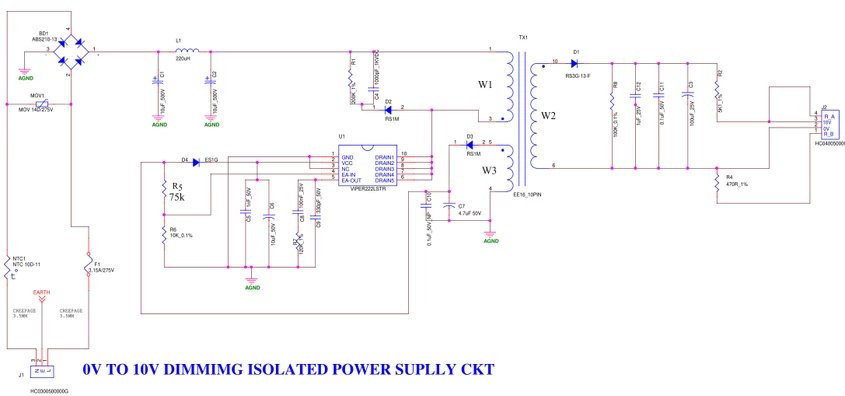
To your question 1:
The behaviour is most likely related to two things:
- the construction of your transformer
- the connected load
Regarding point 1: A flyback controller requires information about the current voltage at the output for precise control. A TL431 or similar is typically used for this purpose, which measures the voltage and reports its value back to pin EA-OUT via an optocoupler, as can be seen in the data sheet, fig 12, for example. Now you do not want to use an optocoupler and have set up a flyback according to data sheet, fig 11. However, you must also take into account that the VIPer222 only sees the voltage of the supply winding and not the output voltage. If you wind the two secondary windings of the transformer in such a way that both are closely intermeshed (e.g. by winding both wires at the same time), you will achieve the maximum possible coupling so that the output voltage can follow the supply voltage in a reasonably acceptable manner.
Regarding point 2: However, all of this only considers the case with a generally constant high load. As soon as the load varies, your output voltage will also fluctuate because the coupling between the first and second secondary winding is not infinitely high.
To your question 2:
In your design, R8 has the value 100k, which at an assumed voltage of 10V allows a current of 100µA to flow, which corresponds to a load of 1mW. This load is far too small for the controller to be able to regulate it sensibly. Now two effects occur:
- Burst mode (see data sheet, section 6.4)
- Pulse skipping (see data sheet, section 6.3)
What you are observing is most likely the pulse skipping mode, because the transformer is not sufficiently discharged during the off-time. You would therefore have to connect a sensible base load to R8 (e.g. 470...560 ohms) in order to avoid the pulse skipping that is usually even audible.
The disadvantage of a primary side flyback converter is precisely this lack of control accuracy due to insufficient coupling, which is why it is used:
- for applications without high demands on the value of the generated voltage, or
- in applications where the flyback is followed by a linear regulator
Hope this helps?
Regards
/Peter