
Associate III
July 7, 2024
Solved

Minimizing Current Consumption in High Voltage Divider Circuit

  • July 7, 2024
  • 7 replies
  • 5248 views

Hello everyone,

I'm working on a circuit for monitoring the bias voltage of a GM tube, which requires a high voltage of 100V. I am currently using a OA1NP22C op-amp configured as a unity-gain buffer to read the divided voltage. To minimize current consumption, I'm considering using a voltage divider with 1GΩ and 12MΩ resistors. However, this configuration still consumes approximately 9.8µA, which is higher than I would like for my low-power application.

Here is a simplified version of my circuit:

100V Bias Voltage (GM Tube)
|
R1 (1GΩ)
|
+----> To OA1NP22C Op-Amp (unity gain buffer) > MCU
|
R2 (12MΩ)
|
GND

My questions are:

  1. How can I further reduce the current consumption of this voltage divider to the nanoampere range?
  2. Would switching out the voltage divider using a transistor be a viable solution? If so, what configuration and components would you recommend for achieving this?
  3. Are there alternative methods or components that could help in significantly reducing the power consumption while maintaining accurate voltage monitoring?

Any insights, suggestions, or examples of similar implementations would be greatly appreciated!

Thank you!


Additional Context:

  • Control Signal: 2.9V from a microcontroller.
  • Power Efficiency: Critical to keep the overall system power consumption as low as possible.

Feel free to ask for further details if needed.
Zaim
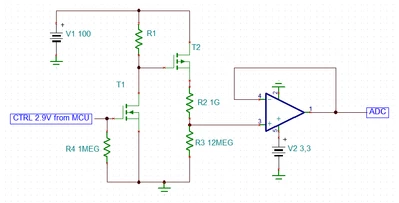
Best answer by Zaim01


You mean a circuit like the one below:

Zaim01_0-1720519054838.png

The issue with this circuit is the leakage of the MOSFET and the current consumption through R1. When increasing the value of R1, the P-MOSFET T1 may not turn off completely, and if R1 is too small, it could draw unnecessary current. Could you please recommend some values based on the schematic above?

Or, if I have misunderstood your point, please clarify.


Thanks in advance,
Zaim
 

7 replies

Peter BENSCH
Technical Moderator
July 7, 2024

Please check your idea again:

  • at 100V at 13Gohms a current of 7.7nA flows, not 9800nA
  • the OA1NP22C will surely be connected to GND, right? What voltage does it then see at his input? What happens then?

It would be better if you could insert schematics as a picture, including the opamp, so that we can make suggestions for improvement.

Regards
/Peter

Zaim01Author
Associate III
July 7, 2024

Hi Peter,


Thank you for your feedback. You are correct about the current calculations.


To clarify, R1 is 1GΩ and R2 is 12MΩ. Please find the schematic below for further reference.


20240707_184405.jpg


Regards,  

Zaim

Zaim01Author
Associate III
July 7, 2024

Hi Again Peter,

Regarding the voltage divider, the mentioned values were just a preliminary idea. The voltage divider network will only be used once a day to check the output voltage is stable, so it should not consume unnecessary current to help preserve the device's battery.

Regards,  

Zaim

AScha.3
Super User
July 7, 2024

Hi,

>How can I further reduce the current consumption of this voltage divider to the nanoampere range?

You are there... 100V/1Gohm = 100nA . (100nA x 100V = 10uW - where you wanna go then ?

+ How much uA needs the cpu and all other circuit ? )


>Would switching out the voltage divider using a transistor be a viable solution?

Yes. But to get lower than 100nA, you only could use a mosfet; but at your 3v3 supply, only few mosfets can work at >100V and be switched with < 3V at the gate - so close to impossible.

"If you feel a post has answered your question, please click ""Accept as Solution""."
Zaim01Author
Associate III
July 7, 2024

Hi AScha.3,

Thank you for your insights, I understand your points exactly. Finding a small MOSFET with a low gate voltage is indeed challenging. Therefore, I still think that the voltage divider solution may be the best for our product. I also realized that I miscalculated the current; it should be 89nA, not 9.8uA.

An important consideration for our product is cost, and as you may know, GΩ resistors are very expensive. Thus, the maximum resistance I can use is 1GΩ. So, the question is: are there any other ways to achieve lower current consumption for this circuit, or should we proceed with the current values?

As I mentioned earlier, I will enable the ADC for this feedback once a day. I was considering completely shutting down the circuit and only powering it when I need to read the values. However, if the switching circuit draws more than 100nA, it might be hard to used, and I might have to use the configuration with the 1GΩ / 12MΩ resistors.

Thank you for your support.

Regards,
Zaim

AScha.3
Super User
July 7, 2024

Hi,

i think, if you really need to measure the voltage, the 1GΩ / 12MΩ resistor is best, simple solution.

All photocouplers (AQVxx series) or mosfet at 100V have 100nA or more leakage current - so useless here.


Just - afaik - most ("professional" ) circuits anyway producing a regulated HV , so there is a point with some divider there, to check the voltage ; if you can access this, it would be the best solution, consuming no extra power.

btw  GM working at only 100V ? typical is 400...700V .

AScha3_0-1720375680468.png

AScha3_1-1720375878761.png


"If you feel a post has answered your question, please click ""Accept as Solution""."
BarryWhit
Lead
July 7, 2024

<removed because OP made it clear he's not a precocious 14 year old playing with fire>

Zaim01Author
Associate III
July 7, 2024

Hi Barry,

Thank you for your concern and valuable insights.

I understand the importance of safety when dealing with high-voltage circuits. Yes, I do have experience designing HV circuits and I did before, and I am also consulting with experts in this field to ensure the design's safety and reliability.

This boost converter is very low power, so the current is minimal. The technique I'm using is called biasing, which is commonly used to bias LCDs, APDs, photodiodes, GM tubes, and more. The circuit is designed with safety in mind, and the PCB will be assembled and insulated with conformal coating.

Using GΩ resistors is still common in medical devices. In the event of a failure, our software algorithms are designed to detect anomalies and immediately shut down the oscillator, effectively closing the high-voltage system.


I appreciate your advice on seeking additional guidance from forums dedicated to HV applications. It's always good to get a wide range of inputs to ensure the design is both effective and safe.

Thank you again for your concern and advice.

Regards,  

Zaim

BarryWhit
Lead
July 7, 2024


Would a N.O. Solid-State Relay (SSR) work in your application instead of a FET? (I've never used one, but it looks like a maybe)

Zaim01Author
Associate III
July 9, 2024

Hi Barry,

Thank you for your suggestion! Using a Solid-State Relay (SSR) could indeed be a viable alternative to using a FET for enabling and disabling the voltage divider in my application. I will get some samples and check their behaviors.

AScha.3
Super User
July 9, 2024

No..i didnt find any, thats even close to the needed off-state current.

Same for the AQVxx opto-mos (solid-state...) , i have some of them here, but also much more off-state current than is needed here.

AScha3_0-1720515067561.png


What you improve, if the off-state current is 0...1uA (depending on temp.), if you have only 100nA to switch off ?

-> useless here.

"If you feel a post has answered your question, please click ""Accept as Solution""."
Lead II
July 9, 2024

Call me old fashioned, but what about using a reed-relay or a permanent magnet relay for a switch? You can switch the high side with no issue since it's isolated. No leakage either. And if it is a latching relay you only need to consume power when switching, not holding. Switching is slower, but if you only need to measure once a day that shouldn't be an issue. You can get 3.3V version or get a 5V (or higher) version and switch it on with a transistor. Low tech is often best.

And what about connecting multiple resistors in series instead of one large value?

There are opamps with an enable pin so you can turn them off when not using them. This would save some power too.

"Kudo posts if you have the same problem and kudo replies if the solution works.Click ""Accept as Solution"" if a reply solved your problem. If no solution was posted please answer with your own."
Zaim01Author
Associate III
July 10, 2024

Hi,

Actually, using a reed relay or permanent magnet relay would be a good option, but the available relays that can handle more than 120V with a 3V coil voltage are either very expensive or too large to fit into my device.

Regarding high-value resistors, you are correct that using multiple resistors in series would be better. However, a single 1GΩ resistor costs about $2, and using multiple resistors in series, such as 2x500MΩ or 4x250MΩ, becomes quite expensive since each resistor costs around $1. Is using a single 1GΩ resistor really that problematic? Is there a way to switch off the voltage divider to allow the use of lower resistance values? Using such high-value resistors might cause issues, or should I stick with using multiple resistors?

I've read in "Op Amps for Everyone" (section 18.6) that it's not recommended to use such high-value resistors. If I could shut down the voltage divider when it's not in use, I could employ resistors with values below 100MΩ. However, I haven't found a suitable solution for this.

Best regards,
Abdurrahman

Lead II
July 10, 2024

@Zaim01 wrote:

the available relays that can handle more than 120V with a 3V coil voltage are either very expensive or too large to fit into my device.

Do you have a 5V or 12V power rail on your PCB? Or only 3.3V? If so you aren't limited by 3.3V only relays.

I don't know how many boards you plan to make, but to me the prices don't seem bad.
This General Purpose Relay  is only $4.43 for 1 piece and $3.84 for 10. It can handle 250VAC. It may be too large for you.  This one is smaller and only $2.03.
This reed relay  is only $3.70. It can handle 200 VAC/ 200 VDC.


I've read in "Op Amps for Everyone" (section 18.6) that it's not recommended to use such high-value resistors.


Use a high input impedance OPAMP, a high input impedance buffer or calibrate your circuit to compensate for the input impedance.


"Kudo posts if you have the same problem and kudo replies if the solution works.Click ""Accept as Solution"" if a reply solved your problem. If no solution was posted please answer with your own."
BarryWhit
Lead
July 9, 2024

@Peter BENSCH , I still can't believe that using such a high resistance in a voltage divider is good practice. Is this really practical? any flux residue, dirt, oily fingerprint or anything really could substantially change the effective resistance of one leg of the divider and make the measurement inaccurate. Would you really expect this to work in a real-life product? even with a conformal coating (I'm assuming it was chosen with this in mind), this seems like a very precarious way to design circuits for the physical world (as opposed to spice). Am I wrong?

AScha.3
Super User
July 9, 2024
"If you feel a post has answered your question, please click ""Accept as Solution""."
BarryWhit
Lead
July 9, 2024

I believe such parts exist, but are they really meant for use as part of a measurement circuit? Do MRI machines, and Tokamaks really measure HV voltage this way? I imagine they use high-power resistors (or chain them in series), but not necessarily such high values.

AScha.3
Super User
July 9, 2024

Even the probes for scope are in Gohm range... (i have some here.) :)

AScha3_0-1720525506586.png

-> 0.8 ... 4 Gohm.

These ARE for measuring...only drawback: cheapest is about 3000 $ .

"If you feel a post has answered your question, please click ""Accept as Solution""."
BarryWhit
Lead
July 9, 2024

@AScha.3 wrote:

Even the probes for scope are in Gohm range... (i have some here.) :)These ARE for measuring...only drawback: cheapest is about 3000 $ .


Very good point (But nothing the 600x difference in the working voltage of those specs vs. OP.  And also wondering how often you're supposed to calibrate them). I wonder what engineering lengths they have to go through to maintain accuracy. Those probes must come in those fancy velvet cases, right? like a wedding ring. They probably don bunny suits and wash them with unicorn tears during final assembly ;)