KMew
Senior III
August 16, 2023
Question

STUSB4710AQ1TR: Clicking Noise and Large Voltage Ripple at No Load

  • August 16, 2023
  • 2 replies
  • 1314 views

Hello,

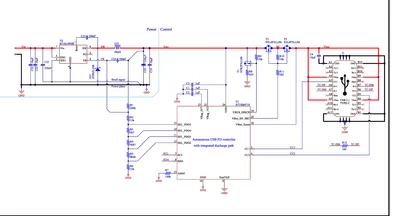
I am using the STUSB4710AQ1TR to charge some USB-C devices at the default 45W. I am operating in a mode that's only charging (no data communication). To do this, I used the recommended application schematic provided in the datasheet. My input voltage (Vin) is a 24V source created by a TI LM5116 (because my input voltage for our system is 48V and the ST1S14PHR cannot handle that high).

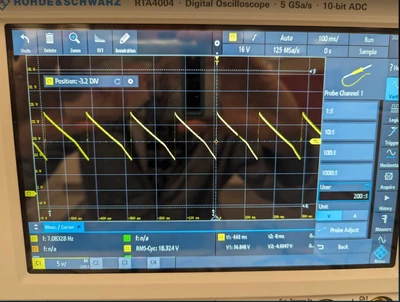
When I am under load, the circuit works as intended and achieves the 45W power charging. However, when there is no load, I hear this clicking noise and the output of the LM5116 is much more variable. I've included an oscilloscope shot of the input voltage at no load. 

I am using the same LM5116 circuitry to power some USB-A circuitry at 5V, and it does not experience this oscillation. 

Does anyone know what would cause this?
KMew_0-1692215462109.png

KMew_3-1692215714244.png


This topic has been closed for replies.

2 replies

RhSilicon
Lead
August 16, 2023

As this LM5116 seems to be from another manufacturer (Texas Instruments), it may be more assertive to seek help on the manufacturer's forum. Anyway, there is the AN1596 that can answer some questions.

KMew
KMewAuthor
Senior III
August 17, 2023

Hello,

Thank you for the reply. I was only mentioning the LM5116 so it was known that the power supply was from a switching source. I'm using the same one on the USB-A and this does not occur, even if there's no load. So I am trying to find the difference and the USB-C charging portion, which is completely an ST product, is the only difference. So wouldn't it make sense to start there?

RhSilicon
Lead
August 17, 2023

when there is no load, I hear this clicking noise and the output of the LM5116 is much more variable


Computer ATX power supplies usually have a load resistor.

atx_ps_load.png

KMew
KMewAuthor
Senior III
August 17, 2023

Interesting.
So they constantly have something to draw a little bit of current just to satisfy the needs of the converter? I was not aware of that! (Still green to the field haha).
Thank you for this!!