

RFlod.2
Associate III
March 14, 2025
Solved

How to measure antenna parameters according to an4974 with NanoVNA

  • March 14, 2025
  • 3 replies
  • 1533 views

I have designed RFID and I am now trying to deternine the antenna parameters by following

AN4974 Antenna matching for ST25R3911B/ST25R391x devices


I have bought NanoVNA-H4 for doing the measurements.

But what confuses me is how to connect the RFID antenna.


The instructions says:

1. Set the measurement mode of the network analyzer to S11 reflection measurement
2. Use the Smith chart format (R + jX) to display the impedance curve

.

.

.

Connect the cable of the network analyzer at the antenna ends


NanoVNA-H4 has two channels S11 and S21. My PCB has a differential antenna based on this antenna design:

https://eds.st.com/antenna/#/


Then I am not sure how I shall connect the two antenna ends to my RFID. I have cut a coax cable and soldered on my PCB:

.RFIDPCB.png
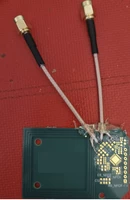
If I connect one end to S11 and another end to 21 of NanoVNA I get resonable values of 


@1 MHz
Serie inductuance = 1.13 uH


@40.543 MHz
Parallel resistance 2.01 KOhm
Self resonance 40.543 MHz


But 

DC serie resistance @ 1 MHz get 49.980 Ohm (in the documention it should be around 394 mOhm)

If I instead use S21 to measure I get DC serie resistance = 230 mOhm which seem realistic.


If only solder on cable on one end of RFID antenna, I get two resosance frequencies  (around 65 and 71 MHz) and Smith chart does not look like expected.

DC serie resistance get 1.5 Ohm 

 So this seems wrong.


Need some help understand how this shall be done.


Best answer by Travis Palmer

Hello RFlod.2,

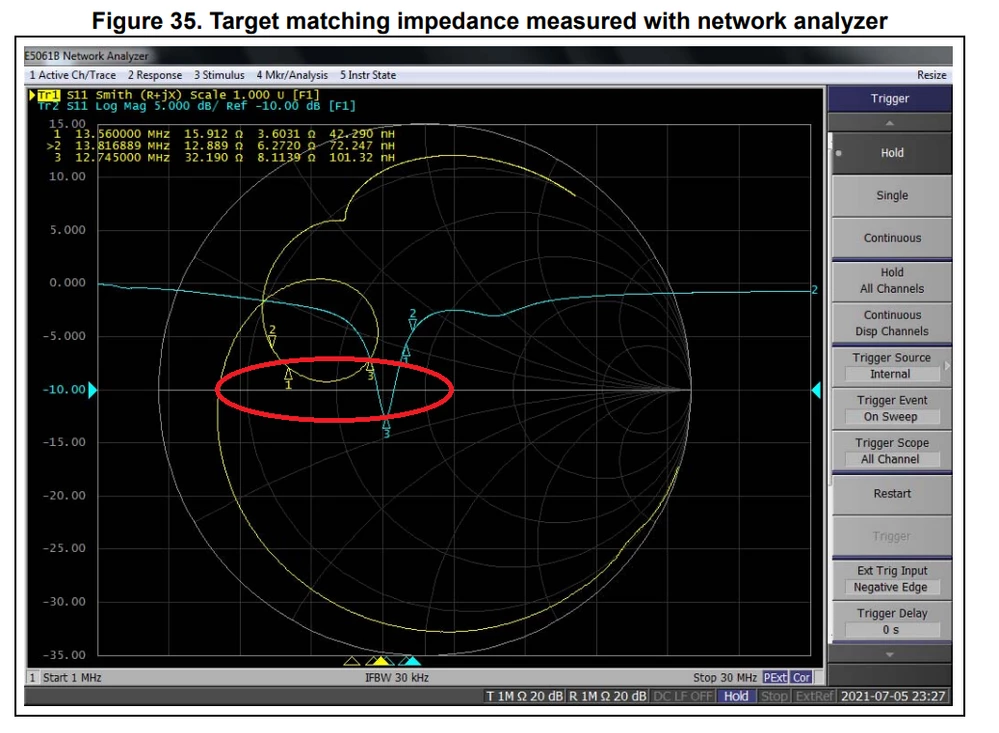
The measurement is described in chapter 7.4 / Figure 34. I will foresee a reference in the next revision of the document. It is the same condition as for the antenna measurement. As long no GND connection is in place between board and VNA, you can use a single ended measurement. Since the IC is high-ohmic when being un-powered, there is also no need to disconnect it for the measurement. 

You may want to tune your reader somewhere in the marked area:

Smith-chart.png

If your matching is outside of this area, the current and voltage going through the driver transistor are not in phase anymore. The system might get slightly inefficient. Also when going further away, due to the inductive or capacitive load you might face issues with the waveshapes. Overshoots or ringing might occur. 

This is the reason why we recommend to stay within the red marked area.

BR Travis.


3 replies

RFlod.2
RFlod.2Author
Associate III
March 15, 2025

I think the problem is that NanoVNA cannot measure in differentiell antennas. But using balun this should be achievable by something like this:


But which balun should be chosen? And how shall calibration be done? Must be done after balun

Travis Palmer
ST Employee
March 17, 2025

Hello RFlod2,


As long as there is no additional connection between antenna (or PCB) GND and your VNA, you can proceed measuring the antenna single ended. Same applies for the populated matching network. 

For this measurement, there is no need to use two channels.


br Travis

RFlod.2
RFlod.2Author
Associate III
March 24, 2025

Interesting.  Can you explain on this schematic where to solder signal and ground from coaxial cable on PCB?

Capture.JPG

Travis Palmer
ST Employee
March 24, 2025

Hello RFlod.2,

Below you can find the schematic and some pictures based on a NFC05A1.

schematic.png

To disconnect the antenna from the matching network, I opened R300 and R301.

VNA-Picture.pngNFC05A1-VNA.jpg


BR Travis

Travis Palmer
Travis PalmerBest answer
ST Employee
March 26, 2025

Hello RFlod.2,

The measurement is described in chapter 7.4 / Figure 34. I will foresee a reference in the next revision of the document. It is the same condition as for the antenna measurement. As long no GND connection is in place between board and VNA, you can use a single ended measurement. Since the IC is high-ohmic when being un-powered, there is also no need to disconnect it for the measurement. 

You may want to tune your reader somewhere in the marked area:

Smith-chart.png

If your matching is outside of this area, the current and voltage going through the driver transistor are not in phase anymore. The system might get slightly inefficient. Also when going further away, due to the inductive or capacitive load you might face issues with the waveshapes. Overshoots or ringing might occur. 

This is the reason why we recommend to stay within the red marked area.

BR Travis.