

STM32 "dual regular simultaneous mode only" - with DMA
Searching through the forum it seems like there are tens of posts regarding this topic. I read many of them, but I struggle to find a solution that applies to me.
First of, I use an STM32H743VIT.
My goal: Use ADC1 and ADC2, one channel each. The two ADCs should be tied together. The whole conversion should be triggered by TIM4 update event and the data should be moved via DMA.
What works: If I just use TIM4 and two DMA streams that move the data for each ADC individually, it works. As soon as I try to use the dual mode, it does nothing.
When I'm in dual mode I have confirmed that the timer is still running. TIM4->CNT is changing. I've spent almost two hours with the debugger in the SFR and checked the registers. I'm not sure if I'm close to the issue, but there is something that seems suspicious based on the research I did: DMA1->S0NDTR->NDT does not change, indicating that the DMA stream does nothing. However ADC1->CR->ADSTART is at 0x1, indicating that it tries to do something but doesn't do it. There are more registers that I checked, but these seem like the most important ones.
I also spent a while discussing registers with Gemini. Not sure if anything meaningful was learned int his discussion, but:
- ADC1/2->ISR->ADRDY is 0x1, both are ready
- DMA1->LISR and DMA1->HISR are bot 0x0, so no errors
My code actually triggering the conversion is rather simple:
HAL_ADC_Start(params->hadc_2); // probably wrong, but I've seen this somewhere, it doesn't change anything though
HAL_TIM_Base_Start(params->htim);
HAL_ADCEx_MultiModeStart_DMA(dev->hadc_1, (uint32_t *) dev->buffer, dev->size);

// HAL_ADC_ConvCpltCallback is never triggered
ADC 1 config:
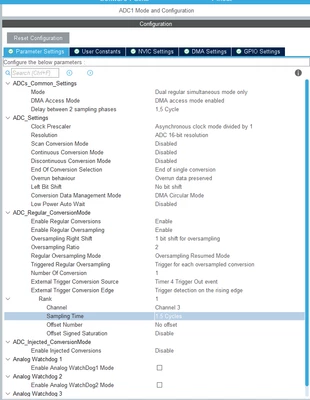
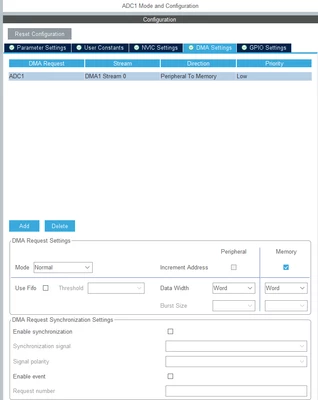
ADC2 config:
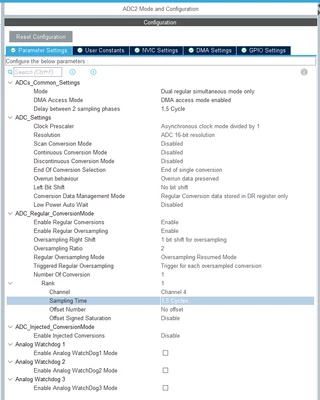
Here's the auto generated code:
static void MX_ADC1_Init(void)
{

 /* USER CODE BEGIN ADC1_Init 0 */

 /* USER CODE END ADC1_Init 0 */

 ADC_MultiModeTypeDef multimode = {0};
 ADC_ChannelConfTypeDef sConfig = {0};

 /* USER CODE BEGIN ADC1_Init 1 */

 /* USER CODE END ADC1_Init 1 */

 /** Common config
 */
 hadc1.Instance = ADC1;
 hadc1.Init.ClockPrescaler = ADC_CLOCK_ASYNC_DIV1;
 hadc1.Init.Resolution = ADC_RESOLUTION_16B;
 hadc1.Init.ScanConvMode = ADC_SCAN_DISABLE;
 hadc1.Init.EOCSelection = ADC_EOC_SINGLE_CONV;
 hadc1.Init.LowPowerAutoWait = DISABLE;
 hadc1.Init.ContinuousConvMode = DISABLE;
 hadc1.Init.NbrOfConversion = 1;
 hadc1.Init.DiscontinuousConvMode = DISABLE;
 hadc1.Init.ExternalTrigConv = ADC_EXTERNALTRIG_T4_TRGO;
 hadc1.Init.ExternalTrigConvEdge = ADC_EXTERNALTRIGCONVEDGE_RISING;
 hadc1.Init.ConversionDataManagement = ADC_CONVERSIONDATA_DMA_CIRCULAR;
 hadc1.Init.Overrun = ADC_OVR_DATA_PRESERVED;
 hadc1.Init.LeftBitShift = ADC_LEFTBITSHIFT_NONE;
 hadc1.Init.OversamplingMode = ENABLE;
 hadc1.Init.Oversampling.Ratio = 2;
 hadc1.Init.Oversampling.RightBitShift = ADC_RIGHTBITSHIFT_1;
 hadc1.Init.Oversampling.TriggeredMode = ADC_TRIGGEREDMODE_MULTI_TRIGGER;
 hadc1.Init.Oversampling.OversamplingStopReset = ADC_REGOVERSAMPLING_RESUMED_MODE;
 if (HAL_ADC_Init(&hadc1) != HAL_OK)
 {
 Error_Handler();
 }

 /** Configure the ADC multi-mode
 */
 multimode.Mode = ADC_DUALMODE_REGSIMULT;
 multimode.DualModeData = ADC_DUALMODEDATAFORMAT_32_10_BITS;
 multimode.TwoSamplingDelay = ADC_TWOSAMPLINGDELAY_1CYCLE;
 if (HAL_ADCEx_MultiModeConfigChannel(&hadc1, &multimode) != HAL_OK)
 {
 Error_Handler();
 }

 /** Configure Regular Channel
 */
 sConfig.Channel = ADC_CHANNEL_3;
 sConfig.Rank = ADC_REGULAR_RANK_1;
 sConfig.SamplingTime = ADC_SAMPLETIME_1CYCLE_5;
 sConfig.SingleDiff = ADC_SINGLE_ENDED;
 sConfig.OffsetNumber = ADC_OFFSET_NONE;
 sConfig.Offset = 0;
 sConfig.OffsetSignedSaturation = DISABLE;
 if (HAL_ADC_ConfigChannel(&hadc1, &sConfig) != HAL_OK)
 {
 Error_Handler();
 }
 /* USER CODE BEGIN ADC1_Init 2 */

 /* USER CODE END ADC1_Init 2 */

}

static void MX_ADC2_Init(void)
{

 /* USER CODE BEGIN ADC2_Init 0 */

 /* USER CODE END ADC2_Init 0 */

 ADC_ChannelConfTypeDef sConfig = {0};

 /* USER CODE BEGIN ADC2_Init 1 */

 /* USER CODE END ADC2_Init 1 */

 /** Common config
 */
 hadc2.Instance = ADC2;
 hadc2.Init.ClockPrescaler = ADC_CLOCK_ASYNC_DIV1;
 hadc2.Init.Resolution = ADC_RESOLUTION_16B;
 hadc2.Init.ScanConvMode = ADC_SCAN_DISABLE;
 hadc2.Init.EOCSelection = ADC_EOC_SINGLE_CONV;
 hadc2.Init.LowPowerAutoWait = DISABLE;
 hadc2.Init.ContinuousConvMode = DISABLE;
 hadc2.Init.NbrOfConversion = 1;
 hadc2.Init.DiscontinuousConvMode = DISABLE;
 hadc2.Init.ConversionDataManagement = ADC_CONVERSIONDATA_DR;
 hadc2.Init.Overrun = ADC_OVR_DATA_PRESERVED;
 hadc2.Init.LeftBitShift = ADC_LEFTBITSHIFT_NONE;
 hadc2.Init.OversamplingMode = ENABLE;
 hadc2.Init.Oversampling.Ratio = 2;
 hadc2.Init.Oversampling.RightBitShift = ADC_RIGHTBITSHIFT_1;
 hadc2.Init.Oversampling.TriggeredMode = ADC_TRIGGEREDMODE_MULTI_TRIGGER;
 hadc2.Init.Oversampling.OversamplingStopReset = ADC_REGOVERSAMPLING_RESUMED_MODE;
 if (HAL_ADC_Init(&hadc2) != HAL_OK)
 {
 Error_Handler();
 }

 /** Configure Regular Channel
 */
 sConfig.Channel = ADC_CHANNEL_4;
 sConfig.Rank = ADC_REGULAR_RANK_1;
 sConfig.SamplingTime = ADC_SAMPLETIME_1CYCLE_5;
 sConfig.SingleDiff = ADC_SINGLE_ENDED;
 sConfig.OffsetNumber = ADC_OFFSET_NONE;
 sConfig.Offset = 0;
 sConfig.OffsetSignedSaturation = DISABLE;
 if (HAL_ADC_ConfigChannel(&hadc2, &sConfig) != HAL_OK)
 {
 Error_Handler();
 }
 /* USER CODE BEGIN ADC2_Init 2 */

 /* USER CODE END ADC2_Init 2 */

}

static void MX_TIM4_Init(void)
{

 /* USER CODE BEGIN TIM4_Init 0 */

 /* USER CODE END TIM4_Init 0 */

 TIM_MasterConfigTypeDef sMasterConfig = {0};
 TIM_OC_InitTypeDef sConfigOC = {0};

 /* USER CODE BEGIN TIM4_Init 1 */

 /* USER CODE END TIM4_Init 1 */
 htim4.Instance = TIM4;
 htim4.Init.Prescaler = 0;
 htim4.Init.CounterMode = TIM_COUNTERMODE_UP;
 htim4.Init.Period = 94-1;
 htim4.Init.ClockDivision = TIM_CLOCKDIVISION_DIV1;
 htim4.Init.AutoReloadPreload = TIM_AUTORELOAD_PRELOAD_ENABLE;
 if (HAL_TIM_OC_Init(&htim4) != HAL_OK)
 {
 Error_Handler();
 }
 sMasterConfig.MasterOutputTrigger = TIM_TRGO_UPDATE;
 sMasterConfig.MasterSlaveMode = TIM_MASTERSLAVEMODE_DISABLE;
 if (HAL_TIMEx_MasterConfigSynchronization(&htim4, &sMasterConfig) != HAL_OK)
 {
 Error_Handler();
 }
 sConfigOC.OCMode = TIM_OCMODE_TOGGLE;
 sConfigOC.Pulse = 0;
 sConfigOC.OCPolarity = TIM_OCPOLARITY_HIGH;
 sConfigOC.OCFastMode = TIM_OCFAST_DISABLE;
 if (HAL_TIM_OC_ConfigChannel(&htim4, &sConfigOC, TIM_CHANNEL_1) != HAL_OK)
 {
 Error_Handler();
 }
 /* USER CODE BEGIN TIM4_Init 2 */

 /* USER CODE END TIM4_Init 2 */
 HAL_TIM_MspPostInit(&htim4);

}
I'm thankful for any helpful pointer as I'm currently a bit lost on what else to try.