Associate
November 3, 2025
Solved

STM32C031 Reseting after receiving data on UART

  • November 3, 2025
  • 5 replies
  • 541 views

Hello, I'm having problems with a simple task: receive blocks of data from UART. The blocks are sequences of 1-300 bytes, that are receiveid with a 1 second interval. The value is stored in one buffer of 350 bytes.

When I send a big block of 270 bytes after other blocks(of 60 bytes by example) in that 1s interval, the Stm32 RESETS! But if the interval is longer, like 5 seconds, it doesn't reset and receive the data correctly. 

I tried with pooling and interruption, the result is the same. I'm using 115200 baud. Lowering the baud rate also reduces the interval that doesn't cause a reset, but I can't use this solution.

WatchDog is already disabled. By this moment, the code doesn't do anything more.
Best answer by gabrielCermob

Hello again, I found the solution!! Thanks to everyone!

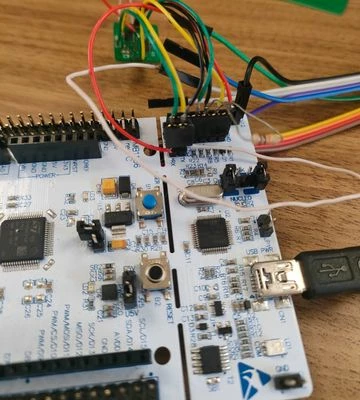
I was using a custom board for the C031G6U6 that was connected to the Nucleo's St-Link, board model MB1136. The 3V3 power comes from the Nucleo(connection made under the board), and the embedded MCU is disabled by the JP6. 

Original connectionOriginal connection

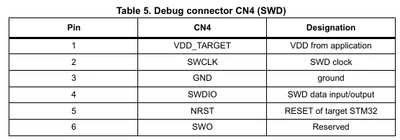
All pins were connected as described on the CN4 documentation.

CN4 PinsCN4 Pins

It was discovered that disconnecting the NRST pin from the Nucleo board eliminates the problem!

I don't know why but, that's it. The custom board seems to be ok, it already had the 100nF cap. 

5 replies

Andrew Neil
Super User
November 3, 2025

Welcome to the forum.

Please see  How to write your question to maximize your chances to find a solution for best results.


Please show the relevant code - see: How to insert source code.

A complex system that works is invariably found to have evolved from a simple system that worked.A complex system designed from scratch never works and cannot be patched up to make it work.
TDK
Super User
November 3, 2025

There is no direct link between receiving UART and resetting the chip. The reason has to be something specific to your code or hardware.


How do you know it's getting reset?

Read the flags in RCC_CSR2 on startup to determine the cause of the reset.

TDK_0-1762205687282.png


"If you feel a post has answered your question, please click ""Accept as Solution""."
Associate
November 4, 2025

Hello! I will post some images of the signals.

In the beggining of the code, the STM sends a 9 bytes message once. After, it waits for blocks of bytes and reply the messages with a two byte response. Just that.

In the first picture, the first message received constains 270 bytes, and is correctly received (I checked in debug). Some more messages are received and the first one is repeated again in the end with a delay of 5,3s, and no problem occured.

In the second picture, it's exactly the same situation, but the delay of the last message is smaller. And the STM replies with the 9 bytes initial message, that could only occur after a reset.

Capture WITHOUT ErrorCapture WITHOUT ErrorCapture WITH ErrorCapture WITH Error

I also checked the RCC_CSR2 after the resets(it's in the initial message), and the value is: 0x04000000. Indicating  Bit 26 PINRSTF: Pin or other system reset flag


MCU Model: STM32C031G6U6

Environment: CubeIDE
Main.c attached


gbm
Principal
November 4, 2025

There is no check for buffer overflow in Rx callback.

My STM32 stuff on github - compact USB device stack and more: https://github.com/gbm-ii/gbmUSBdevice
TDK
Super User
November 4, 2025

Code seems fine.

If NRST is going low as indicated by the reset flag, perhaps a board power issue, or bad decoupling. Can you share your schematic? If you are missing a 0.1 uF cap on NRST, you can get parasitic resets, especially if there's a long trace on that pin.

Consider monitoring the NRST line in analog mode, and maybe VDD as well. You should NRST go low. VDD should be fine since PWRRSTF is not getting set.

"If you feel a post has answered your question, please click ""Accept as Solution""."
gabrielCermobAuthorBest answer
Associate
November 5, 2025

Hello again, I found the solution!! Thanks to everyone!

I was using a custom board for the C031G6U6 that was connected to the Nucleo's St-Link, board model MB1136. The 3V3 power comes from the Nucleo(connection made under the board), and the embedded MCU is disabled by the JP6. 

Original connectionOriginal connection

All pins were connected as described on the CN4 documentation.

CN4 PinsCN4 Pins

It was discovered that disconnecting the NRST pin from the Nucleo board eliminates the problem!

I don't know why but, that's it. The custom board seems to be ok, it already had the 100nF cap. 

Andrew Neil
Super User
November 5, 2025

Good catch!

Please mark the solution.

This is always a problem with using the debugger from a dev kit - there may still be connections from the dev kit, and they can affect your external target.

I would strongly recommend that you get a standalone debugger.

Failing that, you can break off the ST-Link part of the Nucleo board - so ensure no "phantom" connections.


See this and this.

A complex system that works is invariably found to have evolved from a simple system that worked.A complex system designed from scratch never works and cannot be patched up to make it work.
Ozone
Principal
November 4, 2025

Either insufficient power (perhaps due to hardware problems), strong EMI interference with the UART signal, or your code has a watchdog activated.

I very much suspect you talk about a custom design board here.
Try a commercial one like a matching Nucleo.

Andrew Neil
Super User
November 4, 2025

@Ozone wrote:

strong EMI interference 


+1


@gabrielCermob So, as well as your board, you need to give details of the environment in which it is operating.

Some good, clear photos may help.


How to write your question to maximize your chances to find a solution

A complex system that works is invariably found to have evolved from a simple system that worked.A complex system designed from scratch never works and cannot be patched up to make it work.
Ozone
Principal
November 5, 2025

Not to forget, how exactly the "UART connection" is made, and which components are involved.
Because "UART" usually implies RS232, which in turns allows for -15V...+15V signals.
Notwithstanding the fact that the standard requires >= |3V| as proper level, which means the usual USB-serial adapters with 3.3V or 5V levels are compliant, but not sufficient in every case.

And larger currents through serial GND connection can easily upend a low-power device like a C03x, and cause brown-outs.