

Missing Phase Voltage Signal During 6-Step Commutation (EVSPIN32G4)
Hello ST team,
I am using the EVSPIN32G4 evaluation board with sensorless 6-step control.
Hardware Setup:
Board: EVSPIN32G4
Motor: BLDC motor (24 pole pairs)
Control mode: Sensorless 6-step (BEMF zero-cross detection)
Current sensing: 1 mΩ shunt + external amplifier (Gain = 7.33)
PWM frequency: 60 kHz
DC bus voltage: 48 V
Problem Description:
When observing the three phase voltages (U, V, W) on the oscilloscope, I noticed that three phase voltage occasionally becomes flat or loses switching activity during commutation.
This issue becomes much more obvious at high speed operation.
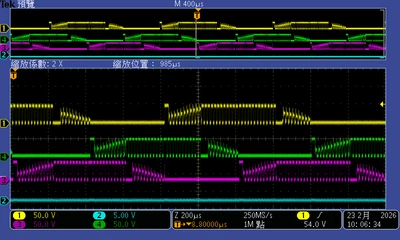
At low speed:
Waveforms are mostly trapezoidal and continuous.as show.
At high speed:
The floating phase voltage becomes unstable.The BEMF signal appears distorted.In some sectors, one phase seems to lose signal briefly.Ringing and high-frequency oscillation increase significantly.as show.
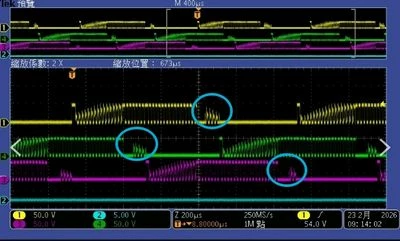
The higher the electrical frequency, the more severe the signal loss.
It seems that the floating phase is being clamped or not properly released during commutation.
The zero-cross detection may become unstable at high speed.
My Questions :
Is this behavior expected due to insufficient blanking time at high electrical frequency?
Could this be related to ADC sampling timing versus PWM timing?
Could dead-time configuration cause the floating phase to be clamped?
Is there any recommended configuration in MC Workbench for high-speed sensorless 6-step operation?
I would appreciate any guidance or recommended debugging steps.
Thank you very much.