
Associate
August 9, 2023
Solved

VNH5019 Current sense gain accuracy/tolerance

  • August 9, 2023
  • 1 reply
  • 1323 views

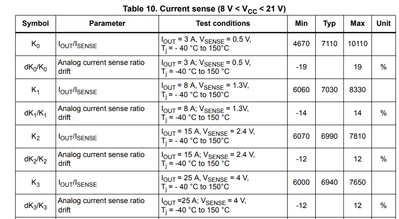
I was looking at the datasheet for the VNH5019, and saw that the current sense gain tolerance is narrower as it drives higher currents. I am trying to use the driver in an application where the motor currents can range from about 100mA to 10 A, and am hoping to gain some insight on the tolerance range for the current sense in the 0 - 1000mA range, since I have seen a very wide range of errors in the current sense calculation (up to 100%, with outliers even worse than that).
ThomasT_0-1691586484018.png


    This topic has been closed for replies.
    Best answer by MasterT

    Could be current mirror, but primary converter I->V is likely resistive Rds of the MOSFET, so the value of R greatly depends on Temp, Voltage and not accurate from the manufacturing dispersion. It's just doesn't worth to specify or calibrate it below 3A, since procedure has to be continuosly repeated in changing enviroment

    1 reply

    MasterT
    Lead II
    August 9, 2023

    The truth is that IC has no "current sensor" build-in, rather "current indicator" likely just for use in OCP protection.

    Option is to use external IC specificaly designed to measure in apointed range

    ThomasTAuthor
    Associate
    August 9, 2023

    I was assuming that it just used a current mirror that should at least be more or less proportional. Is this what you are saying too?

    MasterT
    MasterTBest answer
    Lead II
    August 9, 2023

    Could be current mirror, but primary converter I->V is likely resistive Rds of the MOSFET, so the value of R greatly depends on Temp, Voltage and not accurate from the manufacturing dispersion. It's just doesn't worth to specify or calibrate it below 3A, since procedure has to be continuosly repeated in changing enviroment