Associate II
November 11, 2025
Solved

Bit-banding Alternatives for Modern ARM Cores

  • November 11, 2025
  • 4 replies
  • 257 views

Bit-banding Alternatives for Modern ARM Cores

Background Information:

The bit-banding feature available in ARM Cortex-M cores (ARMv7-M architecture including Cortex-M3 and Cortex-M4) provides hardware-level mapping of individual bits within a 1 MB memory region to words in a 32 MB alias region. This mechanism enables atomic bit manipulation without requiring read-modify-write operations.


Specific Query:

For ARM Cortex cores beyond M7 architecture that do not support the bit-banding feature, could you please provide detailed information regarding:


  • Available alternative methods for atomic bit manipulation
  • Performance implications of these alternatives
  • Recommended implementation strategies for maintaining atomic operations
  • Code examples demonstrating these alternative approaches
  • Request for Documentation
Best answer by mƎALLEm

Hello,

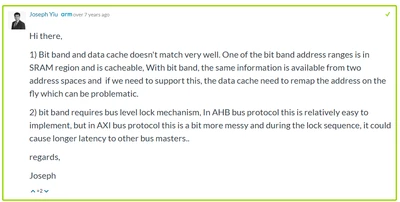
Indeed bit-banding is not available on Cortex-M7. According to ARM community from this post, the reason is the following:

mALLEm_0-1762849836841.png

Regarding an available alternative, I think the only solution is to use CMSIS:

void atomic_set_bit(volatile uint32_t *addr, uint32_t bit) {
 uint32_t old, status;
 do {
 old = __LDREXW(addr);
 old |= (1U << bit);
 status = __STREXW(old, addr);
 } while (status != 0);
}

Use __LDREXW/__STREXW for 32-bit, __LDREXH/__STREXH for 16-bit, and __LDREXB/__STREXB for 8-bit operations.

I don't think there is specific documentation regarding this subject

4 replies

mƎALLEm
mƎALLEmBest answer
Technical Moderator
November 11, 2025

Hello,

Indeed bit-banding is not available on Cortex-M7. According to ARM community from this post, the reason is the following:

mALLEm_0-1762849836841.png

Regarding an available alternative, I think the only solution is to use CMSIS:

void atomic_set_bit(volatile uint32_t *addr, uint32_t bit) {
 uint32_t old, status;
 do {
 old = __LDREXW(addr);
 old |= (1U << bit);
 status = __STREXW(old, addr);
 } while (status != 0);
}

Use __LDREXW/__STREXW for 32-bit, __LDREXH/__STREXH for 16-bit, and __LDREXB/__STREXB for 8-bit operations.

I don't think there is specific documentation regarding this subject

"To give better visibility on the answered topics, please click on ""Accept as Solution"" on the reply which solved your issue or answered your question."
Komal_YAuthor
Associate II
January 7, 2026

Hello ,

Can u please tell me this for 32 bit.. is it same.. can u give me one example how to access single bit of port without bit banding

Associate II
January 7, 2026

@Komal_Y wrote:

Hello ,

Can u please tell me this for 32 bit.. is it same.. can u give me one example how to access single bit of port without bit banding


GPIO ports only cover 16 bits each.

Andrew Neil
Super User
November 11, 2025

@Komal_Y wrote:
  • Available alternative methods for atomic bit manipulation

Check if your particular chip has a register (or registers) to give atomic bit manipulation; eg,

AndrewNeil_0-1762858326607.png

That's for STM32H723/733, STM32H725/735 and STM32H730:

https://www.st.com/resource/en/reference_manual/rm0468-stm32h723733-stm32h725735-and-stm32h730-value-line-advanced-armbased-32bit-mcus-stmicroelectronics.pdf#page=521


PS:

You'll probably find that HAL uses this - it certainly does for F0.

A complex system that works is invariably found to have evolved from a simple system that worked.A complex system designed from scratch never works and cannot be patched up to make it work.
Andrew Neil
Super User
January 7, 2026

@Komal_Y Do you have a specific use case where the lack of Bit-banding is actually causing you real-life problems?

I guess the reason Bit-Banding has been abandoned is probably because there are (very?) few cases where it really brings any actual real-life benefits?

eg, see Bit-Banding in ARM Cortex-M: A Brilliant Feature… But why was it abandoned?


As previously noted, where it is really useful for register-related functions, it's usually implemented in the hardware itself.


So, if you have a real use case, please describe it - then people may be able to give specific answers to that particular question ...

A complex system that works is invariably found to have evolved from a simple system that worked.A complex system designed from scratch never works and cannot be patched up to make it work.
Komal_YAuthor
Associate II
January 7, 2026

we have design ARM compiler for core M4( which has bit banding which mad my execution easy and faster)) now we want to port it to core M85 which does not support bit banding .. so that why i am asking .. how can i achieve this portability with ARM bit banding

Andrew Neil
Super User
January 7, 2026

That's a question for ARM rather than ST!

https://community.arm.com/support-forums/

A complex system that works is invariably found to have evolved from a simple system that worked.A complex system designed from scratch never works and cannot be patched up to make it work.
Tesla DeLorean
Guru
January 7, 2026

The Reference Manual (RM) and Programming Manual (PM) are things you want to read, absorb and understand. 

Joseph Yiu has a number of books that cover the practical aspects in a less dry way than the cores Technical Reference Manual (TRM) or ST's PM.

Bit Banding (BB) had a lot of issues, traps and hazards for the unwary to fall into. Often not being atomic, and being less efficient than more optimal design approaches. 

Tips, Buy me a coffee, or three.. PayPal VenmoUp vote any posts that you find helpful, it shows what's working..