Associate II
September 29, 2025
Solved

CAN wrong bit timing: bit time larger than expected

  • September 29, 2025
  • 2 replies
  • 531 views

Title edited to give an accurate idea of the issue.

Hello together,

i had a problem with setting a correct bit time on a CAN-port.

On my nucleo-h755ZI-Q board, I want to operate the FDCAN1 by the CM4 in classic-can mode with a baud rate of 1 MHz.

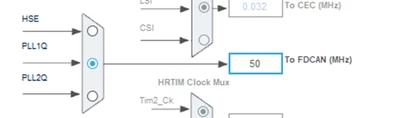
I supply the FDCAN with a clock of 50MHz:
HiSt_0-1759130563982.png

HiSt_1-1759130584276.png

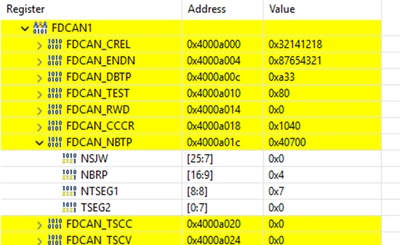
Therefore the corresponding registers are set as follows:
HiSt_2-1759130618964.png

With:

HiSt_3-1759130645218.png

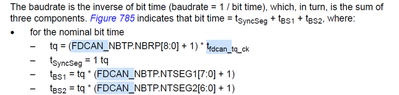
this excerpt in the reference manual, the calculation is:

tfdcan_tq_ck = 0,02 µs  <- (1/50MHz)

tq = 0,1µs          <-             (0,02 *  5)

The bit time ist 1µs   <-  (0,1 *( 7+1+0+1+1))

-> baudrate is 1 Mhz    -> 1/1µs

But in the outgoing frames, I measure a bit time of approx. 3µs.

HiSt_4-1759130686774.png

Enlarged:

HiSt_5-1759130708152.png

How can that be? What did I do wrong or overlook?

Thank you and best regards,

HiST


Best answer by mƎALLEm

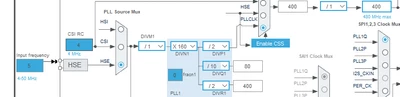
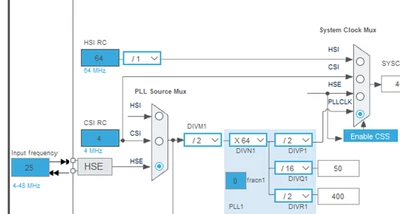
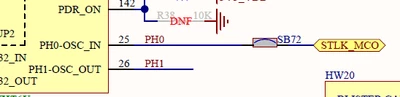
Just forget that you are using a nucleo-h755ZI-Q while in the Clock config you set the crystal to 25MHz in a crystal mode! But there is no external crystal in that board connected to OSC_IN/OSC_OUT.

This is the schematic:

mALLEm_0-1759140281245.png

What I suggest is to use the bypass mode but for that you need some steps:

1- Modify the STLINK MCO output to generate 5MHz instead of 8MH generated from HSI. Ensure SB72 is soldered. Please refer to this article to do that: How to use STLINK-V3 MCO output on Nucleo boards as a precise clock source for STM32

2- In your ioc file you need to update the RCC config: HSE in Bypass mode with HSE value = 5MHz

mALLEm_0-1759140641754.png

mALLEm_1-1759140663420.png

+ use the same bit timing config I provided in my previous post.


2 replies

Senior III
September 29, 2025

Was the CAN communication established between the two nodes at 1Mbps? Were you able to receive and transmit messages? Just for confirmation.

HiStAuthor
Associate II
September 29, 2025

No, due to incorrect bit timing and the resulting incorrect baud rate, I cannot communicate with another participant.

mƎALLEm
Technical Moderator
September 29, 2025

Hello,

Attach your ioc file and tell more about what you are connecting to nucleo-h755ZI-Q as a second CAN node.

"To give better visibility on the answered topics, please click on ""Accept as Solution"" on the reply which solved your issue or answered your question."
mƎALLEm
mƎALLEmBest answer
Technical Moderator
September 29, 2025

Just forget that you are using a nucleo-h755ZI-Q while in the Clock config you set the crystal to 25MHz in a crystal mode! But there is no external crystal in that board connected to OSC_IN/OSC_OUT.

This is the schematic:

mALLEm_0-1759140281245.png

What I suggest is to use the bypass mode but for that you need some steps:

1- Modify the STLINK MCO output to generate 5MHz instead of 8MH generated from HSI. Ensure SB72 is soldered. Please refer to this article to do that: How to use STLINK-V3 MCO output on Nucleo boards as a precise clock source for STM32

2- In your ioc file you need to update the RCC config: HSE in Bypass mode with HSE value = 5MHz

mALLEm_0-1759140641754.png

mALLEm_1-1759140663420.png

+ use the same bit timing config I provided in my previous post.


"To give better visibility on the answered topics, please click on ""Accept as Solution"" on the reply which solved your issue or answered your question."
HiStAuthor
Associate II
September 29, 2025

Hello m3ALLEm,

yes, thank you, this was the solution. 

And also responsible for some other problems I had.

Now I also measure the correct bit time.

Best regards,

   HiST