
Associate II
August 17, 2025
Solved

Crystal oscillator circuit Validation
  • August 17, 2025
  • 6 replies
  • 573 views

LucaBresciani_0-1755421084073.png

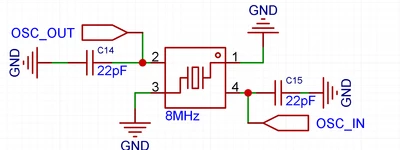
Hi, i am using a STM32F411 for the first time and i am not familiar with the crystal oscillator schematic symbol provided by EasyEDA. Can someone validate this circuit and, eventually, poit out what's wrong plase?


Any help would be apreciated

Best answer by TDK

Pins 1 and 3 should be connected to OSC_IN/OSC_OUT. Pins 2 and 4 should be grounded.

6 replies

MHoll.2
Senior III
August 17, 2025

You do not specify the Crystal You are using, without that I can not comment on the schematic., Please read the Application note AN2867 from ST.

TDK
TDKBest answer
Super User
August 17, 2025

Pins 1 and 3 should be connected to OSC_IN/OSC_OUT. Pins 2 and 4 should be grounded.

"If you feel a post has answered your question, please click ""Accept as Solution""."
marcdraco
Associate
August 17, 2025

I think the OP might be unfamiliar with Pierce oscillators (as "simple" as they are). There is a common idea that we can just drop in a 25Meg Xtal (basic part at JLCPCB) with some caps for the 20 pF loading. 

I've seen a lot of examples online that just take a working example with an unknown xtal and bung in the same values as if it will work. The resistor is also critical and often omitted - I'm going to assume at lot of this descends from early Arduinos based on Atmel chips that are much slower and presumably less fussy about drive.

I don't blame them but it's worth noting that while Arduino has popularised MCUs (for which many of us will be forever thankful, myself included) even the reference designs, particularly the layouts are rather suboptimal. It's not me saying that, it's experts like Dr. Eric Bogatin who uses them as examples of how not to do it. With some fairly simple modifications it's possible to reduce the EMC signature considerably.

I've learned a lot from Dr. Bogatin myself as I come from a time when edge times of a few microseconds were thought to be *really* fast! I dropped out around then and didn't get back into digital until we'd passed the sub-nS timings and my poor brain almost squeezed out of my ears. In those days we pretty much worked on two layer boards that were hand-taped. Can you imagine doing that now. :)

Associate II
August 23, 2025

The answer @TDK gave corresponds with what i read in these days.

I also ordered my PCB and i will be delivered in a couple of weeks. If everything proves to work fine i will post my updated schematic.


Thanks everyone

Associate II
August 27, 2025

Hi everyone

The PCB finally arrived and it's proven to work just fine: here is the updated crystall oscillator circuit i used

LucaBresciani_0-1756289614073.png

Here is also the link to the actual component i used: https://www.lcsc.com/product-detail/C889706.html?s_z=n_C889706


Thanks everyone for the support

MHoll.2
Senior III
August 27, 2025

I'm happy that your oscillator is working, but I don't think that You have read the AN2867, specially the capture 3.3 Loade capacitence, otherwise You had reduce C14 and C15. Even assuming that Your Cs is very Small (for example 2pF), with a CL of 8pF from the datasheet of Your crystal, C14 and C15 will be about 12pF and not 22pF.

This (wrong) value will propably not stop Your oscillator but the frequency will be shifted a little bit.

Peter BENSCH
Technical Moderator
August 29, 2025

@LucaBresciani 

You should read the knowledge base article How to select a compatible crystal and load capacitors, who explains the topic from AN2867 mentioned be @MHoll.2 in a more practical way.