Associate
October 1, 2025
Question

NUCLEO-L552ZE-Q : 32bits data formats via SPI

  • October 1, 2025
  • 3 replies
  • 301 views

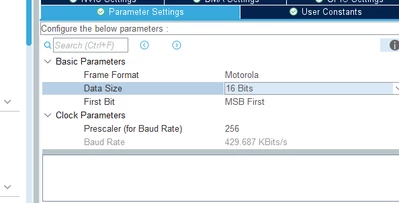
Hello, do you know if we can transmit data formats of 32 bits via SPI in NUCLEO-L552ZE-Q. and if yes, how?
 

nala_ed70_0-1759312097536.png


3 replies

Associate II
October 1, 2025

That depends on the comm partner.

If you have to develop both sides it is up to you how it will be done - byte by byte or half word by half word, and if binary or converted to some kind of text (like ubase64).

Andrew Neil
Super User
October 1, 2025

@mfgkw wrote:

That depends on the comm partner.


The STM32L552ZE SPI hardware can't do 32 bits as such - it would have to be synthesised from smaller "chunks" of 4-16 bits.

A complex system that works is invariably found to have evolved from a simple system that worked.A complex system designed from scratch never works and cannot be patched up to make it work.
Andrew Neil
Super User
October 1, 2025

That would be down to the MCU - nothing to do with the board - so check the MCU's datasheet.

The datasheet - and other documentation & resources - will be found on the MCU's Product Page:

AndrewNeil_0-1759312463938.png

https://www.st.com/resource/en/datasheet/stm32l552ze.pdf#page=75

via: https://www.st.com/en/microcontrollers-microprocessors/stm32l552ze.html


But, of course, you can send a 32-bit value as 8x4 bits, or 4x8 bits, or 2x16 bits.

Or even 2x8 bits plus 1x16 bits - if you really wanted to ...

A complex system that works is invariably found to have evolved from a simple system that worked.A complex system designed from scratch never works and cannot be patched up to make it work.
Ozone
Principal
October 1, 2025

SPI is a relatively simple protocol, realizing a bidirectional shift register.
A transmission starts with a /SS going low and is ended with /SS going high again, both controlled by the master.
The number of transferred bits is theoretically arbitrary, but most STM32 MCUs support only 8, 16 or 24 bit directly. This means the STM32 SPI peripheral will only handle transfers of those sizes automatically, directly in hardware.

Transferring any other number of bits is not difficult as long as it's a multiple of the lowest supported size, i.e. 1 byte.
Configure software control for the /SS signal, and consecutively feed the number of bytes to the Tx register to accomplish a full transfer - 4 in your case.
Use the "Tx Empty" flag to feed consecutive bytes, and "transmission complete" for /SS handling.

nala_ed70Author
Associate
October 1, 2025

Thank you! What do you mean by  /SS? I am relatively new to programming microcontrollers. I am using the board as a master to control another chip. Basically, if I want to control the second bit of the first register high and the 4-th bit of the 15 register high, seeing something like this should be correct or .....? Can you maybe provide some more insights, please? Because I see here some idle time after 16 cycles and I am not sure which chucks of information are together


nala_ed70_0-1759318688543.png


Andrew Neil
Super User
October 1, 2025

@nala_ed70 wrote:

What do you mean by  /SS?


That's the Slave Select signal.

The '/' prefix indicates that it's active-low; sometimes written SSn

The diagram shows it with a bar over the top - but that's hard to do with normal text:

AndrewNeil_0-1759320056177.png

https://en.wikipedia.org/wiki/Serial_Peripheral_Interface


Gaps in the transmission shouldn't matter - the bus is only sampled at clock edges.


PS:

AndrewNeil_1-1759320278408.png

So here, presumably, you have your STM32 set to 16 bits?

You can tell that by the groups of 16 clock pulses - one clock for each bit.


@nala_ed70 wrote:

 Can you maybe provide some more insights, please?


I think the original question - "can the STM32 do 32 bits" - has been answered?

If so, please mark the solution, and start a new thread for a new question.


@nala_ed70 wrote:

I am using the board as a master to control another chip.


It would help to say what chip.

A complex system that works is invariably found to have evolved from a simple system that worked.A complex system designed from scratch never works and cannot be patched up to make it work.
