Senior
September 25, 2025
Solved

STM32H723: Window WatchDog (WWDG)

  • September 25, 2025
  • 4 replies
  • 499 views

I am using STM32H723 and have implemented WWDG. Below is my configuration: 
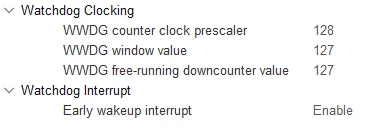
jowakar122_0-1758793248726.png

Are there possibility that when the system resets due to watchdog it would not trigger its ISR. 

Best answer by jowakar122

For now I am using a timer to refresh the WWDG when file transfer is happening and it is working fine. But couldn't figure out the reason behind the above mentioned unusual condition.

4 replies

LCE
Principal II
September 25, 2025

Not sure, never used WWDG, but why not 

NVIC_DisableIRQ(WWDG_IRQn);

?

TDK
Super User
September 25, 2025

The EWI interrupt will function as intended.

There exist scenarios in which it will not be called. For example, if interrupts are disabled, it won't be called.

"If you feel a post has answered your question, please click ""Accept as Solution""."
Senior
September 26, 2025

@TDK I am not disabling its interrupts. Even if I disable the interrupt it will still reset but without triggering its ISR

LCE
Principal II
September 26, 2025

Are there possibility that when the system resets due to watchdog it would not trigger its ISR.

...

Even if I disable the interrupt it will still reset but without triggering its ISR


Isn't that what you asked for? Scratch head...

Senior
October 6, 2025

I had a doubt about RTOS blocking the WWDG ISR. So I have implemented without RTOS and the issue persists. 

int main(void)
{

 /* USER CODE BEGIN 1 */

 /* USER CODE END 1 */

 /* MPU Configuration--------------------------------------------------------*/
 MPU_Config();

 /* Enable the CPU Cache */

 /* Enable I-Cache---------------------------------------------------------*/
 SCB_EnableICache();

 /* Enable D-Cache---------------------------------------------------------*/
 SCB_EnableDCache();

 /* MCU Configuration--------------------------------------------------------*/

 /* Reset of all peripherals, Initializes the Flash interface and the Systick. */
 HAL_Init();

 /* USER CODE BEGIN Init */

 /* USER CODE END Init */

 /* Configure the system clock */
 SystemClock_Config();

 /* USER CODE BEGIN SysInit */

 /* USER CODE END SysInit */

 /* Initialize all configured peripherals */
 MX_GPIO_Init();
 MX_USART3_UART_Init();
 MX_TIM24_Init();
 MX_LWIP_Init();
 MX_WWDG1_Init();
 /* USER CODE BEGIN 2 */
 HAL_UART_Transmit(&huart3, "OS Starts\n", 10, 10);
 /* USER CODE END 2 */

 /* Infinite loop */
 /* USER CODE BEGIN WHILE */
 while (1)
 {
	 HAL_WWDG_Refresh(&hwwdg1);
	 HAL_GPIO_TogglePin(GPIOB, LED_GREEN_Pin);
	 MX_LWIP_Process();
	 if(!FLAG_OTA)
	 {
		 if((FLAG_LINK) && (!FLAG_TCP_CONNECTED))
		 {
			 tcp_client_init();
		 }
	 }
	 else
	 {
		 if(!FLAG_TFTP_CON)
		 {
			 HAL_UART_Transmit(&huart3, "TFTP\n", 5, 5);
			 tftp_init_client();
//			 HAL_Delay(10);
		 }

		 if(FLAG_TFTP_CON) { if(!OACK_RECV) { send_rrq_periodic(); } }

		 if(Flag_TFTP_Error) { HAL_UART_Transmit(&huart3, "ERROR\n", 6, 5); /*NVIC_SystemReset();*/ }

		 if(Flag_FILE_RECVED)
		 {
			 uint32_t t_buf[1] = {tsize};
			 if(FLASH_If_Erase(ADDR_FLASH_SECTOR_7_BANK1, 1) == FLASHIF_OK)
			 {
				 if((FLASH_If_Write(ADDR_FLASH_SECTOR_7_BANK1, t_buf, 1)) != FLASHIF_OK)
				 {
					 strcpy(debug_string, "\r------>ERROR: Writing file size in flash<------\n");
					 HAL_UART_Transmit(&huart3, (uint8_t*)debug_string, strlen(debug_string), 10);
				 }
			 }
			 Flag_FILE_RECVED = 0;
//			 NVIC_SystemReset();
		 }
		}
		HAL_Delay(100);
 /* USER CODE END WHILE */

 /* USER CODE BEGIN 3 */

 }
 /* USER CODE END 3 */
}

This is what was printed in my log:

jowakar122_0-1759736150951.png


jowakar122AuthorBest answer
Senior
October 6, 2025

For now I am using a timer to refresh the WWDG when file transfer is happening and it is working fine. But couldn't figure out the reason behind the above mentioned unusual condition.