STM32H753 QUADSPI – Clarification on Dual Bank, IO Lines, and Multi-Flash Possibilities
Hi Team,
I am designing a custom PCB using STM32H753 and planning to use the QUADSPI peripheral for external memory. My use case is data read/write (indirect mode) — not XIP or memory-mapped execution.
While working in STM32CubeMX, I came across some configurations that are confusing, and I’d like to clarify the actual hardware behavior.
1. Dual Bank vs Chip Select behavior
In CubeMX, I can configure:
-
QuadSPI Mode: Dual Bank with Quad Lines
-
Chip Select options:
-
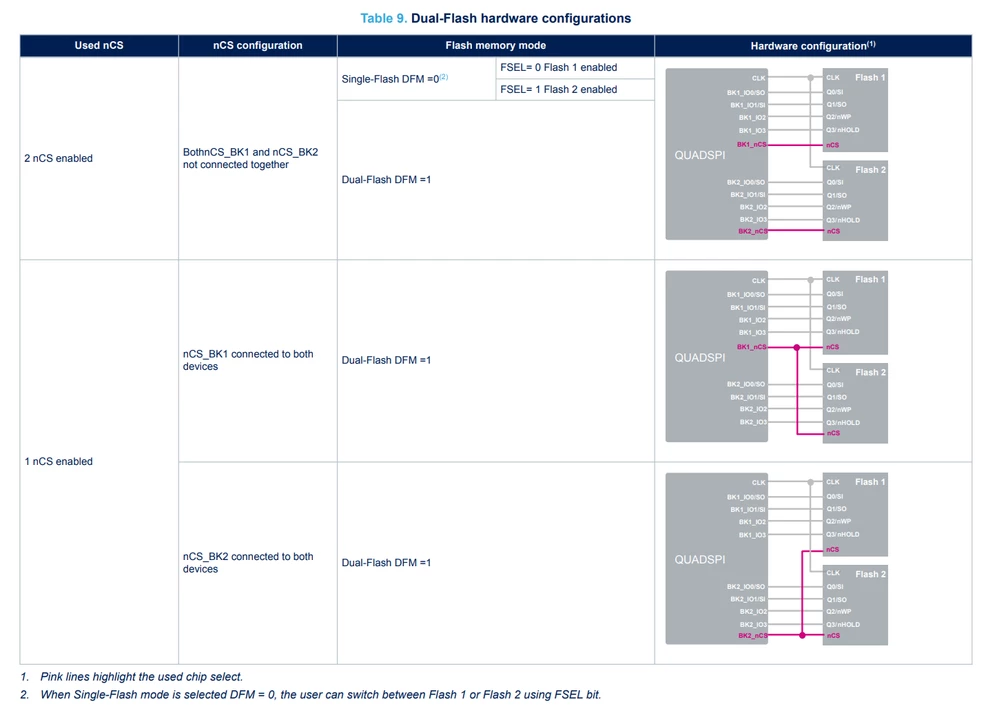
Enable Chip Select 1 for both banks
-
Enable Chip Select 2 for both banks
-
Enable Chip Select for each bank
-
My understanding:
-
NCS → Bank1
-
NCS2 → Bank2
Questions:
-
If I select “Enable Chip Select 1 for both banks”, does this mean:
-
Only one physical flash is used and banks are logical partitions?
-
Or is there any way two physical memories are still utilized?
-
-
What is the exact meaning of “bank” in this context (hardware vs logical)?
2. BK1_IOx and BK2_IOx pins confusion
CubeMX exposes:
-
QUADSPI_BK1_IO0–IO3
-
QUADSPI_BK2_IO0–IO3
This gives the impression of 8 data lines (4 per bank).
Questions:
-
Are BK1_IOx and BK2_IOx:
-
Independent data buses for each bank?
-
Or alternate pin mappings of the same internal IO signals?
-
-
If both sets are enabled simultaneously (as CubeMX allows), are these pins internally shorted?
-
What is the correct way to route these signals on PCB when using:
-
Single flash
-
Dual flash (2-chip setup)
-
3. Multi-flash usage beyond 2 chips
Given the hardware has:
-
1 shared IO bus
-
2 chip select lines (NCS, NCS2)
Questions:
-
Is it possible in any supported way to interface 4 QSPI flash chips
4. Manual Chip Select using GPIO
Questions:
-
Can we use GPIO-controlled chip select instead of the hardware NCS/NCS2 pins in QUADSPI?
-
Or is hardware-controlled CS mandatory for correct operation?
-
If GPIO CS is used:
-
Will timing or protocol issues occur?
-
Is it reliable for read/write (non-memory-mapped mode)?
-
5. Dual Bank + 1 CS behavior
Questions:
-
In dual bank with single CS configuration, is it possible to:
-
Read/write data to two different physical chips?
-
Or does it always operate on only one physical chip?
-
-
If it is only one chip, is this configuration purely a logical memory split?
6 Extending dual-bank concept
Questions:
-
If dual bank works with 2 CS lines (2 chips), is there any way to extend this concept to:
-
4 chips (e.g., 2 banks × 2 chips each)?
-
-
Can STM32 QUADSPI handle such a setup in any supported or semi-supported way?
7. Summary of my understanding (please correct if wrong)
-
QUADSPI has only one internal 4-bit data bus
-
BK1_IOx and BK2_IOx are not independent buses
-
True multi-chip support is limited to 2 devices via NCS/NCS2
-
“Dual bank with single CS” is logical partitioning, not physical dual memory
I would really appreciate clarification from someone who has worked with this peripheral at hardware level or designed boards using it.
Thanks in advance!
JYOTHISH B CHANDRAN