

VThan.2
Associate III
July 16, 2024
Solved

Voltage and Temperature calculation macro not responding on STM32H563ZIT6

  • July 16, 2024
  • 5 replies
  • 1933 views


Hello Community,


I am using 2 function calls 

__LL_ADC_CALC_VREFANALOG_VOLTAGE();
__LL_ADC_CALC_TEMPERATURE_FLOAT();

My implementation:

uhADCxConvertedData_VrefAnalog_mVolt = __LL_ADC_CALC_VREFANALOG_VOLTAGE(aADCxConvertedData[1], LL_ADC_RESOLUTION_12B);


temperature = __LL_ADC_CALC_TEMPERATURE_FLOAT(uhADCxConvertedData_VrefAnalog_mVolt, aADCxConvertedData[2], LL_ADC_RESOLUTION_12B);


I am seeing the above macros not respond and there is a hard-fault whenever I call the above functions. Any help would be appreciated. 


Thank you
Best answer by Andrew Neil

@VThan.2 wrote:

there is a hard-fault whenever I call the above functions. 


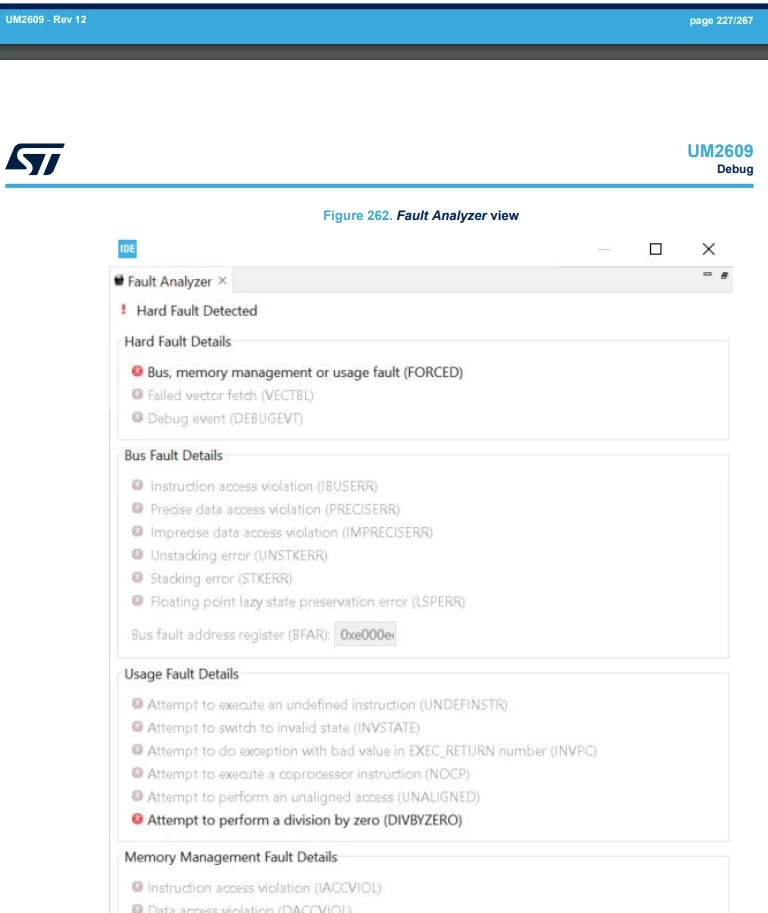
So what have you done to debug the Hard Fault?

AndrewNeil_0-1721147240945.png

https://www.st.com/resource/en/user_manual/um2609-stm32cubeide-user-guide-stmicroelectronics.pdf


5 replies

Lead II
July 16, 2024

Have you checked this topic?
https://community.st.com/t5/stm32cubeide-mcus/ll-adc-calc-temperature-hardfaults-ts-cal1-ts-cal2-read-as-zero/td-p/77106

A macro should not result in a hardfault error unless it refers to an illegal memory location or divides by zero or something. What do you see when you debug the code and step through it? What are all the values? If this doesn't help you please upload your ioc file.

"Kudo posts if you have the same problem and kudo replies if the solution works.Click ""Accept as Solution"" if a reply solved your problem. If no solution was posted please answer with your own."
Billy OWEN
ST Employee
July 16, 2024

Hi @VThan.2 


This post has been escalated to the ST Online Support Team for additional assistance.  We'll contact you directly.


Regards,

Billy

Andrew Neil
Andrew NeilBest answer
Super User
July 16, 2024

@VThan.2 wrote:

there is a hard-fault whenever I call the above functions. 


So what have you done to debug the Hard Fault?

AndrewNeil_0-1721147240945.png

https://www.st.com/resource/en/user_manual/um2609-stm32cubeide-user-guide-stmicroelectronics.pdf


A complex system that works is invariably found to have evolved from a simple system that worked.A complex system designed from scratch never works and cannot be patched up to make it work.
VThan.2
VThan.2Author
Associate III
July 17, 2024

Thank you this worked. 

Lead II
July 17, 2024

What was the problem? How did you fix it?

"Kudo posts if you have the same problem and kudo replies if the solution works.Click ""Accept as Solution"" if a reply solved your problem. If no solution was posted please answer with your own."
Visitor II
April 2, 2025

I am getting the same issue. It looks like 0x08FFF814 is not a valid address.

Associate II
September 22, 2025

I am also seeing this exact problem with STM32H573.

I see a hard fault just when reading TS_CAL1 with this code:

volatile uint16_t cal = *(volatile uint16_t*)0x08FFF814UL;
 
I've debugged the hardfault (well, chatgtp did the decoding..)
HFSR=0x40000000
CFSR=0x8200
BFAR=0x8fff814
 

1. HFSR = 0x40000000

  • Bit 30 (FORCED) = 1 → This means a configurable fault (like bus/memory/usage fault) escalated to HardFault.

  • Other bits are 0 → not a vector table read fault.

So: the real cause is in CFSR, not in HFSR.


2. CFSR = 0x8200

The CFSR is 32 bits, split into three sub-registers:

  • [31:16] UsageFault Status (UFSR)

  • [15:8] BusFault Status (BFSR)

  • [7:0] MemManage Fault Status (MMFSR)

Let’s decode 0x8200:

  • Binary: 1000 0010 0000 0000

  • Bits [15:8] = 0x82 → BusFault Status = 1000 0010

So BFSR bits:

  • Bit 7 (BFARVALID) = 1 → BFAR holds the faulting address.

  • Bit 1 (PRECISERR) = 1 → Precise data bus error.

  • Others = 0.

Thus: a precise bus fault occurred while accessing BFAR address.

No MemManage or UsageFault bits are set.


3. BFAR = 0x08FFF814

That’s exactly the TEMPSENSOR_CAL1_ADDR you pasted earlier.
So: the fault was triggered when the CPU tried to read the calibration constant at 0x08FFF814.

===

However, if I connect to the device using stm32programmer, I can see those addresses are written:

benjacam_0-1758552310825.png

Is there a requirement to enable a specific clock or power domain to read these registers?

Associate II
September 22, 2025

... I also just worked out why...

In this example linked below, there is a function MPU_Config which makes the area of flash containing trims un-cacheable. Adding this function results in no faults accessing the trims.

https://github.com/STMicroelectronics/STM32CubeH5/blob/f6cd6bcde45b717a229f73ded6258776e9a07a3e/Projects/NUCLEO-H533RE/Examples/ADC/ADC_MultiChannelSingleConversion/Src/main.c